Maryland stops juveniles from automatic adult charges for many gun, assault crimes despite prosecutors' warning

Maryland will no longer automatically charge some juveniles as adults for several serious crimes.
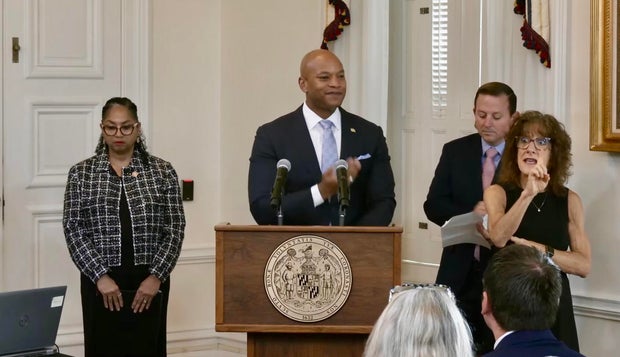
Governor Wes Moore signed the Youth Charging Reform Act into law on Tuesday morning.
Supporters praised it as giving young offenders a second chance, but opponents—including many prosecutors—said it gives young offenders a free pass.
The impact of reform
Juvenile crime has alarmed many across Maryland. Video WJZ Investigates obtained earlier this month shows a convenience store robbery in Baltimore, with suspects as young as 14.
But advocates for charging reform said the state treats young offenders too harshly and locks many of them up without judicial discretion.
They have been fighting for more than a decade to stop automatic adult charges for certain crimes—including for many handgun offenses and serious assaults.
They finally won a victory with the governor signing the Youth Charging Reform Act.
"Maryland was automatically charging kids as young as 14 as adults for cases that almost always—almost always in the super majority of cases—ended back into the juvenile court anyway but only months after being locked up in jail and many times in solitary confinement," said Senate President Bill Ferguson, a Baltimore City Democrat. "Nearly a semester of high school is gone. For you and I, that might not seem like a long time, but for 14-year-old or a 15-year-old, that is a lifetime."
Ferguson stressed a statistic long cited by advocates for youth charging reform.
"Here in Maryland, we charge more children as adults than in every other state other than Alabama," Ferguson said. "This bill will change that. It keeps cases in the right court from the start, which actually and by the data makes us safer and is better for those young people."
House Speaker Joseline Peña-Melnyk, a Democrat representing Anne Arundel and Prince George's counties, echoed Ferguson's comments at the signing ceremony.
Peña-Melnyk said it shows lawmakers' "commitment to giving people a better life" and noted her own experiences as a prosecutor and a public defender.
"You need to give people an opportunity," Peña-Melnyk said. "You need to give them second chances."
Certain severe crimes including rape and murder still mandate adult charges.
The new law also keeps juveniles out of adult prisons, away from the "sight and sound" of adult offenders, with rare exceptions.
What the numbers show
State data revealed in 2025 that 303 Maryland youth were charged as adults for gun crimes. More than 200 were charged as adults with first-degree assault.
Only 58 of those weapons charges stayed in adult court, along with only 38 of the first-degree assault charges.
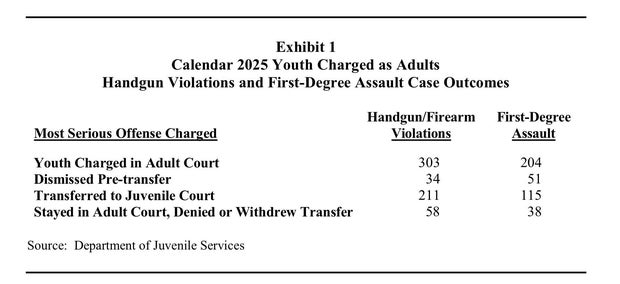
The fiscal impact report on the bill also showed a drastic change for state's attorneys' offices across Maryland.
Baltimore City will have to hire as many as 16 new employees, including 11 assistant state's attorneys, to review the cases involving juveniles.
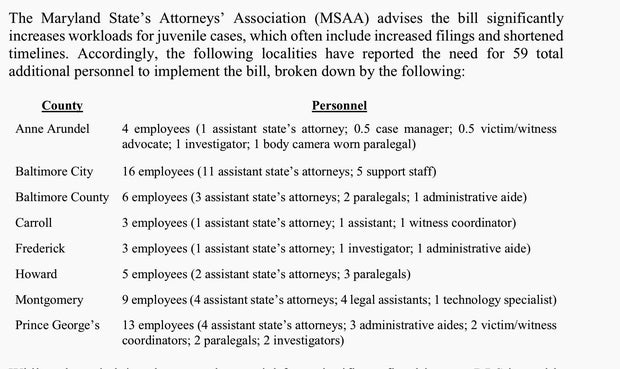
You can read the fiscal impact report here.
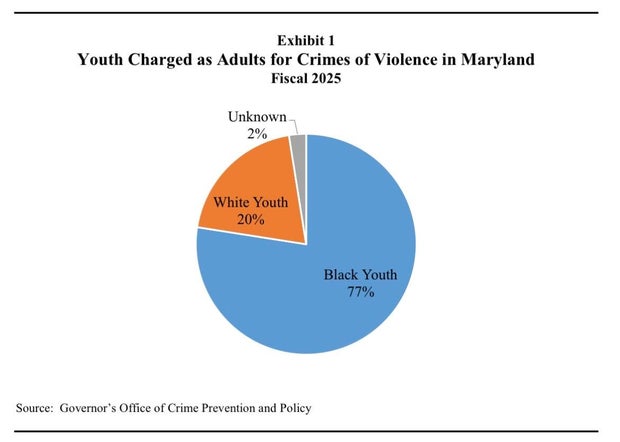
The law is also expected to address racial disparities, with a state analysis showing 77% of youth charged as adults in Maryland in 2025 are Black.
What prosecutors are saying
Many top prosecutors, including Baltimore City State's Attorney Ivan Bates, believe the charging reform is misguided.
Bates, in his role as head of the state's attorney's association, told WJZ, "…The General Assembly chooses to ignore the data once again and pass legislation that will allow youth with guns who commit robberies and violent assaults to be given a free pass time after time when they are caught illegally carrying or using a firearm."
Bates said prosecutors wanted the General Assembly to delay implementation of the reforms by three years to allow the Maryland Department of Juvenile Services to develop new programming to assist young offenders.
"Instead, our request was ignored, and the members of the General Assembly vilified us for it," Baltimore City's top prosecutor wrote.
Howard County State's Attorney Rich Gibson cited the case of 19-year-old Emmetson Zeah who killed a 15- and a 16-year-old outside the Mall In Columbia
Gibson said Zeah was given multiple second chances before being sentenced to life without parole last week.
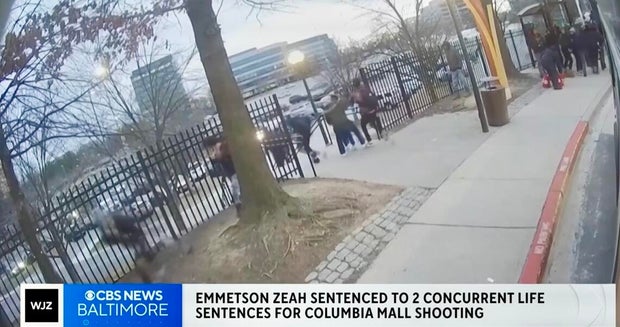
"Our broader system failed him long before we arrived at this moment," Gibson said. In the span of two years, this defendant had six separate contacts with the justice system. The majority occurred within the juvenile justice system, and yet none of those interventions altered the trajectory that he was on—nor did they accurately recognize the escalating warning signs that ultimately led us to where we are today."
Gibson also told reporters, "Let me be clear, prosecutors across the state have never opposed appropriate juvenile diversion or rehabilitative efforts. We support keeping more youthful offenders in the juvenile system, but only once that system is equipped with the resources, the staffing, the accountability measures, and the evidence-based programming necessary to address specific factors that drive that juvenile behavior."
Baltimore County State's Attorney Scott Shellenberger denounced the reform law last week at a debate hosted by WJZ and The Banner.
"I believe we should leave the laws the way they are in Maryland. Juveniles who commit violent crimes can be held accountable as adults," Shellenberger said. "…We need to put more money into the juvenile justice system so that when they commit their first breaking-and-entering at the age of 14 or 15, we can get them the kind of help they and their family need, so that I don't have to put them in jail for life when they've killed somebody at the age of 17."
Public defender says reform "overdue"
"For more than a decade, Maryland has automatically routed children into adult criminal court based solely on the charge filed at arrest, without considering the child's history, circumstances, or capacity for growth," said Maryland Public Defender Natasha Dartigue. "Maryland does this for 33 separate offenses, which is more than any state in the country except Alabama. Yet 85 percent of those cases are ultimately dismissed or sent back to juvenile court anyway, often only after the children spend months in adult facilities without school, services, or meaningful family contact."
While she praised the signing of the reform legislation, Dartigue noted there are still 26 offenses where juveniles are automatically charged as adults and called for further reforms.
"The evidence is clear: automatic adult prosecution does not make communities safer," Dartigue said. "It makes children more likely to reoffend, families less stable, and communities fractured at public expense. Every one of those 26 pathways is a choice Maryland is making with full knowledge of what that choice costs. It is a system we must change."