What's a dirty bomb? What Iran's reported threat on Washington, D.C. could mean for Maryland

New reports suggest Iran may be planning a dirty bomb attack targeting Trump administration officials in Washington, D.C.
WJZ Investigates examined what such an attack could mean for nearby Maryland, which is home to several high-profile federal facilities that could potentially be targeted.
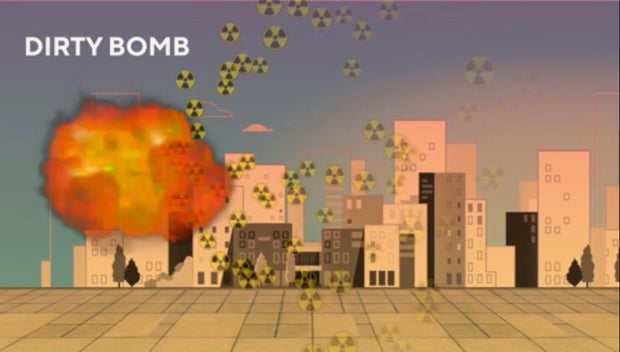
What is a dirty bomb?
A dirty bomb combines conventional explosives with radioactive material. While it can spread radioactive contamination, it is far less powerful than a nuclear weapon, which would have catastrophic consequences.
Experts say the explosion itself would likely pose the most immediate danger, while the radiation threat would generally be more localized.
"It does not usually have the enriched uranium necessary to have a full-blown nuclear detonation," said Michael Vesely, a counterterrorism expert with the University of Maryland Center for Health and Homeland Security. "We in Baltimore would not feel a dirty bomb. It's really localized, and what it's intended to do is spread around contaminants on top of a conventional explosive."
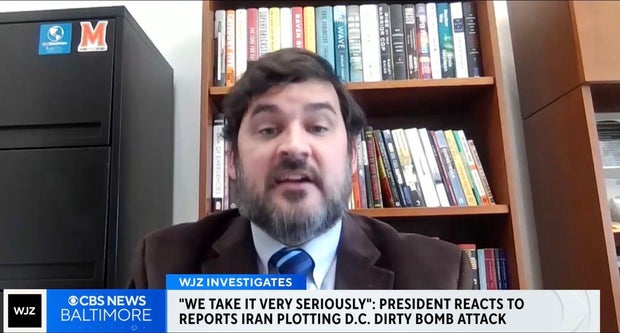
But Vesely cautioned against minimizing the threat.
"A victim of a conventional bomb will go to a trauma center and receive various treatment for whatever kinds of complex injuries they have. With a dirty bomb, you have the potential to contaminate the victim, and then they can contaminate the entire hospital because they're carrying that radiological contamination into the healthcare facility, so there are cascading effects," Vesely told WJZ Investigator Mike Hellgren. "It's far more difficult to deal with a dirty bomb than a conventional attack, but it does not rise to the level of a full nuclear strike."
Vesely said carrying out this type of attack could be easier than building a nuclear weapon because radioactive materials can potentially be obtained within the United States and combined with conventional explosives.
"It's much easier to carry out this kind of attack because you can harvest the materials locally in the United States and then just assemble them with a conventional explosive. The good news is we are very good at detecting this. Our local, state, and federal partners in the intelligence community are very good at intercepting and detecting these kinds of patterns long before we get to the actual detonation point."
President's reaction
Reporters asked President Trump about the alleged plot Tuesday during a trip to Manila, Philippines.
"We take it very seriously because they happen to be crazy. This is why they can't have a nuclear weapon by the way in case people had any questions," Trump said of Iran.
He also warned that if the threat is carried out, Iran "will pay a price the likes of which no country has ever paid before."

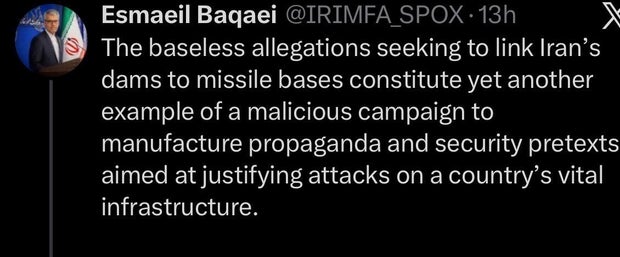
CNN first reported on the possibility of a dirty bomb plot. Iranian officials dismissed the report as "baseless."
"We've been in a heightened state of alert for quite some time. Now, we've kicked the anthill in the Middle East. There's a conflict in Ukraine, and there's a lot of hostile foreign government state actors and terrorists who would love to see us go down," said Chris Swecker, the FBI's former assistant director of its Criminal Investigative Division.
Cyberattack threat
Experts say cyberattacks pose a more persistent threat from Iran. The United States has experienced several concerning technical outages recently, although none have been directly linked to Iran.
"It's very, very easy to launch attacks, whether they originate directly from the adverse country or their hired-out attackers, especially in a world where AI bots can be used to send these attacks. They can be quick. They're cheap to send out. They're hard to stop, and they're hard to assign responsibility for," Vesely told WJZ Investigates.
"These bots can scan numerous systems to identify weaknesses quickly and cheaply and blanket-attack systems that may not be as traditionally hardened as other systems. I think that is a far more likely attack, and I would not be surprised if some of the current issues that have cropped up in the last two to three months especially are the result of some kind of nefarious actor cyberattack."
At the National Security Agency (NSA), headquartered in Anne Arundel County, employees experienced problems accessing the internal NSANet system, which is used to securely send classified information, on Tuesday.
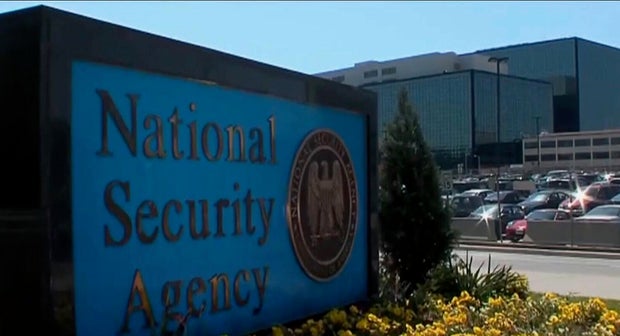
The NSA also adjusted arrival times for some employees at its headquarters at Fort Meade.
An NSA spokesperson said in a statement that the agency experienced a "temporary degradation during scheduled routine maintenance."
"While some internal systems were affected, mission/critical capabilities remain fully operational and our ability to defend National Security continues," the statement continued.