Police body camera video shows deadly shooting of man with autism in Howard County

The Maryland Attorney General's Office released body camera video Monday that shows the moment when Howard County police shot and killed an armed man during a mental health call.
The shooting on March 1 killed 25-year-old Alexander LaMorie, a man with autism who had called for a wellness check, officials said.
The involved officers were identified as 2-year veteran Officer Joel Rodriguez, six-year veteran Officer Cody Bostic and 10-year veteran PFC Joseph Riebau, according to the Attorney General's Office.
The Attorney General's Independent Investigations Division is investigating the shooting.
"There are no words that can adequately express my grief regarding the tragic loss of Alexander Lamorie," Howard County Executive Calvin Ball said in a statement following the release of the body cam footage.
"My team has been in communication with Alex's family and the Autism Society of Maryland in advance of the release of footage. Our thoughts and condolences are with Alex's family and loved ones as they grieve Alex's loss," Ball added.
WJZ has reached out to the Howard County Police Officers' Association for a statement.
Fatal police shooting
The shooting took place at Patuxent Commons in Columbia, an apartment complex that includes units for seniors and people with disabilities.
As officers were on their way to the scene, they spoke to LaMorie, who threatened to harm himself. A first responder was heard in the dispatch audio saying, "We were speaking with a caller on the phone. He began making suicidal statements."
When police arrived at the apartment complex, they were seen in the body camera video going to LaMorie's unit, where they failed to find him. Two officers then began searching the building before they received a report on the radio that a suspect was coming at officers with a knife, video showed.
The officers encountered LaMorie outside, armed with a knife. In the video, they are heard giving LaMorie several commands to drop the knife. However, LaMorie continues to walk toward the officers with the knife, the video shows.
In the video, LaMorie is heard saying, "I don't care. I don't want to live anymore, I want to be free of my pain, man."
An officer responds, saying, "It'll get better, man. I'm telling you it can get better."
As LaMorie continues walking toward the officers, one notes that they are being cornered as their backs are against a wall.
The officers then fire several shots, hitting LaMorie and causing him to fall to the ground. They continue commanding LaMorie to drop the knife as they begin providing first aid.
A knife was recovered near LaMorie's body, according to the Attorney General's office.
Family says body-camera video is "horrific"
LaMorie's family called the released police body-worn video "horrific" and "deeply shocking."
His mother, Dr. Jill Harrington, said her son was shot and killed after calling for help as a victim of a cyber scam. In a statement, she said she couldn't watch the video, but it was reviewed and summarized for her.
"The loss of Alex continues to cause deep trauma and pain for me, my husband, Alex's siblings, family, and friends," Harrington said. "I have chosen not to watch the police response to my son's call for help as a victim of a cyber scam."
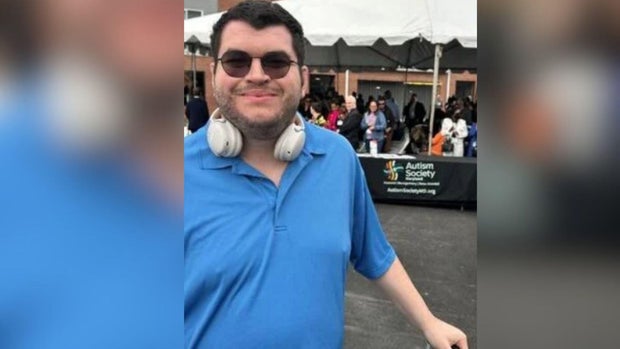
LaMorie lived at Patuxent Commons, a housing community serving low-income adults with disabilities, young adults, and seniors.
His family questioned the police response that ended with LaMorie being shot by officers.
"It is also disturbing to know that in his cry for help, during his darkest hour, the onus to save himself seems to have been placed on him when he was at his most wounded," Harrington said. "For these reasons and for the protection of my own mental health, I have decided not to watch the body cam footage of my son (one person) being shot and killed by multiple bullet wounds from three out of the four police officers present, with weapons drawn, after he called for their assistance and stated that he was in pain and at risk of self-harm."
The family said LaMorie had previously shared his experience dealing with grief and autism in online videos with the help of his mother, an author and grief counselor.
LaMorie was one of the first people chosen to live in Patuxent Commons, and his family said, "He was excited to be a part of the Patuxent Commons Community, which is full of caring and support for people with autism."
LaMorie's family also described him as an advocate for others with autism, and said he gave presentations and appeared on panels to help others experiencing grief and loss.
Residents are concerned by police shooting
Neighbors who live in the apartment complex said this shooting concerns them and call it devastating.
Asia, who preferred to go only by her first name in this story, says she saw the aftermath of the shooting earlier this month.
"For someone to call for help, and there was, their response is to be death is sad," Asia, who has lived in the building since it opened, said.
She also says she is afraid to call police now and is worried how they would respond moving forward. She says she doesn't feel safe.
"No, not at all," Asia explained. "Even in coming out [that night], I didn't feel safe. They didn't let me know anything that was going on. So, it's a lot."
Howard County leaders push for change
Following the shooting, County Executive Ball and County Police Chief Gregory Der vowed to improve police responses and said training is a priority.
"Since the incident occurred, my team began immediate conversations with Chief Der and our Police Department on strategies to support our residents during mental health crises and support people with autism and other developmental disabilities to ensure they are handled with a great level of understanding, patience, and specialized response," Ball said.
Ball said nearly 80% of police officers in the county are certified with specialized intervention training, which focuses on individuals with autism and other disabilities. The county executive noted that the county has received more than 5,000 mental health calls in the past five years, where an individual threatens to harm themselves.
"Moving forward, here in Howard County, we will forge even closer partnerships among law enforcement, disability advocates, mental health professionals, and members of our neurodivergent community to identify meaningful ways to learn and grow," Ball said.
Ball also said the county is looking to expand its police resources to add more non-lethal options.
On Monday, Ball said the county purchased 200 tasers to give officers alternatives when facing dangerous situations. He also said the county shared information with a confidential 911 flagging program to ensure dispatchers and responding officers better understand communication styles, potential triggers and de-escalation strategies.
Ball said the county began reviewing its Critical Incident Training for officers and enhanced the officer liaison program to improve open dialogue and two-way communication.
"Mental health, neurodiversity, and community trust remain vital priorities in our community," Ball said. "We will continue evaluating our policies, strengthening our training, and working alongside families, advocates, and experts to ensure our community remains a place where families feel supported, people in crisis are met with understanding and specialized care, and that every encounter carries the greatest possible chance for a safe outcome."
Anyone in need of emotional support is encouraged to call the Suicide and Crisis Lifeline by dialing 988.
Expert breaks down body-camera footage
Dr. Tyrone Powers, a former Maryland State Trooper and police use-of-force expert, worked with officers on training and testifying as an expert witness in court.
After reviewing this video, which he says is only part of the full report by the Attorney General's Office, Powers says the officers seemed to follow proper procedure, initially trying to create distance between themselves and LaMorie while trying to de-escalate.
"What is abundantly clear in this particular video, the officers are trying to talk him down," Powers said. "They're trying to maintain distance. They're thinking about alternatives because they ask about a taser. They have increased the number of officers there for safety reasons."
Powers also said LaMorie's advance toward officers while holding a knife made him a threat to the officers.
"They give him more leeway," Powers said. "They actually retreat back a few steps until an officer determines in his mind with his perception at that time, that he's cornered…At this particular point, this is the option we're left with."


