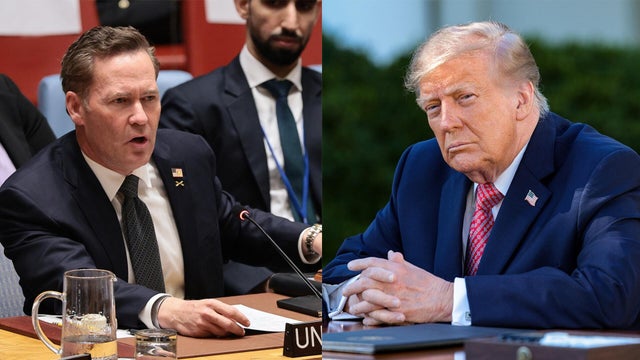
PETER NAVARRO:
00:00:53
The problem is, he simply doesn't understand the power of Trumponomics to actually grow our economy without creating inflation. And for the last six months, we've seen every inflation indicator go down. We've seen positive indicators. And I don't know what this guy is thinking? [AUDIO LOGO]
ERROL BARNETT:
00:01:14
CBS News Correspondent Natalie Brand joins us from the White House, with more on all of this. Natalie, good morning. So much to look into, but tell us about these trade deals and tomorrow's deadline. Good morning, Errol. Yeah, we got one day to go. The latest deal that has been announced is the one with South Korea, as mentioned. Goods from that country will now face a 15% tariff, according to the administration, which is significant when you think about things that are imported, such as cars, car parts. And then as part of that, the president says that South Korea has agreed to give the US $350 billion for investments owned and controlled by the US. Now, unclear how that would work, but similar to what we saw with the deal with Japan. And this is kind of a theme in these deals if you look at the ones made so far. Promises of investment in the United States to the tune of hundreds of billions of dollars, as well as opening those countries markets to US goods. But questions remain about big trading partners that we don't yet have deals with, such as Mexico, Canada. Talks with China underway. And then, we also know that the president has made good, in a new executive order, on his threatened tariff of 50% for Brazilian goods. Although, we're hearing there's reports that there are exemptions for some top exports from that country, such as orange juice and civil aircraft. But then, other items, such as coffee, prices could go up. The president addressing concerns about tariffs raising prices. Take a listen. [AUDIO LOGO]
DONALD TRUMP:
00:03:03
Critics said that our tariffs would hurt the economy, but the data shows the exact opposite. And the exact opposite is happening. The US Treasury has taken in $150 billion from tariffs, and we'll be adding about $200 billion next month, for totals that nobody's ever seen before, frankly. But again, tomorrow is the big day. And moving forward, economists are watching to see how the increased tariffs really ultimately do impact prices in the short- and long-term. Errol.
ERROL BARNETT:
00:03:40
And Natalie, let me ask you the latest on the Epstein issue. The Justice Department now says grand jury documents they're pushing to unseal only contain testimony from two witnesses, none of which are victims. Is that really what people are pushing to see? I know Democrats are pushing for much more information to be shared. Yeah, there's bipartisan calls for more information to be shared, including from the public. And in new court filings, we've learned that the grand jury in the Epstein and Maxwell cases did not hear directly from alleged victims, but rather, they're accounts through these two witnesses, an FBI agent and also, an NYPD detective. Now, experts say that that's not a surprise, that that's who would have talked to the grand jury. But again, it raises questions about what the DOJ is moving to unseal here. If it is unsealed, again, critics say it falls short of what they want to see. All of the files and documentations. We also, Errol, have a new statement from the family of Virginia Roberts Giuffre, who again sadly died by suicide earlier this year. But her family, since her name was mentioned in the news by the president, confirming that she was one of the Mar-a-Lago employees poached by Epstein, according to the president, they're raising questions about the timeline, saying that she was approached by Maxwell in 2000. But the falling out between Trump and Epstein happened years later, according to them, so they're raising questions about that. They also say if our sister could speak today, she would be most angered by the fact that the government is listening to a known perjurer, a woman who repeatedly lied under oath and will continue to do so as long as it benefits her position, referring to Maxwell, who Guthrie, in interviews, described her as the mastermind of the sex-trafficking operation. Of course, those are allegations that Maxwell and her attorneys have denied, as they try to appeal this case. But it really just shows that in light of all of this new reporting, the calls for more information around this case only continue to intensify. Errol. Yeah, really interesting updates there. Natalie, thank you. [AUDIO LOGO] For more analysis on the trade deals and tomorrow's deadline, we're going to speak now with Lori Bettinger. She's the President of Bank Alliance and the former Director of the Troubled Asset Relief Program. Lori, good morning. Thanks for being with us. So if we take a look at what was said yesterday by Chairman Powell, the Fed says the elevated economic uncertainty is a reason they are keeping rates steady. Are we talking about tomorrow's tariff deadline? What do you make of that? Good morning. I think it's a little bit of tomorrow's tariff deadline, and also the tariffs that are already in place, and how that has the ability to impact prices going forward, which always comes down to inflation, I think, as far as the Federal Reserve is concerned. And, we just heard from a few people talking about the fact that there really hasn't been a huge uptick in inflation so far. But the question that, I think, a lot of economists, and certainly it seems like the Federal Reserve, is asking, when will we get inflation? Because for the most part, tariffs tend to cause some, and that timing is what everyone seems to be waiting on.
ERROL BARNETT:
00:07:09
So if these tariffs hit tomorrow, is it reasonable to think that inflation is coming? Is that what our viewers should expect? I think it might be coming, but that doesn't mean it might be coming tomorrow. I think, what we've seen over the past few months is in anticipation of tariffs, of expecting to pay more for imports, a lot of companies tried to build up their inventory, the amount of items that they have available to sell to all of us. So I think that, in many cases, people have been able to delay price increases. But over time, I don't know if that's sustainable? Like, perhaps, you've sold down your inventory, or you might just say as a company, perhaps even a smaller company, hey, so far, I've been paying those increased costs, but I can't do that forever. Eventually, I might have to raise the prices a little bit, so that I share some of those extra expenses with my customers.
ERROL BARNETT:
00:08:02
So always a good idea to have money on hand, but save up even more, it sounds like, you're saying to folks watching. Lori Bettinger-- Exactly
ERROL BARNETT:
00:08:09
--great to chat with you. Thank you very much.