Millennial woman designing Ukraine's own ballistic missile says it will soon put Moscow in reach
Kyiv — Ukraine's most important weapons manufacturer wears mismatched earrings and a black knit dress.
"The good thing about being the boss is that you get to set the dress code," Iryna Terekh, the 34-year-old CEO of Fire Point, one of Ukraine's largest drone makers, told CBS News, grinning as she took a seat next to a model of one of the company's latest designs.
With her high heels, bright smile, and entourage of millennial assistants and executives, Terekh stands out in her factory, where throngs of middle-aged men lug drone parts, wield power tools and chain-smoke cigarettes. But she is hardly an exception in a country forced to reinvent itself since Russia launched its invasion in February 2022.
"When the full-scale invasion started, a lot of people had to review what could be their personal impact," she said. "You never really know what kind of knowledge and what kind of experience could be transformed and pivoted into something new."
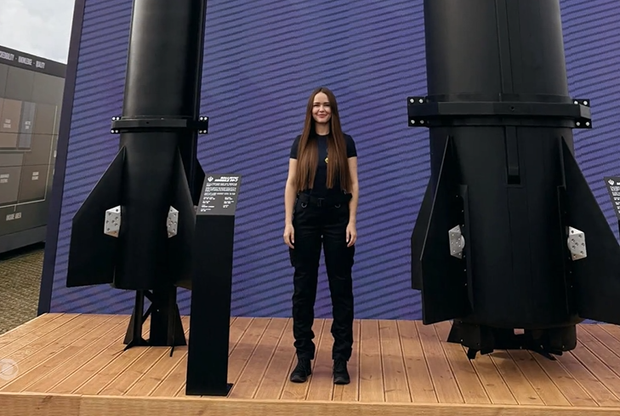
Terekh's experience was in design and management.
Trained as an architect in the northern Ukrainian city of Irpin, she started building patios and outdoor furniture while also developing a successful high-performance concrete company.
In the early months of 2022, Russian forces occupied Irpin, destroying roughly 70% of the city.

"I understood how vulnerable we are to the complete barbarian behavior of our enemy," Terekh told CBS News. "And if there are any competences that I could put on the table for the sake of fighting this war, then I have to do this."
After escaping Russian occupation, Terekh began looking for a way to help. In the fall of 2022, Russia started attacking Ukrainian cities with Iranian-made, long-range Shahed exploding drones. It also started manufacturing its own versions, known as Gerans.
Terekh and Ukrainian businessman Denys Shtilerman, whom she had worked with designing outdoor urban spaces before the war, decided to build their own long-range attack drones to help Ukraine strike back.
Shtilerman had a background in defense engineering, but most other initial members of the team, including Terekh, came from civilian backgrounds. Yehor Skalyha, their third co-founder, was a film producer.
At first, the company aimed to build 20 of its FP-1 drones per month. By 2024, they were regularly being used to strike Russian airfields, ammunition depots and oil refineries. But over the last two years, the company's ambitions, and its arsenal, have grown.
Fire Point now makes 300 to 400 long-range attack drones per day, and it has added more advanced weapons to its production lines.
In June, a Fire Point cruise missile completed a mission of over 1,000 miles, which she claimed as the longest-range strike ever carried out by a cruise missile in combat history.
Terekh also made the bold claim that Ukraine has launched twice as many deep strikes into Russia as Russia has into Ukraine in 2026 — with 60% of the Ukrainian attacks using Fire Point weapons.
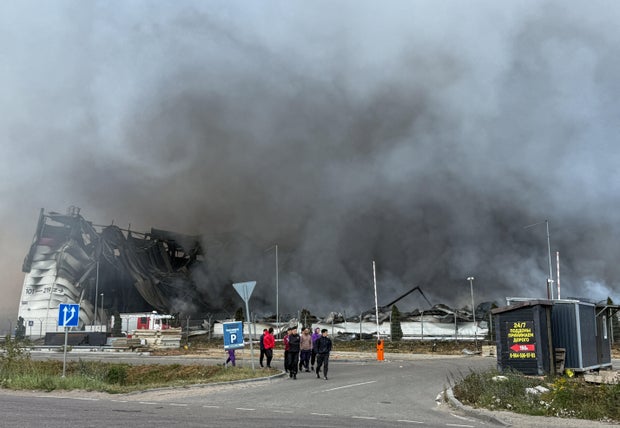
She said her company is now just months away from deploying Ukraine's first domestically designed and manufactured ballistic missile. Unlike cruise missiles, which stay lower to the ground, ballistic missiles follow an arc trajectory that takes them much higher, making them harder to intercept.
Fire Point is among many Ukrainian startups that have helped to shift the country from being solely a recipient of military aid to an engine of defense technology innovation.
Many other companies have similar, unlikely stories of their beginnings. The founder of Sine Engineering, which has attracted American investment in its communications and navigation technology, ran a business making standing desks before the war. Yaroslav Azhnyuk, founder of the Fourth Law, which makes autonomous guidance systems for drones, previously founded Petcube, a pet tech startup backed by the American business accelerator Y Combinator.
Terekh believes these companies, with their founders' diverse backgrounds outside the defense sector and their shared ability to pivot to new endeavors, have been key to their successes.
"This works in Ukraine because we have very low bureaucracy, because we have direct communication with the army, and because we have companies that react," she said.
The country's innovative approach to defense manufacturing and procurement has also attracted the attention of its allies.
In 2025, the U.S. military announced its own program to copy Iran's Shahed drones, known as "LUCAS," which deployed its first relatively cheap long-range drones in the Middle East in February.
The U.S. and Ukrainian governments are expected to sign a new defense agreement soon that would expand Ukrainian military technology exports to the U.S. and joint ventures with American companies.
Terekh said Fire Point's primary focus remains on Ukraine's defense, but she welcomed the idea of one day playing a role in a new, wider Western security architecture.
"We need to ensure that Ukraine will stop just being a breadbasket for the world," she said, referring to the country's longtime primary export of grains. "Now we have something to offer which is much more valuable, and the defense industry is a huge driver for this."


