North Texas pastor among foreign-born religious workers forced to self-deport

In the small town of Gordon, Texas, about 70 miles west of Fort Worth, Pastor Albert Oliveira is preparing to leave the country and his congregation behind. Like many other foreign-born religious leaders across the United States, a visa backlog has forced him to make the difficult decision to self-deport.
After two years of effort and legal fees, trying to figure out a way to stay in the country, Oliveira, his wife and young son have booked a November flight to Brazil.
"I was in denial for a long time," Oliveira said. "Personally, we feel scammed."
Not only is his upcoming departure a disruption to Oliveira's life, but it's also a blow to his congregation.
"When you live in a very small community as this is, it's very difficult to get a pastor to come out to relocate," said Rebecca Sue Collins, a member of the church. "We don't have that kind of money to get a lot of big pastors."
Oliveira's life in Gordon
Originally from Brazil, Oliveira first came to the United States on a student visa in 2011. He built his life here — marrying German national Caroline Schuster Oliveira and moving to Gordon seven years ago, initially to serve as a youth minister.
"This church saw potential in me and they believed in me," Oliveira said. "This church has opened the door for me to be a leader."
Three years ago, Oliveira became the church's pastor. Since then, he and his parishioners say they've seen the congregation flourish. At one point, members thought the church would close because there weren't enough worshipers in weekly attendance. Today, up to 150 people fill in the pews every week to hear Oliveira's sermons.
Oliveira jokes that while by some measures it's a small church, it's a megachurch in a town of 500.
"I've watched our church grow because of your leadership and your love for people," said parishioner Janis Mills during a bible study CBS News Texas attended in September. "And it just means so much to us."
A growing backlog
For the past five years, Oliveira and his family have been in this country on an R-1 visa, which is a temporary visa given to religious workers. He currently is applying for an EB-4 visa, which is a pathway for immigrants seeking a green card.
Immigration attorney Lance Curtright, who is not involved in Oliveira's case, said this has been standard for immigrant religious workers seeking permanent status in the U.S. for years.
Two years ago, the Biden administration changed the way EB-4 visas are distributed — making it so that some migrants, including unaccompanied minors from El Salvador, Honduras and Guatemala were placed in the same queue as religious workers from other countries.
"It resulted in a backlog of visas, not enough visas for really anyone," Curtright said. "I can just tell you that I've seen a lot of individuals suffering on account of it, a lot of people are scrambling trying to find ministers for their church services."
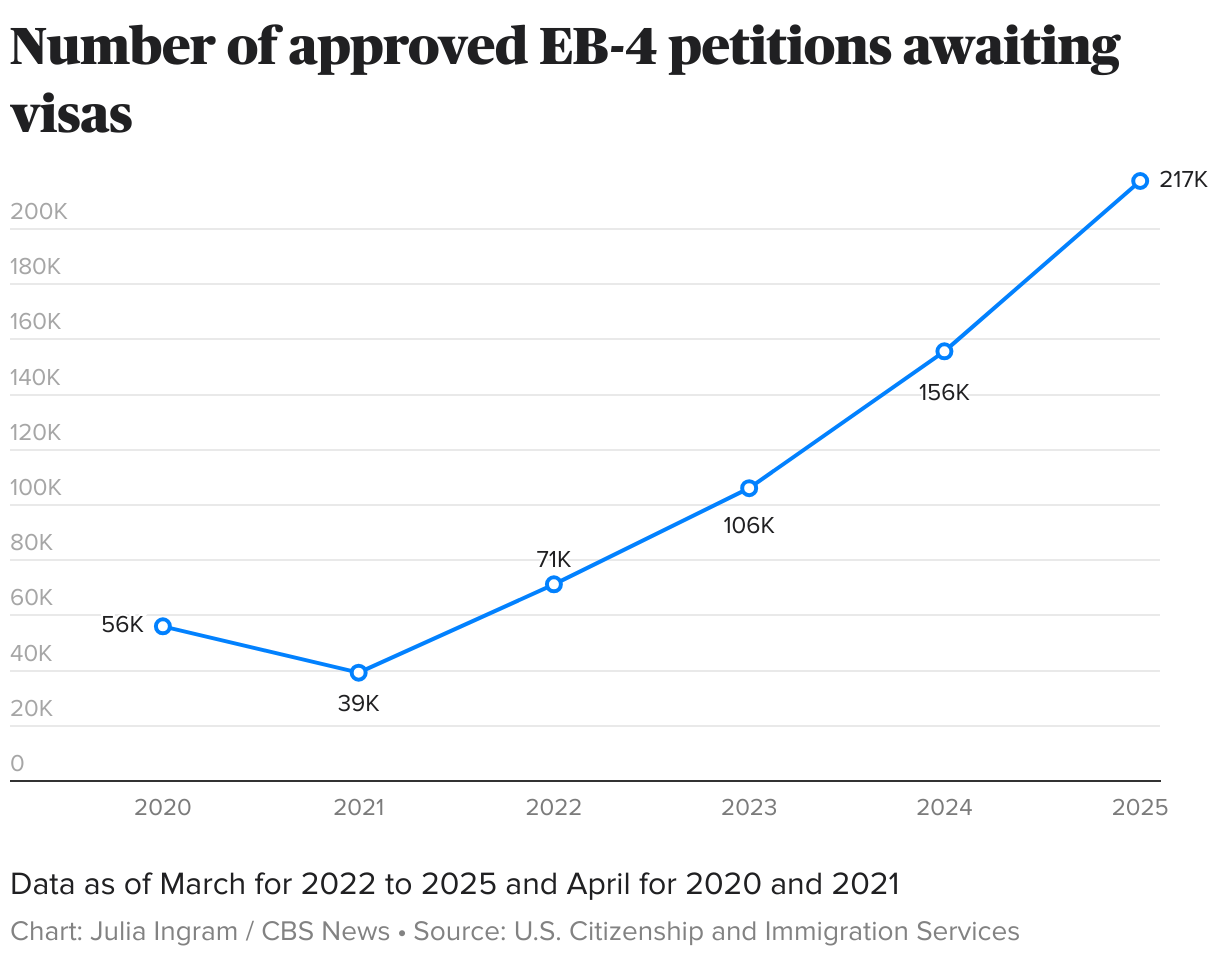
Increased migration at the southern border has led to an increase in EB-4 visa applications, worsening the backlog. According to U.S. Citizenship and Immigration Services data analyzed by the CBS News Data Team, in March of 2022, there were 71,147 petitions for EB-4 visas. In March of this year, there were 214,771 — a 200% increase in three years. About 10,000 total EB-4 visas are granted each year.
Knowing that it's unlikely his family will receive an EB-4 visa before his R-1 visa expires in November, Oliveira plans to leave with his family to Brazil next month to avoid undocumented status here.
"It breaks my heart," said Mills. "It's in God's hands and we just keep praying everyday that something's going to happen."
Oliveira will be able to apply for another R-1 visa after spending a year out of the country. He hopes to return then, but in the meantime he plans to continue to preach remotely.
Lawmakers propose solution
In April, U.S. Sens. Tim Kaine, Susan Collins and Jim Risch introduced the Religious Workforce Protection Act as a potential solution. The bipartisan legislation would allow religious workers with pending EB-4 applications the ability to stay in the U.S. while awaiting permanent residency.
For now, that bill remains pending in committee.
"We are not the only church that is going through this," Oliveira said. "There are many pastors, many priests, people of different religions that are going through this in their place of faith. The hope that we have is that this is solved."