A North Texas man searched for his grandfather's grave. What he found raised even more questions.

There is no doubt that David Wade Ruby is buried in the New Hope Cemetery in Cooke County. His actual location, on the other hand, isn't that exact.
"Basically, I was thinking there would be some sort of marker or something," Jimmy Hadley said.
Hadley is Ruby's grandson. The 38-year-old believes he knows where his grandfather may be buried, but he's settled on a spot that's "as close as I can get" rather than "he's right here."
"I know in my heart that he's up in heaven. I know that," he said. "As far as his remains, you just don't know. You just don't know."
Grandson searches for missing grave of Vietnam veteran in North Texas cemetery
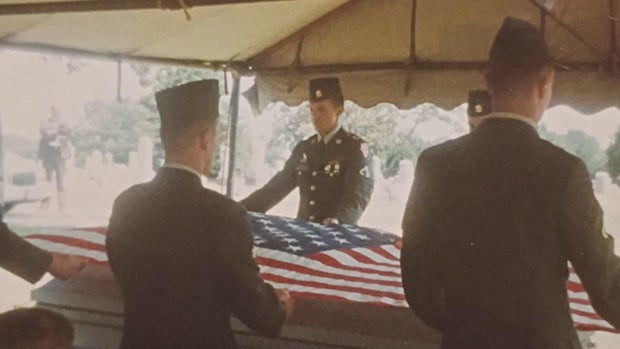
Ruby is a native of Mountain Springs, not far from the physical address that lists the cemetery in Valley View. He is a Vietnam veteran who was married to Rosa Bailey. She had three biological children, who became his. According to the Texas Veterans Hall of Fame, he was a paratrooper who received the Bronze Star Medal and the Purple Heart.
"The real decoration is the way he treated people — and the work he put in for 22 years in the military to serve his country," Hadley said.
Ruby was buried in the rural cemetery with a temporary marker. His wife is still alive, but her family said she battles health challenges. Her husband was 53 when he died. Nearly 29 years later, Hadley said he found Ruby's government-provided grave marker.
He went to put it on Ruby's grave, but couldn't find it.
"I don't see how you can keep track of people being buried if there's nothing even there," he said.
Family discovers government-issued grave marker but can't find burial site
Hadley called the Board President of the New Hope Cemetery seeking answers, but left with more questions. Dan Alexander, the president, said he didn't know where Ruby was buried.
Alexander told CBS News Texas he wanted to help Hadley but had prior obligations both times Ruby's grandson called.
"Everybody that was in charge of that all passed away," Alexander said. "I'm sure the guy that was taking care of the marker at the time marked the spot."
But Alexander admits the cemetery has no real system for recordkeeping. He keeps a list of who's there in a book.
"No one ever took it on to create a log for the cemetery," he said. "There's been little pieces and patches of logs of different times that people have took care of, but there's no complete [log]."
Cemetery president admits records are incomplete despite state requirements
Hadley and his wife took a picture from his grandfather's funeral and used it to match the spot as closely as possible. Then, at the cemetery leader's advice, Hadley used a metal probe to stick into the ground over and over until he hit something.
"And I heard 'thunk thunk.' And you can feel it in the rod," he said. "You can ask my wife, it killed me," he said.
Hadley took a hammer to make sure the discovery, two to three feet in the dirt, was not a rock. He doesn't believe it was. The Tarrant County husband and father said he felt like he'd stabbed his grandfather in the heart.
He said he called Alexander about the find and was given permission to place the grave marker. Alexander said he didn't give Hadley permission, then that's where David Wade Ruby lies unless there's a challenge.
"Unless someone comes up and protests that that's my grave, we'll let it be yours," Alexander said.
Family places grave marker but questions remain about veteran's final resting place
Alexander said he's been the cemetery board's president for 35 years. He has been doing grave markings for free for the past four to five years. Even so, Alexander said he doesn't know of a state law that requires recordkeeping, and who oversees it.
The Texas and Safety Code requires cemeteries to keep a record of the interment, including the date the person was received and buried, name, age, and where the body is plotted in the graveyard.
New Hope Cemetery is old. There are graves from the late 1800s. Some crumble. Tombstones have shifted in the ground. Other stone markers resembling concrete poured into a coffee can, pushed into the ground with two initials. Several have information that faded into oblivion over time. A few look like stepping stones with black paint and very little information.
Alexander said if the family had placed a marker on Ruby's grave sooner, this wouldn't be an issue. He said for more than 20 years, they've heard nothing until now.
Hadley admits there was a gap and that his grandfather became the ultimate victim in this situation. None of that has anything to do with the cemetery keeping proper records, he said. So, when family members decide to come out, they can find their loved ones.
They have a place to visit his grandfather, a marker, and a bit of mystery.
"Nobody will ever know if that's actually where he's buried," he said.


