As massive data centers face opposition, could tiny ones move into Texas backyards?

When most people picture a data center, they probably imagine something big. Really big. But what if the next data center looked less like a giant warehouse and more like an air conditioning unit sitting outside of a home?
Instead of building massive data centers, SPAN, a San Francisco-based home energy technology company, wants to build thousands of tiny ones and spread them across neighborhoods.
"We take that same idea and rather than doing it in a giant centralized facility, why don't we make smaller computers and distribute them around?" Chris Lander, SPAN's vice president, said in an interview with CBS News Texas.
The concept is called XFRA. Each unit would contain a computer to run AI programs along with a cooling system and backup battery. Put enough of them together and, SPAN says, they could operate like one giant data center.
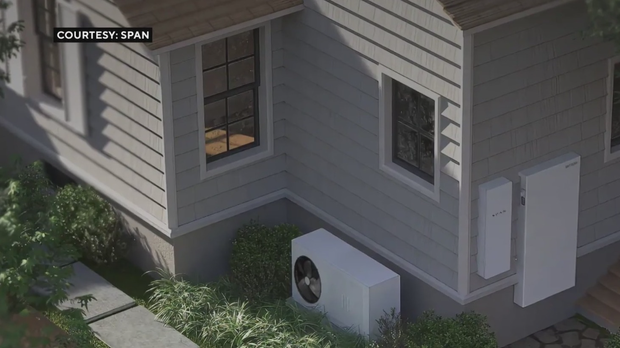
Plus, SPAN says its mini data centers can be deployed much faster than large data centers, which can often take years to plan, permit and build.
SPAN is currently testing the system in a limited number of homes in California and plans to expand to a 100-home pilot later this year. The company has partnered with home builder PulteGroup and says its initial deployments will focus on newly built neighborhoods.
SPAN expects to begin a broader U.S. rollout in 2027, including developments in Texas.
Using power homes already have
SPAN's idea relies on something many homes already have: extra electrical capacity.
Most homes are built to meet peak electricity demand, when the air conditioner, lights, clothes dryer and even an electric vehicle charger may all be running at the same time.
But most homes do not use that much electricity all the time.
SPAN says that homes use about 40% of their peak capacity on average. The company believes some of the unused capacity could be used to power its mini data centers.
"The resource is there, and we're just not using it," Lander said. "So SPAN with XFRA is finding a way to tap into that headroom that we've already built."
What homeowners would get
In return for hosting an XFRA unit, SPAN says homeowners could receive monthly payments to help lower their electricity and internet bills. The company says it would also provide the XFRA unit, an electrical panel and a home battery at no cost.
"So your bills are going to come down, and you'll get a free panel and a free battery on your home," Lander said.
SPAN has not released details on how much homeowners would receive or how the payments would be calculated.
Questions about the power grid
Tianqiao Zhao, a professor at the University of Texas at Arlington who studies power and energy systems, said one unit at one home would likely have little effect on the electric grid. But a neighborhood full of them could be different.
"The question will be how we can manage hundreds or thousands of them at the same time when the AI workloads come to us," Zhao said.
The concern is that many units could need more electricity at the same time.
SPAN says its software would monitor the amount of electricity available at each home and move computing work among different nodes when necessary. The company also says it could reduce the amount of power the units use during times of stress on the grid.
Would tiny data centers use more electricity?
Another concern is efficiency.
Jie Zhang, a professor of mechanical engineering at the University of Texas at Dallas, said small data centers would likely be less efficient than massive ones.
"The efficiency of the mini data center will actually be lower compared to hyperscale ones," Zhang said.
Large data centers can share cooling equipment, power systems and other infrastructure across tens of thousands of computers. With SPAN's approach, each unit would need its own cooling system, battery and equipment. That means a network of tiny data centers could require more electricity to deliver the same amount of computing power as a large data center, Zhang said.
"Those are the tricky things you have to consider," he said.
What about security, weather and fire?
Placing computers in residential neighborhoods raises other questions.
- How secure would the units be from hackers?
- How would they perform during a Texas heat wave or a winter freeze?
- What would happen if a unit overheated or caught fire?
"These are valid concerns that we have to build solutions for," Lander said.
SPAN says the units would be protected by secure enclosures that include tamper-evident features. The company also says information moving through its network would be encrypted.
Could tiny data centers change the debate?
Communities across Texas are pushing back against massive data center projects because of concerns about power, water, land, and quality of life.
Lander said he hopes his company will get people to view data centers differently.
"We've got to think about when people say they don't want data centers. What is it about the data centers they don't want?" Lander said. "Maybe we can find a way to solve those issues for the communities or find benefits for the communities in those areas, versus saying no to all data centers."
SPAN says XFRA is not designed to eliminate the need for large data centers. Massive facilities would still be needed to train the largest AI systems.
However, SPAN says its XFRA units can add computing power more quickly as the demand for AI continues to grow.


