Organizers unveil 2026 FIFA World Cup transportation plan for North Texas
With just 70 days until the 2026 FIFA World Cup arrives in North Texas, organizers have unveiled a transportation plan addressing how thousands of fans will move across the region.
An influx of international visitors, many of whom rely on public transit, is expected, raising questions about accessibility, navigation and potential language barriers.
Travel into the North Texas region for fans and spectators
There are 30 general aviation airports, including Fort Worth Meacham International Airport, Addison Airport, McKinney National Airport, and Arlington Municipal Airport an addition to the two major commercial airports:
- Dallas Fort Worth International Airport (DFW)
- Dallas Love Field (DAL)
Ground transportation
The GoPass mobile ticketing and travel planning app for public transit in North Texas, primarily used for Dallas Area Rapid Transit (DART), Trinity Metro, and several surrounding transit agencies. It enables contactless payments, real-time trip planning, and digital ticket storage for buses and trains, essentially acting as a mobile ticket vending machine. Plan trips and purchase tickets.
Getting to Dallas Stadium for matches
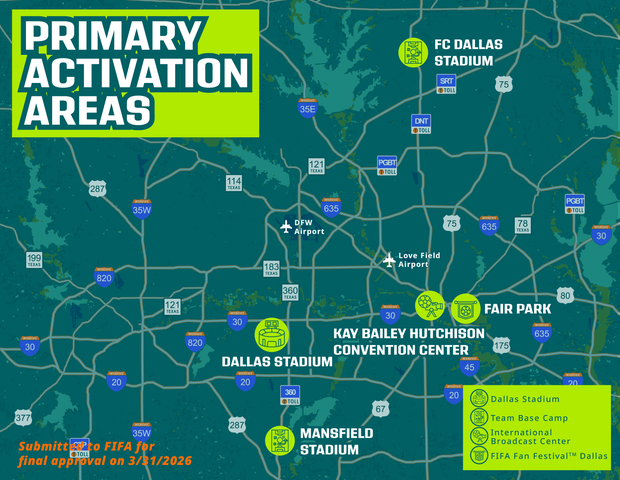
Dallas Stadium, located within the Entertainment District in the City of Arlington, will be the focal point of Match Day.
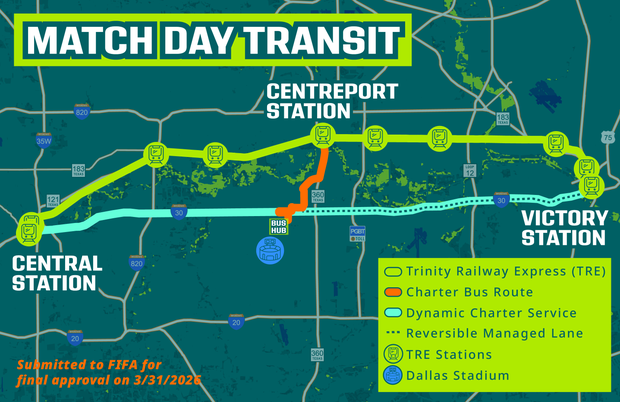
NCTCOG, the City of Arlington, Dallas Area Rapid Transit (DART), Trinity Metro, and Trinity Railway Express (TRE) are coordinating a regional, multimodal transit strategy. The plan introduces enhanced connections and special event services designed to move fans, media, and staff safely and efficiently across the region while meeting FIFA's global standards.
The TRE - the regional commuter rail line connecting Fort Worth and Dallas and jointly operated by DART and Trinity Metro - will be the primary passenger rail option for fans traveling to matches.
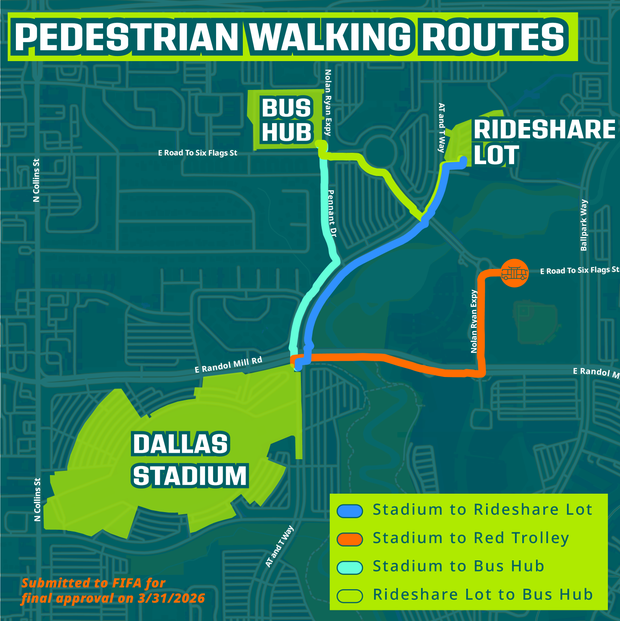
- Attendees will ride the TRE from downtown Dallas or Fort Worth to CentrePort Station, then transfer to charter buses that will take them directly to the Bus Hub, the designated transit drop‑off zone near the stadium. From there, it's a short half‑mile walk to the entrance. Fans will need a match ticket to ride the charter bus.
- Boarding the TRE: Passengers may board at any TRE station, but will be encouraged to start at Victory Station in Dallas and the Fort Worth Central Station in downtown Fort Worth.
- Transfer at CentrePort Station: At the station (about 8 miles from the Stadium), attendees will complete a quick soft ticket check before boarding charter buses. Anyone without a ticket will be directed to rideshare services or alternative return
- Charter bus segment: Buses will run CentrePort Station → the Bus Hub, a route with an estimated 20-minute drive time under normal traffic.
- Final approach: All riders will be dropped off at the Bus Hub, followed by a 10-minute walk to the stadium.
- Total estimated travel time: Door to door, from Victory Station or Fort Worth Central Station to the stadium, spectators should plan for about 1.5 hours, including:
· 15 minutes for boarding at TRE stations
· 30‑minute TRE ride
· 15‑minute wait/boarding for charter buses
· 20‑minute ride to Bus Hub
Transit users will be advised to begin their journey up to four hours before the match
Backup capacity: Dynamic Charter Service
If the TRE reaches capacity, a Dynamic Charter Service will take match ticket-holders directly from Victory Station or the Fort Worth Central Station to the Bus Hub.
Rideshare pick-up and drop-off
The Esports Stadium Arlington lot has been designated for rideshare operations and taxi pick-up and drop-off. The lot is about 0.7 miles from the stadium, or a 10 to 15-minute walk.
Spectators using the lot for drop-off or pick-up will be directed to use the newly constructed 10-foot sidewalk along the east side of AT&T Way for a direct walking route to and from the Stadium.
Rideshare vehicles will enter via Ballpark Way and exit via AT&T Way. If rideshare vehicles attempt to arrive via AT&T Way, they will be directed to turn around and re-enter from Ballpark Way.
Driving
The region is supported by a robust highway system connecting Dallas, Fort Worth, Arlington, and surrounding cities. Interstate 30 serves as the primary east-west route to Dallas Stadium, with managed toll lanes that will be used for FIFA vehicles and charter services to help ensure reliable travel times. Additional north-south corridors, including State Highway 360 and President George Bush Turnpike, provide alternative access and direct connections to DFW Airport.
Organizers said locals are encouraged to drive to matches.
Parking
Approximately 16,600 spaces will be allocated for general spectator parking around the stadium on Match Days. If parking is purchased from FIFA, the best travel route to get to the parking lot will be assigned to balance the loads on the transportation system. The route recommended by your GPS system may not be the quickest or most effective route.
Road closures around Dallas Stadium
To support pedestrian movements from the Bus Hub, one southbound lane on Pennant Drive (from Road to Six Flags Drive to AT&T Way) will be closed to provide a wider pedestrian walkway.
In addition, the right-most southbound lane on AT&T Way (from Randol Mill Road to Pennant Drive) will be closed to accommodate spectators walking between the Bus Hub and the stadium.
AT&T Way from Randol Mill to Cowboys Way will be closed.
Cowboys Way from AT&T Way to Collins Street will be closed.
The location of the FIFA Fan Festival Dallas and how to get there
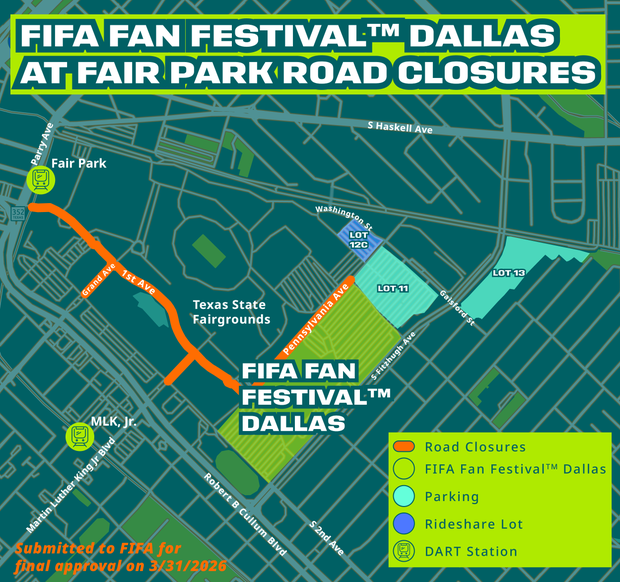
The FIFA Fan Festival™ Dallas will be held at Fair Park in Dallas, a historic and high‑capacity venue located just east of downtown.
Fair Park has a long track record of hosting major events, including the State Fair of Texas, which drew 2 million attendees in 2025. Fair Park is well‑served by public transit and parking infrastructure to support high‑volume attendance:
- The DART Green Line provides direct rail service to the venue.
- Two stations - Fair Park Station and MLK, Jr. Station - offer convenient access and historically experience heavy ridership during major events.
- Fair Park offers more than 14,000 parking spaces for visitors attending events
Getting to the International Broadcast Center
The FIFA World Cup 2026™ International Broadcast Center will serve as the tournament's global media hub for thousands of broadcasters and FIFA officials. FIFA will control the facility from January 14 through August 24, 2026, covering the full buildout, tournament operations, and teardown period.
The IBC is accessible via DART's Red and Blue Lines at Eddie Bernice Johnson Union Station.
The DART Convention Center Station will be closed due to ongoing construction at the Convention Center.
The Convention Center has over 1,200 on-site parking spaces spread across several parking garages and surface lots.
Construction Coordination Ongoing construction in the I-30 corridor and at the Convention Center will be scaled back during a designated "quiet period" from May 26 through July 23, 2026, to ensure uninterrupted global broadcast operations.
Traffic and street closures
Multiple agencies, including FIFA, Texas Department of Transportation (TxDOT), the City of Dallas, NCTCOG, Oak View Group, and others, are coordinating to align traffic management with construction and tournament needs.
During the tournament, targeted street closures will support security and operational needs in downtown Dallas.
- FIFA IBC Operations: Griffin Street (between Canton Street and Ceremonial Drive) will be fully closed during FIFA's designated "quiet period."
- TxDOT IH-30 Project: Long-term construction will impact several key corridors. Griffin Bridge is currently partially closed with two-way traffic maintained through late 2027. The Lamar Street bridge is scheduled to close in late April or early May 2026 through late 2027, contingent on completion of a temporary truck ramp to maintain convention center access. Additional closures include Akard Street (through 2028) and Hotel Street (through 2030).
- Kay Bailey Hutchison Convention Center (KBHCCD) Expansion: Construction began in January 2026 and will continue through 2029, with closures along Lamar Street and Memorial Drive near the convention center. The project will also require closure of the Jefferson Viaduct, starting in Q2 2026, with Houston Street