U.S. voices concern as China drops travel bans despite COVID surge
The fast-changing rules have fueled excitement and a boom in travel queries in China, but with hospitals overwhelmed, many other nations are imposing new restrictions.
Watch CBS News
The fast-changing rules have fueled excitement and a boom in travel queries in China, but with hospitals overwhelmed, many other nations are imposing new restrictions.

The Dow Jones Industrial Average finished the day Tuesday relatively flat. George Ball, chairman for the financial services firm Sanders Morris and Harris, dives into what drove the markets Tuesday, and what to look for in 2023.

Residents reacted gleefully to the news and the travel industry began to prepare for an expected surge. But COVID cases have leaped as key pillars of China's broader containment policy have ended.

Taiwan says China's military sent 71 planes and seven ships toward Taiwan in a 24-hour display of force directed at the self-ruled island.

Every new infection offers a chance for the coronavirus to mutate, and the virus is spreading rapidly in China.

A rapid surge of COVID-19 infections in China is overwhelming the country's hospitals. Some health experts predict China could suffer up to 1 million COVID-19 deaths in the next few months. Elizabeth Palmer has the latest.

The war in Ukraine could last "three to five years," according to Matthew Kroenig, a professor at Georgetown University's Department of Government. He joined CBS News to discuss this year's many foreign policy developments.

Rep. Jamie Raskin, member of the House select committee on Jan. 6, and our annual correspondents roundtable will appear on "Face the Nation with Margaret Brennan" this Sunday.

Congress is considering the idea of banning TikTok from all government devices amid growing national security concerns around the social media platform, whose parent company, ByteDance, is Chinese-owned. Alex Palmer, a contributing writer for New York Times Magazine, discussed the issue.

China is struggling with a rapid rise in new coronavirus infections. The spike comes just weeks after the country loosened restrictions of its long-standing "zero-COVID" policy. Thomas Bollyky, director of the global health program at the Council on Foreign Relations, joined CBS News to discuss.

China is currently seeing a spike in new COVID infections after the government dropped its harsh “zero-COVID” policy. The Institute for Health Metrics and Evaluation projects that cases in China will peak around April 1, 2023, and that deaths will reach around 322,000 by then. The institute's director and professor at the University of Washington Dr. Chris Murray joins CBS News to discuss.

China is seeing a spike in COVID-19 cases after ending its "zero-COVID" policy. Meanwhile, Japan is increasing its defense spending in an effort to boost its counteroffensive capabilities, and North Korea is threatening a military response. CBS News senior foreign correspondent Elizabeth Palmer joined "CBS News Mornings" to discuss.

As China battles a surge in COVID-19 cases after dropping its "Zero COVID" policy, crematoria, and funeral homes in Beijing are reportedly working at capacity. Elizabeth Palmer reports.

China is facing its biggest public health challenge since the start of the coronavirus pandemic as COVID-19 is once again spreading days after the government abandoned its "zero-COVID" policy. Elizabeth Palmer has more.

U.S. officials were quick to praise the massive adjustment to post-WWII Japan's pacifist policy as marking "a new era in the defense of democracy."
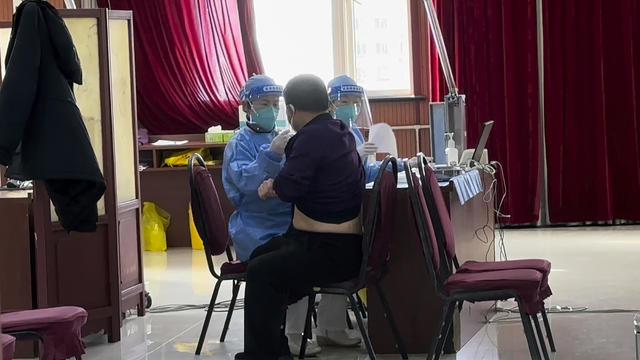
Despite official promises of a vaccine surge and calls for most of those infected to just ride it out, sudden policy changes have left many people nervous.

President Biden on Wednesday announced a series of economic and investment initiatives in a speech at the U.S.-Africa Leaders Summit. The goal is to expand free trade opportunities across the continent, while also countering Russia and China's influence. Michelle Gavin, senior fellow on Africa policy studies at the Council on Foreign Relations, joined CBS News to discuss.

Official case numbers have been falling, but many in Beijing are still in near-panic mode despite government efforts to clarify the new policy.

Duggan was classified as an "extreme high-risk restricted inmate" inside a maximum-security facility in Sydney, his lawyer said

First it was a suicide bomber outside the Russian embassy, then an attempt on the Pakistani ambassador's life, and now a hotel used by Chinese nationals has been attacked.

A growing number of states and the U.S. military have banned the Chinese-owned platform on government-issued devices.

Jamie Dimon, the CEO of JPMorgan Chase, discusses the economic impact of Russia's war in Ukraine, China loosening its "zero COVID" policy, mortgage rates and more.

Five states have banned TikTok on government devices, citing national security concerns over the app's ties to China. Robert Anderson, chairman and CEO of Cyber Defense Labs, spoke to CBS News about the extent of those security concerns.

The British government has announced an overhaul of financial regulations that were originally put in place following the 2008 financial crisis. And China eases its strict "zero-COVID" policies in an effort to bring down inflation. CBS News foreign correspondent Ramy Inocencio discusses with anchors Anne-Marie Green and Meg Oliver.

China and Saudi Arabia have signed a strategic partnership deal during Xi Jinping's trip to the Middle Eastern country for a summit. Isaac Stone Fish, a CBS News contributor and CEO of Strategy Risks, joins "CBS News Mornings" to explain what this means for U.S. relations with both nations.