Bill Gates tells Congress that meeting Epstein was "a grave error in judgment"
Bill Gates told members of Congress on Wednesday that Jeffrey Epstein put his philanthropic work at risk, and that meeting him represented "a grave error in judgment."
The Microsoft co-founder was the latest witness to appear before the House Oversight Committee, which is examining the government's handling of the Epstein case and those with ties to him. Gates testified for nearly six hours.
Gates told the committee in his opening statement, which was provided to CBS News, that he was introduced to Epstein through trusted individuals when Epstein was working to establish a charitable fund.
"I want to state very clearly: I never witnessed nor had any indication that Epstein was engaged in ongoing criminal conduct. I never went to his island, his ranch, or his Florida home," Gates said. "I have never victimized anyone. While he may have sought to foster a personal relationship, I was never interested in that and never reciprocated."
Gates denied ever spending time with Epstein socially, including by visiting his island or flying in his plane.
He said that between 2011 and 2014, he and Epstein discussed "potential giving structures" related to Gates' philanthropic fund, but the discussions "were a dead-end." Around that time, he said, Epstein was also involved in negotiating an exit package for an employee who was leaving Gates' private office.
Gates did not name the employee, but Epstein exchanged frequent emails with former Gates adviser Boris Nikolic, including some in which he appeared to be acting as a middleman between the two as they negotiated an exit deal.
"It was after this that I learned Epstein had become aware of sensitive information about my personal life, including the fact that I had been unfaithful in my marriage. These affairs had nothing to do with my interactions with Epstein, but they were painful for my family," Gates said.
He said Epstein used his knowledge of Gates' extramarital affairs to pressure him to resume work on the charitable effort.
"Epstein was working to use information about my infidelities — in addition to many lies that he layered on top — to pressure me to re-engage with him," Gates said. "He was unsuccessful in this effort, but it shows some of the ways he tried to leverage his interactions with me to further his agenda."
He added: "In the work I do, reputation is the basis for developing partnerships that save lives. Meeting with Epstein was a grave error in judgment and put this work at risk. His behavior was antithetical to all my efforts to contribute to a world where everyone has a chance to live a healthy and productive life. If the time I spent with Epstein lent him any credibility, I am deeply sorry."
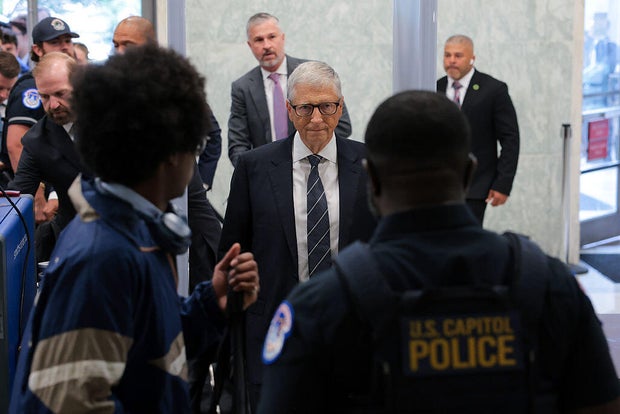
In a statement released following his testimony, Gates said that he "appreciated the opportunity to meet with the House Oversight Committee today and to answer all of their questions. I support the release of all the files and hope my participation contributes to getting justice for the victims."
In February, Gates apologized to staff at the Gates Foundation for his ties to Epstein, and said their relationship lasted from 2011 through 2014. After he was invited to testify in March, a spokesperson for Gates said he "welcomes the opportunity to appear before the Committee."
"While he never witnessed or participated in any of Epstein's illegal conduct, he is looking forward to answering all the committee's questions to support their important work," the spokesperson said.
In July 2013, Epstein sent himself a pair of emails containing unverified allegations that Gates had extramarital "sex with Russian girls" that resulted in a sexually transmitted infection requiring antibiotic treatment. In one email, Epstein claimed Gates also sought to "surreptitiously give" antibiotics to his then-wife, Melinda Gates.
A spokesperson for Gates told CBS News in January that the "claims are absolutely absurd and completely false."
The Wall Street Journal reported in February that Gates admitted during a town hall with staff that he "did have affairs, one with a Russian bridge player who met me at bridge events, and one with a Russian nuclear physicist who I met through business activities."
Text messages from 2017 show Epstein communicating with an apparent adviser to Gates, seeking to pitch the billionaire on a donor-advised fund, a tax-deductible charitable vehicle that Epstein wanted to operate.
The adviser told Epstein that Gates was interested in the idea, but said Melinda Gates didn't want him to communicate with Epstein. The two divorced in 2021.
"He wants to talk to you but his wife won't let him," the adviser said. In a series of texts a minute later, the adviser said of Gates, "he loves you," "he says hi," and "he feels bad about the [donor-advised fund] btw He thought great idea but wife wouldn't allow."
Gates is just the latest billionaire to be called before the committee, which has already interviewed Commerce Secretary Howard Lutnick and billionaires Les Wexner and Leon Black.
Others who have appeared include former President Bill Clinton, former Secretary of State Hillary Clinton, sex trafficker Ghislaine Maxwell and former Attorney General Pam Bondi.
The committee's chair, Rep. James Comer of Kentucky, said before entering the hearing Wednesday that he wants acting Attorney General Todd Blanche to come in before the committee in July and he also intends to invite prominent attorney Alan Dershowitz to testify about his relationship with Epstein.