U.S.-Iran ceasefire holding for now, Hegseth says, as Trump looks to finalize deal
Follow updates on the war in the Middle East for Wednesday, May 6, here. See earlier developments below.
What to know about the Iran war:
- President Trump put Project Freedom on pause Tuesday night, announcing that the U.S. and Iran have made "Great Progress" toward a final agreement. He said he made the decision at the request of Pakistan, which has helped mediate negotiations.
- Secretary of Defense Pete Hegseth said Tuesday the U.S.-Iran ceasefire "certainly holds" for now. He called Project Freedom, an effort to guide commercial ships through the Strait of Hormuz — which drew Iranian attacks on Monday — a totally separate and "temporary" operation.
- Earlier Tuesday, Secretary of State Marco Rubio said the offensive military operation known as Operation Epic Fury has concluded and that the U.S. has moved on to Project Freedom. Rubio said U.S. Navy ships in the region would continue to defend themselves after U.S. destroyers fended off a sustained attack from Iran as they protected two ships transiting the strait.
- The United Arab Emirates said Iran launched a missile and drone attack on the Gulf nation for a second consecutive day Tuesday after Iran fired 15 missiles at the UAE on Monday, wounding at least three workers.
China is "deeply distressed" over the war, its foreign minister tells Iran's
Chinese Foreign Minister Wang Yi on Wednesday told his Iranian counterpart Abbas Araghchi that China was "deeply distressed" over the war that has lasted more than two months and said a "comprehensive ceasefire" was needed.
China's top diplomat met with Araghchi in Beijing, the first time the Iranian foreign minister traveled to China since the war with the U.S. and Israel started Feb. 28.
"We believe that a comprehensive ceasefire is urgently needed, that a resumption of hostilities is not acceptable, and that it is particularly important to remain committed to dialogue and negotiations," Wang said, according to a video of the meeting.
Iran, China top diplomats huddle in Beijing
Iran Foreign Minister Abbas Araghchi met with China's top diplomat Wang Yi in Beijing on Wednesday, China's Xinhua news agency reported without giving details on what happened in the session.
Iran's Fars news agency earlier said Araghchi would "discuss bilateral relations and regional and international developments with his Chinese counterpart."
After the meeting, Araghchi said Tehran would only accept "a fair and comprehensive agreement" to end the Mideast war, the Reuters news agency reported, citing reports in Iranian state media.
"We will do our best to protect our legitimate rights and interests in the negotiations," Araghchi was quoted as saying, without addressing President Trump's pause in "Operation Freedom."
CBS/AFP
U.S. pressing Iraq on pro-Iran armed groups
The United States is looking for "concrete actions" by Iraq's next prime minister to distance the state from pro-Iran armed groups before resuming financial shipments and security aid, a senior official said Tuesday.
Iraq's ruling coalition has put forward Ali al-Zaidi as the next leader and he quickly received a congratulatory call from President Trump, who had threatened to end all U.S. support if former frontrunner Nouri al-Maliki took office.
But a senior US State Department official, speaking on condition of anonymity, said Zaidi must address the "blurry line" between pro-Iran armed groups in the Shia-majority country and the state.
Washington suspended cash payments for oil revenue, which have been handled from the Federal Reserve Bank of New York in an arrangement dating to the aftermath of the 2003 U.S. invasion of Iraq, as well as security assistance, over a spate of attacks on U.S. interests.
Resuming full support "would start with expelling terrorist militias from any state institution, cutting off their support from the Iraqi budget (and) denying salary payments to these militia fighters," the official said. "Those are the type of concrete actions that would give us confidence and say that there's a new mindset."
The official said U.S. facilities in Iraq suffered more than 600 attacks after Feb. 28, when the U.S. and Israel launched their war on Iran. The attacks have stopped since the shaky U.S.-Iran ceasefire began on April 8, except for Iranian strikes in Iraqi Kurdistan.
Iran foreign minister arrives in Beijing for talks with China's top diplomat
Iranian Foreign Minister Abbas Araghchi arrived in Beijing ahead of scheduled talks with China's top diplomat Wang Yi, according to Iran's Tasnim and Fars news agencies.
"Seyyed Abbas Araghchi arrived in Beijing... at the head of a diplomatic delegation. During this visit, our country's Foreign Minister will discuss bilateral relations and regional and international developments with his Chinese counterpart," Fars reported.
China is a key customer for Iranian oil, defying sanctions imposed by the United States as Washington seeks to choke off revenue to Tehran.
Araghchi's trip comes before President Trump's scheduled visit to China on May 14-15 to see President Xi Jinping — a trip he delayed after the U.S. and Israel attacked Iran.
Secretary of State Marco Rubio on Tuesday called on China to put pressure on Araghchi to loosen Tehran's chokehold on the Strait of Hormuz, through which one-fifth of the world's oil once transited.
"I hope the Chinese tell (Araghchi) what he needs to be told, and that is that what you were doing in the straits is causing you to be globally isolated," Rubio told reporters.
AFP
Trump says "Great Progress" made toward agreement with Iran, pauses Project Freedom
President Trump said Tuesday that Project Freedom will be paused as the U.S. and Iran make "Great Progress" toward a final agreement, but said the U.S. blockade would remain in place.
"Based on the request of Pakistan and other Countries, the tremendous Military Success that we have had during the Campaign against the Country of Iran and, additionally, the fact that Great Progress has been made toward a Complete and Final Agreement with Representatives of Iran, we have mutually agreed that, while the Blockade will remain in full force and effect, Project Freedom (The Movement of Ships through the Strait of Hormuz) will be paused for a short period of time to see whether or not the Agreement can be finalized and signed," Mr. Trump wrote on Truth Social.
Project Freedom, the U.S. military's effort to help move ships through the Strait of Hormuz, began Monday.
Gen. Dan Caine, chairman of the Joint Chiefs of Staff, said Tuesday there are more than 1,500 vessels with about 22,500 mariners trapped inside the Persian Gulf.
Rubio speaks with Russian foreign minister about Iran
Secretary of State Marco Rubio on Tuesday spoke with Russian Foreign Minister Sergei Lavrov, according to the State Department.
State Department spokesperson Tommy Pigott said the two discussed Iran, the U.S.-Russia relationship and the Russia-Ukraine war. The call was at Lavrov's request, according to Pigott.
Russian forces launched attacks that killed 21 people in Ukraine on Tuesday, as Ukrainian President Volodymyr Zelenskyy condemned Moscow's "utter cynicism" for launching deadly strikes while simultaneously seeking a truce to stage its annual World War II Victory Day commemorations on May 8-9.
Zelenskyy on Monday announced his own ceasefire for Tuesday and Wednesday, saying in a statement posted to X that he has not received an official appeal from Russia about its Victory Day truce.
CBS/AFP
Missile strikes cargo ship in Gulf region, injuring several crew members, U.S. officials tell CBS News
A cargo ship in the Gulf region was hit by a possible land-attack cruise missile, causing several injuries among the ship's Filipino crew, two U.S. officials told CBS News.
The hit on the CGM San Antonio — which is owned by a French firm — took place late Tuesday evening local time, the officials said. The ship was near Dubai as of midday on Tuesday, but it is not clear whether the vessel has moved since then, according to public ship tracking data.
The U.K. Maritime Trade Operations Centre said Tuesday it received a report that "a cargo vessel has been struck by an unknown projectile."
Since Sunday, UKMTO has reported incidents on three other ships in the region, including a fire, a projectile strike and a reported attack by small craft.
Eleanor Watson and Joe Walsh contributed to this report.
U.S., Gulf allies propose U.N. resolution threatening Iran with sanctions over Strait of Hormuz chokehold
The United States and its Gulf allies have proposed a United Nations resolution threatening Iran with sanctions or other measures if it doesn't halt attacks on ships in the Strait of Hormuz, stop imposing "illegal tolls," and disclosing the placement of all mines to allow freedom of navigation.
The draft Security Council resolution, obtained Tuesday by The Associated Press, also demands that Iran "immediately participate in and enable" U.N. efforts to establish a humanitarian corridor in the strait for the delivery of vital aid, fertilizer and other goods.
It is the latest diplomatic effort by the U.S. and its Gulf allies after a watered-down resolution aimed at opening the strait was vetoed by China and Russia hours before Washington and Tehran announced a temporary ceasefire in early April.
Secretary of State Marco Rubio in a statement on Tuesday accused Iran of continuing "to hold the world's economy hostage" by trying to close the strait, threatening to attack ships, laying sea mines, and attempting to charge tolls "for the world's most important waterway."
Whether the resolution succeeds will be "a real test" for the U.N. "as something that functions, that can solve global problems," Rubio added at the White House briefing.
Rubio says Operation Epic Fury is over, U.S. has moved on to Project Freedom
During his press briefing with reporters, Secretary of State Marco Rubio said Operation Epic Fury is over.
"The operation is over," Rubio said. "Epic Fury is, the president notified Congress, we're done with that stage of it. OK? We're now onto this project of freedom."
Project Freedom is a U.S. effort to help commercial ships through the Strait of Hormuz.
"The operation, Epic Fury, is concluded," Rubio also said. "We achieved the objectives of that operation."
Rubio said the issue of Iran's enriched uranium is being addressed in negotiations, although he didn't go into where negotiations stand.
Rubio says nuclear-armed Iran would be worse than high gas prices
Asked about high gas prices in the U.S. as a result of the war, Secretary of State Marco Rubio said Americans are in a better position than other people around the world and that things would be worse if Iran had a nuclear weapon.
"Everybody needs to think about it this way: If Iran had a nuclear weapon and they decided to close the straits and make our gas prices like $9 a gallon or $8 a gallon, we wouldn't be able to do anything about it because they have a nuclear weapon," Rubio said. "A nuclear-armed Iran could do whatever the hell they want with the straits, and there's nothing anyone would be able to do about it."
According to AAA, the average price for a gallon of regular gas is $4.48.
Rubio says Iran's top people are "insane in the brain" as he calls for negotiations
Secretary of State Marco Rubio called for Iran's leaders to negotiate an end to the war with the U.S.
"The time's come for Iran to make a sensible choice," Rubio told reporters, "and it's not easy for them to do that, obviously, because they have a fracture in their own leadership system, and apart from that, I mean, the top people in that government are, to say the least, you know, they're insane in the brain."
"We are only responding if attacked first," Rubio says
Secretary of State Marco Rubio told reporters that the U.S. Project Freedom initiative was a defensive operation.
"This is not an offensive operation, this is a defensive operation," Rubio said. "What that means is very simple: There's no shooting unless we're shot at first."
"We are only responding if attacked first," Rubio said.
Rubio briefing reporters at White House ahead of Italy trip
Secretary of State Marco Rubio is briefing reporters at the White House ahead of his expected trip to Italy on Wednesday. The briefing comes while White House press secretary Karoline Leavitt is on maternity leave.
During the Italy trip, Rubio is expected to meet with officials at the Vatican as well as his Italian counterparts.
"Secretary Rubio will meet with Holy See leadership to discuss the situation in the Middle East and mutual interests in the Western Hemisphere," State Department spokesperson Tommy Pigott said in a statement. "Meetings with Italian counterparts will be focused on shared security interests and strategic alignment."
Israel's military chief says it's ready to "respond with force" if attacked by Iran
Israel's military chief Lt. Gen. Eyal Zamir said on Tuesday that the country was prepared to respond "with force" to any attack by Iran.
"The IDF remains on high alert across all fronts. We are closely monitoring developments in the Persian Gulf and are prepared to respond with force to any attempt to harm Israel," Zamir said at a ceremony marking the appointment of the country's new air force chief.
Israel ready to deploy "entire air force" against Iran if needed, new chief says
Israel's new air force chief said on Tuesday that the country was prepared to deploy its entire fleet of fighter jets against Iran if necessary.
"We are closely monitoring the developments in Iran and are prepared to deploy the entire air force eastward if required," Maj. Gen. Omer Tischler said at a ceremony where he assumed command from his predecessor, Tomer Bar.
Iran vows "firm response" if ships diverge from declared corridor in Strait of Hormuz
Iran's Revolutionary Guard warned on Tuesday that it would respond firmly to any ships that diverge from the Islamic Republic's approved route through the Strait of Hormuz.
"We warn all vessels planning to transit the Strait of Hormuz that the only safe passage is the corridor previously announced by Iran. Any diversion of ships to other routes is dangerous and will result in a firm response from the Iranian Revolutionary Guards navy," it said in a statement carried by state television.
The warning came on the second day of a U.S. effort to facilitate the transit of commercial ships through the waterway, which Iran closed in response to the U.S.-Israeli war.
Iran's Foreign Ministry insists "no hostility toward Arab countries of the Gulf," despite ongoing attacks
Iran bears "no hostility toward Arab countries of the Gulf," the country's Foreign Ministry spokesman Esmail Baqaei insisted Tuesday, but he warned Iran's neighbors against what he called a reliance on "imported security."
In remarks to Iran's state-run IRNA news agency, Baqaei called the U.S. military presence "the only source of insecurity" in the region and said Gulf states were exposing themselves to risk rather than finding protection by allying with Washington.
He gave the statement shortly before the United Arab Emirates reported incoming Iranian missile and drone fire for a second consecutive day. Monday's attacks, which UAE authorities said included 15 Iranian missiles and numerous drones, were the first since the U.S. and Iran agreed to a ceasefire on April 8.
"Iranians never surrender under pressure," said Baqaei, insisting that all of Iran's actions were defensive, targeting U.S. military assets and bases used for operations against Iran, and not aimed at harming other regional countries.
Trump says "we don't want to go in and kill people"
President Trump said he doesn't want to send U.S. forces into Iran, calling on the Islamic Republic to "do the smart thing."
"They should do the smart thing because we don't want to go in and kill people, really," Mr. Trump told reporters during an Oval Office event. "I don't want to, I don't want to. It's too tough."
The president made the comment while talking about Iran's fragile economy, which is facing skyrocketing inflation under the strain of the war and Western sanctions.
"I hope it fails," Mr. Trump said. "You know why? Because I want to win."
Arab interior ministers condemn Iran's renewed attacks on UAE
Arab interior ministers condemned Iran's renewed attacks on the United Arab Emirates.
The UAE said Tuesday that Iran had targeted it with a missile and drone attack for a second consecutive day after Iran fired 15 missiles at the Gulf nation on Monday, wounding at least three workers.
On Tuesday, the general secretariat of the Arab Interior Ministers Council, which consists of the 22 members of the League of Arab States, "strongly condemned renewed Iranian attacks on the United Arab Emirates, targeting civilian and economic sites with missiles and drones," according to Sana, the Syrian state news agency.
Trump says Iran will be on agenda during China visit
President Trump said the Iran war will be on the agenda when he meets with Chinese leader Xi Jinping in Beijing next week.
"I'll be talking about that, that'll be one subject," Mr. Trump said. "But, he's been very nice about this."
The president reiterated his offer for China, which relies on oil from the Middle East, to send tankers to Alaska, Louisiana and Texas instead.
Trump says Iran knows "what not to do" during ceasefire
President Trump was asked during an Oval Office event what action by Iran would be considered a violation of the ceasefire after the U.S. and Iran exchanged fire Monday.
"You'll find out because I'll let you know," Mr. Trump told reporters. "They know what to do, and they know what not to do more importantly, actually."
Trump says Iran doesn't like "playing games" with U.S.
President Trump briefly addressed the Iran war at the beginning of an Oval Office event after complimenting Defense Secretary Pete Hegseth, who was standing near the president.
Mr. Trump said Hegseth gave a "great news conference" with Gen. Dan Caine, chairman of the Joint Chiefs of Staff.
"They don't like playing games with us," Mr. Trump said, referring to Iran. "They don't like it at all. You'll see that. As time goes by, you're going to see it. I think you've already seen it. We basically wiped out their military in about two weeks."
UAE reports new "missile and drone attacks originating from Iran"
"The UAE's air defenses are currently dealing with missile and drone attacks originating from Iran," the United Arab Emirates' Ministry of Defense said Tuesday in a social media post.
Iran launched 15 missiles at the UAE on Monday, in the first such attacks since a U.S.-Iran ceasefire came into effect on April 8. Tension between Washington and Iran soared again on Monday as the U.S. began a new military operation, dubbed Project Freedom, to guide commercial ships through the Strait of Hormuz in defiance of Iranian threats to the vital waterway.
In addition to the attacks on the UAE, which caused a fire at the sprawling Fujairah industrial complex and wounded at least three workers, Iran also renewed attacks on commercial vessels Monday, targeting at least two ships with drones and disabling one.
UAE air defenses were "actively engaging with missiles and UAV threats" again on Tuesday, the defense ministry said.
U.S. Defense Secretary Pete Hegesth said Tuesday that, despite the renewed violence, "right now, the ceasefire certainly holds," but he warned the Trump administration was closely monitoring Tehran's actions, and that the military remained poised "to restart major combat operations if necessary."
CENTCOM says 51 vessels "directed to turn around or return to port" by U.S. blockade
The U.S. military's Central Command said in a social media post that 51 vessels "have been directed to turn around or return to port" as of Tuesday under the U.S. blockade of Iranian ports and Iran-linked vessels.
Iran has blasted the blockade as a violation of the ceasefire with the U.S., and the Islamic Republic regime insists it controls maritime traffic in the Strait of Hormuz, threatening to attack ships that try to transit the narrow waterway, with or without U.S. military assistance.
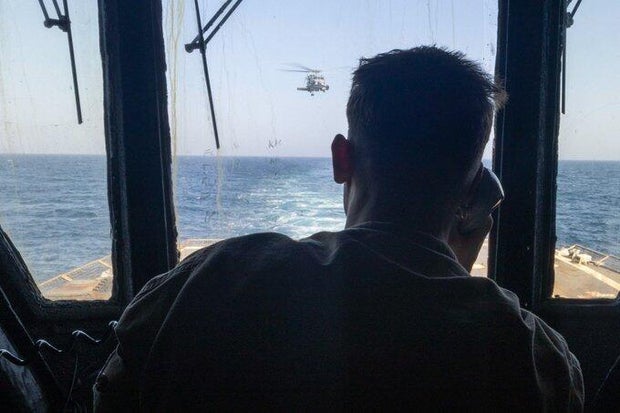
On Monday, as the first two commercial vessels were escorted through the strait with U.S. protection under Project Freedom, Iran launched a barrage of missiles and drones at the vessels. President Trump said seven or eight small Iranian military boats were destroyed in the encounter.
Iran claims some tankers loaded with its energy products are getting through the strait to reach customers in Asia, but the Pentagon insists no Iranian or sanctioned vessel has made it through the blockade.
Germany sends minesweeping ship to Mediterranean ahead of possible mission to help clear Strait of Hormuz
Germany is sending a minesweeping vessel from its navy to the Mediterranean, ready for potential participation in a future effort to clear the Strait of Hormuz, the Der Spiegel news magazine says, citing the country's Defense Ministry.
The Fulda left the Kiel-Wik naval base Monday, breaking off a previous deployment as part of a NATO mission.
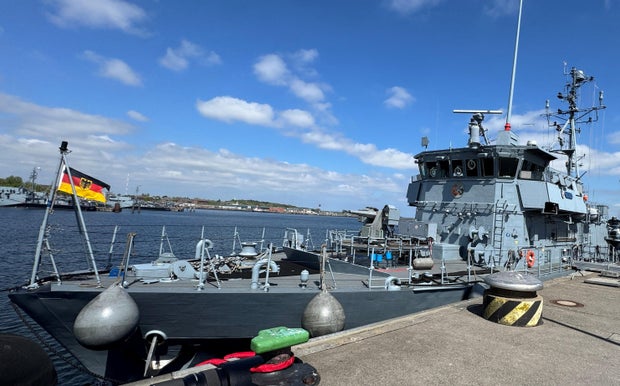
German Defense Minister Boris Pistorius stressed that repositioning the ship would save time if a decision was made by the government to join an international effort to clear the Middle Eastern waterway, but that any such deployment remained contingent on an end to hostilities between Iran and the U.S. and Israel.
France and the U.K. have led efforts to build a coalition of nations willing to help ensure the strait remains safe and passable after the war, amid sharp criticism from President Trump at all NATO allies for declining to join offensive efforts against Iran.
Lebanese president says army should be "sole authority for security" in long-time Hezbollah stronghold
Lebanon's President Joseph Aoun said Tuesday that the country's army should be the "sole authority for security" in the south of the country, where Iranian-backed Hezbollah has long had a major presence.
Hezbollah has criticized the ceasefire agreed to by the Israeli and Lebanese governments in mid-April, with one lawmaker from the group last week calling it "appeasement."
Both Hezbollah and the Israeli military have launched regular attacks since the U.S.-brokered truce began, both claiming to act in self-defense and accusing the other side of breaching the deal.
During a meeting Tuesday with local leaders from southern Lebanon, which has been a base of Hezbollah's operations for decades as it fired rockets at northern Israel, Aoun said "when the south is exhausted, the whole of Lebanon is affected. It is time for the south… to rest."
"The negotiation path is the only option left after other solutions, including war, have been exhausted," he said in a statement posted on X. "It is time for [the army] to return fully and assume its responsibilities as the sole authority for security there."
"Those attempting to stir sectarian or religious strife will not succeed, because civil peace is a red line," he said, in an apparent reference to Hezbollah.
Hegseth says U.S. military is "locked, loaded and ready to go" if necessary as clashes test ceasefire
As the U.S.-Iran ceasefire continues, Secretary of Defense Pete Hegseth said President Trump "retains the opportunity and the capabilities — more capabilities than we had at the start of this — to restart major combat operations if necessary."
"If Iran is not willing to follow through on its side of the bargain or make a deal, then the War Department is postured, locked, loaded and ready to go," he said.
"We hope it doesn't have to go in that direction," Hegseth added, but he said U.S. forces were "in a three-point stance and ready to go."
U.S. renews call for citizens to "depart now" as Iraq reopens airspace for limited commercial flights
Iraq has reopened its airspace with limited commercial flights available, the U.S. Embassy in Iraq said Tuesday, reminding Americans of standing guidance for anyone considering air travel within Iraq to "be aware of the ongoing potential risks posed by missiles, drones, and rocket-propelled grenades in Iraqi airspace."
In a post on X, the U.S. Embassy in Baghdad also reiterated the standing guidance to not travel to Iraq for any reason and for citizens to "Depart now if you are there."
"Iraq's Iran-aligned terrorist militias continue to plan additional attacks against American citizens and U.S.-associated targets throughout Iraq," the embassy said. "Additionally, certain entities affiliated with the Iraqi government continue to provide political, financial, and operational cover for these terrorist militias."
Hegseth says "right now, the ceasefire certainly holds"
Secretary of Defense Pete Hegseth told reporters Tuesday that "the ceasefire is not over" with Iran, calling the Project Freedom operation to guide commercial vessels through the Strait of Hormuz "a separate and distinct project."
"We expected there would be some churn at the beginning, which happened, and we said we would defend and defend aggressively and we absolutely have," he said, referring to a violent encounter between the U.S. and Iran on Monday during the first Project Freedom operation to guide two commercial vessels through the strait.
Hegseth said "Iran knows" the U.S. military is resolved to continue with Project Freedom, "and ultimately the president's going to make a decision whether anything were to escalate into a violation of a ceasefire. But certainly we would urge Iran to be prudent in the actions that they take to keep that underneath this threshold."
The defense secretary said "right now, the ceasefire certainly holds." But he noted that "we're going to be watching very, very closely."
Caine says clashes with Iran so far "below the threshold of restarting major combat operations"
Joint Chiefs Chairman Gen. Dan Caine, speaking at the briefing alongside Hegseth, said beyond the operation in the Strait of Hormuz, U.S. forces "remain ready to resume major combat operations against Iran if ordered to do so."
"No adversary should mistake our current restraint with a lack of resolve," he added.
Caine outlined that on Sunday, CENTCOM initiated Project Freedom at the president's direction, "with the objective of facilitating the safe passage of international, commercial shipping through the Strait of Hormuz."
He said guided missile destroyers and warships are "detecting and defeating Iranian threats," while more than 100 aircraft are in the air providing defensive overwatch. He said the forces are made up of over 15,000 American service members.
"Commercial vessels that transit through the area will see, hear and frankly feel U.S. combat around them — on the sea, in the skies and on the radio," Caine said.
Caine said Iran had attacked U.S. forces "more than 10 times" since President Trump first announced the ongoing ceasefire on April 8, but said that fell "below the threshold of restarting major combat operations."
"Since the ceasefire was announced, Iran has fired at commercial vessels nine times and seized two container ships," Caine said. "And they've attacked U.S. forces more than 10 times, all below the threshold of restarting major combat operations at this point."
Hegseth says Project Freedom not part of wider war effort, "and temporary in duration"
Defense Secretary Pete Hegseth on Tuesday defined Project Freedom, a day-old U.S. military operation to assist commercial vessels stuck in the Persian Gulf to get out via the Strait of Hormuz, as completely separate from hostilities with Iran that began with joint U.S.-Israeli strikes on the country on Feb. 28.
"This operation is separate and distinct from Operation Epic Fury. Project Freedom is defensive in nature, focused in scope, and temporary in duration, with one mission: protecting innocent commercial shipping from Iranian aggression," Hegseth said at a press briefing.
Hegseth said American forces would not need to enter Iranian waters or airspace for Project Freedom, adding: "We're not looking for a fight."
"But Iran also cannot be allowed to block innocent countries and their goods from an international waterway," he said, calling Iran the "clear aggressor," and accusing the Islamic Republic regime of "weaponizing a critical chokepoint for its own financial benefit."
"Iran's plan, a form of international extortion, is unacceptable," Hegseth said. "That ends with Project Freedom."
Hegseth said U.S. warships and aircraft assisting two commercial vessels to transit the strait on Monday showed "the lane is clear."
He said U.S. Central Command was actively communicating with hundreds of ships from around the world that "want to get out of the Iranian trap that they have been stuck inside."
"We'd prefer this to be a peaceful operation, but are locked and loaded to defend our people, our ships, our aircraft and this mission without gestation," he said. "To Iran: Let innocent ships pass freely. These international waters belong to all nations, not to Iran to tax, toll for control."
Iranian news agency claims U.S.-flagged commercial ships stuck in shallow, rocky area off Oman
Iran's semi-official Fars news agency, which is associated with the country's Islamic Revolutionary Guard Corps, claimed Tuesday that two U.S.-flagged commercial vessels had become stranded off Oman's coast in shallow, rocky waters near the southern entrance to the Strait of Hormuz.
The report came a day after the U.S. military said warships and aircraft had assisted two U.S.-flagged ships in transiting the strait as part of the newly launched Project Freedom.
Danish shipping giant Maersk confirmed to CBS News on Tuesday that one of the ships guided out of the Persian Gulf through the Strait of Hormuz, under U.S. military protection, was the cargo ship ALLIANCE FAIRFAX.
Maersk did not give a precise location for the vessel but said it had "exited the Persian Gulf accompanied by U.S. military assets" on Monday and that the company "looks forward to the ALLIANCE FAIRFAX returning to its normal commercial service."
Under Project Freedom, the U.S. military has urged vessels to coordinate passage through the strait via a southerly route, skirting Oman's coast, rather than the normal route through the middle of the waterway, where there are believed to be sea mines. Iranian authorities previously told ships to use a northern path, but only after gaining explicit permission from the Islamic Republic's military.
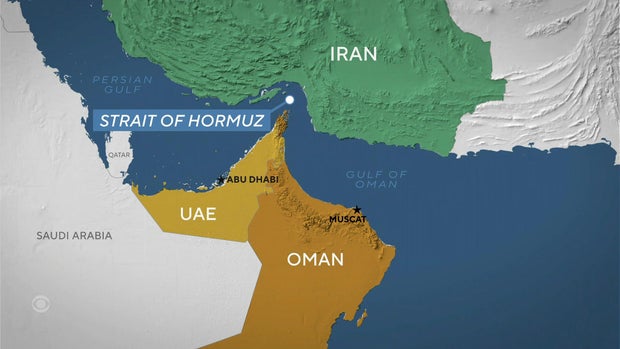
Fars claimed the southern section of the strait, near Oman's Musandam Peninsula and the Al Kheil islands, is unsuitable for maritime passage due to shallow waters and rocky terrain.
According to the Strauss Center for International Security and Law, however, the strait "is deep and relatively free of maritime hazards," and is actually deepest "near the Musandam Peninsula and tapers as you move north toward the Iranian shore."
According to the Strauss Center, which is affiliated with the University of Texas at Austin, the water is "deep enough for large ships to travel through an Inshore Traffic Zone south of the Omani island of Didimar. Depths in this area reach over 650 feet, but the Omani government restricts access to this area to smaller vessels in normal, peacetime situations."
Senior Iranian commander predicts U.S. "will ultimately be defeated," as Trump again says U.S. has already won
A high-ranking commander of the Islamic Revolution Guards Corps (IRGC) warned Tuesday that any further "escalation of tensions between Iran and the U.S." would bring a "much more severe" outcome for the U.S., which he said "will ultimately be defeated," despite the Iran's military being vastly outgunned.
President Trump downplayed a clash between U.S. warships and Iranian forces on Monday during which American ships and aircraft destroyed seven Iranian fast boats. Speaking later in the day with conservative radio host Hugh Hewitt, Mr. Trump renewed his assertion that the U.S., "from the military standpoint," has already won the war, saying all of Iran's navy ships were "at the bottom of the sea."
Nonetheless, Major General Yadollah Javani, deputy IRGC commander for political affairs, said Tuesday that if there was further escalation between Iran and the U.S., the fallout "will be much more severe for the latter."
"The U.S. will flex its muscles, but will ultimately be defeated," he claimed in remarks carried by Iran's state-run Press TV.
The commander renewed Iran's threat to shipping after the first operation under the U.S Project Freedom to get commercial vessels through the strait, warning that any ship wishing to transit the waterway must do so with permission from the Iranian Armed Forces "in order to stay safe."
Iran's foreign minister to visit Beijing for talks on bilateral ties and "international developments"
Iran's Foreign Minister Abbas Araghchi was headed to China's capital Beijing on Tuesday for discussions on bilateral ties between the two countries and on "international developments" amid the U.S.-Israeli war with Iran.
Araghchi and the foreign ministry confirmed his trip on Tuesday, saying he would meet for the talks with his counterpart, Chinese Foreign Minister Wang Yi, but offering no additional information.
China has portrayed itself as a neutral party during the two-month war, calling often for diplomacy to end the conflict, but continuing to support its trade partner by buying Iranian energy — reportedly even since the U.S. imposed a blockade on Iranian ports and vessels.
American intelligence agencies detected signs early in the war that Russia and China were both supporting Iran in a bid to blunt the joint U.S.-Israeli military operations.
U.S. Defense Intelligence Agency analysts assessed that China had been considering whether to provide Tehran with advanced radar systems, multiple U.S. officials familiar with the matter told CBS News in mid-April.
South Korean ship hit by Iranian fire disabled and waiting for a tow into Dubai port
A South Korean cargo ship that President Trump said was hit by an Iranian attack Monday in the Strait of Hormuz was waiting to be towed into Dubai's port Tuesday after being disabled by the strike, according to South Korea's state-owned Yonhap news agency.
The ship's operator, Seoul-based logistics company HMM, confirmed a fire on board the NAMU had knocked out the vessel's primary power supply Monday, leaving the ship unable to move on its own power.
Yonhap said six South Korean sailors were planning to return home, while 24 others of various nationalities were to remain on board, where a backup generator was keeping the lights on, and HMM said there were adequate food and water supplies.
"The conditions are for the crew to disembark if they decide to disembark, but it seems that the fire suppression has been completed and there are no additional risk factors, so it is determined that they will stay on the ship," Yonhap quoted an HMM representative as saying.
South Korea's government said earlier Tuesday that it would "review its position" on joining U.S. military operations to secure shipping in the Strait of Hormuz after President Trump called explicitly for Seoul to do so in light of the attack on the NAMU.
Saudi Arabia calls for "de-escalation, restraint" and diplomacy amid "military escalation in the region"
After Iran launched its first attack on a Persian Gulf neighbor in almost a month on Monday, lashing out as the U.S. started an operation to guide tankers through the Strait of Hormuz, Saudi Arabia's government issued a call for "de-escalation, restraint" and diplomacy.
In a statement, the Saudi Foreign Ministry voiced concern over the "current military escalation in the region" and called for "de-escalation, restraint, and support for Pakistani mediation and diplomatic efforts to reach a political solution that prevents the region from sliding into further tension and instability, which is not in the interest of the region or the world."
The Saudi government also stressed "the importance of restoring international maritime navigation in the Strait of Hormuz to its normal state," demanding that all ships "be guaranteed safe and secure passage without restrictions."
Top Iranian negotiator claims "status quo is intolerable for" U.S., while Iran has "not even started"
Iran's chief negotiator in talks with the United States warned Tuesday that his country has "not even started" in its standoff over the Strait of Hormuz.
"We know full well that the continuation of the status quo is intolerable for America; whilst we have not even started yet," Mohammad Bagher Ghalibaf said in a social media post.
Ghalibaf, who's also the speaker of Iran's parliament, said the actions of the U.S. and its allies had put shipping security at risk but said their "malign presence will diminish."
South Korea to review joining U.S. Hormuz operation
South Korea said Tuesday it will "review its position" on joining U.S. operations in the Strait of Hormuz after President Trump urged Seoul to take part in what he has dubbed "Project Freedom," in the wake of an apparent Iranian attack on one of its ships.
An explosion and fire were reported on a South Korean cargo vessel on Monday in the key waterway, which has been effectively blocked since the Mideast war erupted on Feb. 28.
South Korea's foreign ministry said Tuesday that all 24 crew members aboard the stricken HMM Namu — including six South Korean nationals — were unharmed and the fire on the vessel had been "completely extinguished."
Mr. Trump said the incident should prompt South Korea to join American efforts to guide stranded ships through the strait, a major artery for the fuel exports that Seoul relies on.
On Tuesday, South Korea's defense ministry said it would "carefully review our position" but didn't commit to any change.
Seoul would consider its stance based on international law, the safety of international maritime routes, its alliance with the United States and the security situation on the Korean peninsula, the ministry said.
It added that it had been "actively participating in international discussions on cooperation to ensure safe passage through the Strait of Hormuz."
The HMM Namu is almost 590 feet long and sails under the flag of Panama, data from tracking site MarineTraffic shows.
CBS/AFP
Maersk says ship transited Strait of Hormuz under U.S. escort
Denmark's freight giant Maersk said on Tuesday that one of its ships has successfully sailed through the Strait of Hormuz under U.S. escort.
The ship, the U.S.-flagged Alliance Fairfax, had been stuck in the Gulf since the war erupted in February and was "offered the opportunity" to leave accompanied by the U.S. military, Maersk said in a statement.
"The vessel subsequently exited the Persian Gulf accompanied by U.S. military assets" on May 4, the company said, adding that "the transit was completed without incident, and all crew members are safe and unharmed."
2 U.S. Navy destroyers transit Strait of Hormuz after dodging Iranian onslaught
Two U.S. Navy destroyers transited the Strait of Hormuz and entered the Persian Gulf after navigating an Iranian barrage, according to defense officials who spoke to CBS News under condition of anonymity to discuss national security matters.
The USS Truxtun and USS Mason, supported by Apache helicopters and other aircraft, faced a series of coordinated threats during the passage, the defense officials said. Iran launched small boats, missiles and drones against them in what officials described as a sustained barrage.
Despite the intensity of the attacks, neither U.S. vessel was struck.
Military officials said that defensive measures, bolstered by air support, successfully intercepted or deterred each incoming threat. They added that no projectiles that were launched reached the ships.
Iran's foreign minister says "talks are making progress," but Project Freedom can't solve a political crisis
Iran's Foreign Minister Abbas Araghchi said Monday talks with the U.S. are making progress but criticized the U.S. military's Project Freedom in the Strait of Hormuz.
"Events in Hormuz make clear that there's no military solution to a political crisis," Araghchi said in a social media post. "As talks are making progress with Pakistan's gracious effort, the U.S. should be wary of being dragged back into quagmire by ill-wishers. So should the UAE."
"Project Freedom is Project Deadlock," he added.