A partial lunar eclipse will turn the moon red in Pittsburgh. Here's how to see it.

The moon is set to turn red tonight as we see a near-total lunar eclipse here in Western Pennsylvania late tonight. Eclipses, which used to be thought of as magic or even witchcraft, depending on what suited them at the moment, are now understood to be just a function of the Earth's alignment with the sun and moon.
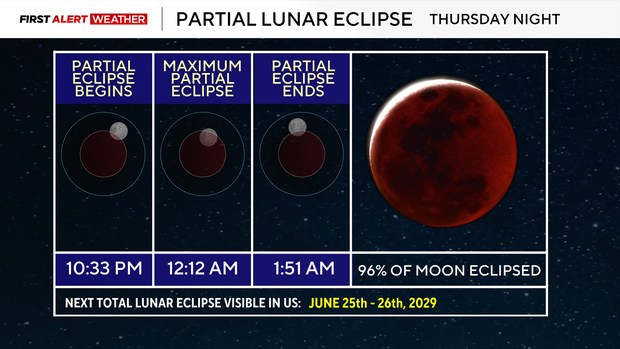
Through math, we know that if you are in Pittsburgh, tonight's "partial" lunar eclipse will be pretty close to full, with around 96% of the moon turning a reddish hue.
A partial eclipse occurs when the Earth forms a line with the sun on one side and the moon on the other side. Most partial eclipses will only see the Earth's shadow cast on the moon's surface, making it almost just look like a better-defined new waxing or waning moon.
When the total portion of the moon is 92% or more covered, you get what we are expecting tonight, which is a "blood moon." In the past, blood moons have played a part in things like the destruction of the Athenian dynasty, the salvation of Christopher Columbus from starvation, and the confirmation of Einstein's Big Theory, according to History.com.
Do you want to check out the "near full" blood moon tonight?
If so, it looks like the weather is going to cooperate, with partly cloudy skies in place tonight.
The eclipse begins at 10:33 p.m. and ends at 1:51 a.m. The eclipse peaks at 12:12 a.m. For the best viewing, get as far away from bright lights as possible and give your eyes a few minutes to adjust to the darkness. The moon will be high in the sky, so you won't need any help finding it. If you want to take pictures, make sure your phone is in night mode. Most phones will automatically switch over to take the picture.
Besides that, just enjoy!
If you miss tonight's partial lunar eclipse, no worries. We will have two penumbral lunar eclipses occurring next year, with the first happening on Feb. 20th. Our next partial lunar eclipse happens on Jan. 12, 2028, but the coverage will only be around 5%. There will also be a partial solar eclipse in 2028.
Interestingly enough, 2029 is going to be fairly active, with a nearly 50% partial solar eclipse coming in January and two total lunar eclipses occurring, with the first happening on June 26, 2029.
Credit for these Pittsburgh dates goes to timeanddate.com.


