Philadelphia's overnight business curfew expands again, covering more North Philly neighborhoods

A business curfew that began in Kensington in 2024 expanded, forcing some bodegas, take-out restaurants and food trucks to close between 11 p.m. and 6 a.m. in several North Philadelphia neighborhoods, city and business leaders said.
The ordinance will apply beyond Kensington to Fairhill, Germantown, Nicetown, Hunting Park, Frankford and Mount Airy — and portions of City Council Districts 7 and 8 and parts of District 1. Businesses that violate the curfew face fines of up to $1,000 per day, according to legislation passed in June.
The curfew was first enacted in Kensington in March 2024 after council members and local leaders said it was needed to curb violent crime. In April of this year, City Council passed an expansion of the legislation, which took effect in June and included neighborhoods like Hunting Park.
A second expansion of the legislation, passed in June, will take effect Thursday, widening the footprint again. However, it won't be enforced for 60 more days.
Supporters say the curfew has helped improve public safety. Councilwoman Quetcy Lozada, who sponsored the original Kensington ordinance, believes the curfew has led to a sharp drop in homicides in the area, saying homicides dropped by 80% in the neighborhood after it went into effect.
"We are going to continue to put legislation on the floor that is going to protect my community," Lozada said. "That is going to welcome responsible businesses into the community, and those that don't want to be responsible, you can leave."
Mayor Cherelle Parker voiced support for the intent of the ordinance but said the city's law department had concerns about aspects of the legislation, so she declined to sign it.
"It will become law without my signature, but it will become law," Parker said at a press conference Wednesday.
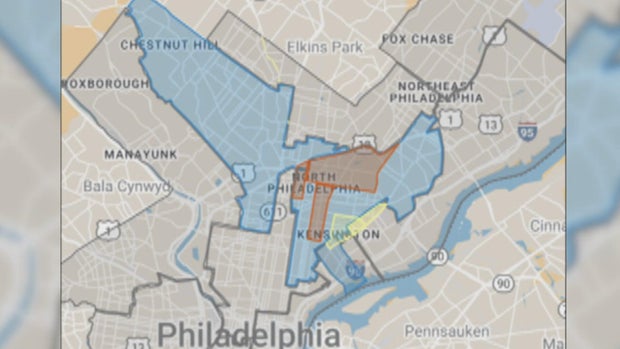
But the move has drawn opposition from business groups and legal advocates. A coalition of 10 Philadelphia business organizations, backed by the Institute for Justice, has urged City Council to recall the expanded ordinance, saying it will disproportionately harm small, often immigrant-owned businesses and late-night workers who rely on overnight service. The Institute for Justice has released maps showing the expanded coverage and says the ordinance increases the area affected by more than 500% compared with the original Kensington zone.
At Hunting Park's North Fifth Street corner, food truck owner Edward Bonilla said late-night sales are essential to his business. He said he started losing customers when the first expansion of the curfew went into effect this June.
"We don't know what we're going to do," Bonilla said. "The people who got food trucks — they have to close, because they don't make [any] money."
Bonilla went to City Hall on Thursday to speak out against the law. Speaking through a translator, Bonilla told City Council members that he's already been losing customers due to the existing curfew.
"I had to cut down the hours for my workers, and if they don't work and have less hours, they have less money to support themselves," Bonilla said.
Jennifer McDonald, a representative from the Virginia-based Institute for Justice, also testified during the meeting. She said all businesses shouldn't be punished because of places that cause problems.
"We understand that nuisance businesses are a very serious problem and we want to help the city come up with a policy solution that will fix those nuisance business issues without harming the community trust and the economic vitality of our small business owners," McDonald said.
City Councilmember Curtis Jones pushed back against McDonald's comments.
"Businesses that enable bad actors, we're closing, period," Jones said.