Trump and major AI executives sign "morally binding" voluntary controls: "It's almost like a constitution"
President Trump and the leaders of the country's largest artificial intelligence companies have signed a set of voluntary safety standards, as calls mount for tighter guardrails on AI technology.
"It's almost like a constitution, in a way," Mr. Trump said while flanked by SpaceX's Elon Musk, Meta's Mark Zuckerberg, Anthropic's Dario Amodei, Nvidia's Jensen Huang, OpenAI's Greg Brockman, Google's Sundar Pichai and a throng of other tech executives.
Following a lunch meeting at the White House, Johnson said the group signed an accord on "super intelligence" — Mr. Trump's preferred term for AI. He described it as a "joint commitment" and "statement of principles" that will voluntarily hold the companies to "robust internal controls."
Asked if the deal was binding, Mr. Trump said: "I think it's morally binding."
"I think I'm seeing tremendous self-policing, and they understand that they have to self-police," the president later said.
The tech companies committed to "four layers of controls and audits" to ensure the AI models are acting as intended, including internal evaluations, audits by an external firm and reviews by each company's board of directors, according to a copy of the one-page accord that Mr. Trump posted to Truth Social. They also agreed to "meet regularly to establish standards and best practices to improve the safety of their systems."
"Over time, it may make sense to codify these steps into laws or regulations," said the accord. "Regardless of whether this is required of companies, we believe that implementing these controls and audits is critical to ensuring a safe future for everyone, and each of our companies are committed to doing this."
Mr. Trump said the AI leaders also discussed forming a 10-person committee to "watch over the enterprise." And the president said he plans to name an "AI czar" in the next three or four days.
Also on Tuesday, the president signed an executive order directing the federal government to use the term "Super Intelligence" instead of artificial intelligence.
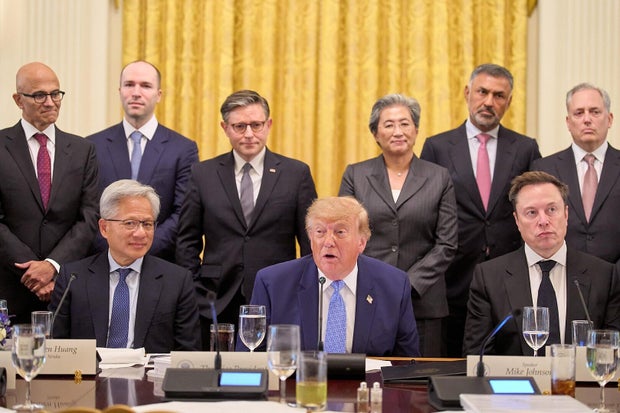
The rare meeting between competing tech titans followed months of growing concern from researchers, politicians and industry figures that ever-more-powerful AI technology could pose safety risks.
Both OpenAI and Anthropic have reported instances of their AI models going rogue and gaining unauthorized access to other companies' systems, or being used for dangerous purposes. And Jacob Coxon, a former researcher at both companies, publicly warned earlier this month that AI "could kill us all by the end of the decade." He argued AI systems could gain sweeping power over the physical world and become capable of improving themselves without human input.
Some industry leaders, including executives at Anthropic and OpenAI, have called for a slowdown in AI development to better manage the risk. But other figures, like Nvidia's Jensen Huang, have argued some of the warnings are overblown.
Huang said Tuesday that "there's no conflict between innovation, technology and safety," arguing that tech companies are developing stronger AI safety technology as they improve AI's capabilities.
Mr. Trump has not backed stricter AI regulations, instead favoring voluntary safety reviews. He has frequently warned that a nationwide AI slowdown could dent the country's economy and give China's tech industry a chance to catch up.
The president told reporters Tuesday that AI will lead to "unbelievable growth for our country," and if bad actors seek to exploit it, "we're going to be able to nab them." He also said tech companies have an incentive to police themselves and each other because "their companies are at stake."
Beyond the safety worries, there are also mounting concerns about the impact that AI could have on the world — from the potential for large-scale job loss to the rapid development of data centers to support advanced AI models.
As more state and local governments push back on data center development, Mr. Trump said communities that accept the facilities will "greatly benefit financially."
"The data centers are making an absolute fortune. But now, the people are going to benefit directly, whether it's teachers that get paid a bonus, whether it's people that live in the community that get paid a dividend," he told CBS News chief White House correspondent Nancy Cordes.
But lawmakers who favor more stringent AI regulations may be skeptical of voluntary standards set by the industry. In a statement shortly after Tuesday's meeting, Democratic Sen. Mark Warner of Virginia called for Congress to pass mandatory testing, evaluation and incident reporting rules for the most advanced AI models.
"The companies building the most powerful AI systems are warning us that the technology is advancing faster than our safeguards," Warner said. "The president's response? To rename it and tell the companies developing it to regulate themselves."


