Live Updates: Iran warns that U.S. military not allowed in Gulf "under any circumstance"
What to know about the Iran war today:
- Iran warned on Saturday that U.S. ships would never be allowed in the Persian Gulf "under any circumstances," as tensions between Tehran and Washington continue mounting. Both sides have signalled a possible return to strikes, with the U.S. ambassador to Turkey warning Iran could be struck as soon as this weekend.
- Director of National Intelligence Jay Clayton warned Friday that Iran has "substantially increased efforts to target U.S. personnel" abroad, with plots to kill Americans reaching "advanced stages" in the Middle East and other countries.
- U.S. Ambassador to the United Nations Mike Waltz has told the Financial Times the war with Iran could last another year, but Waltz said he hopes the Iranians "come to the table" before that.
Iran president admits many struggling for food as war, sanctions take toll
Iranian President Masoud Pezeshkian said Saturday many Iranians were struggling to put food on the table, as economic pressure from the war with the United States mounts.
The U.S. has in recent weeks dialed back military operations in favor of economic pressure, while Iran's leaders have said peace negotiations will only succeed without pressure and threats from Washington as the conflict remains locked in a stalemate.
"There are many people in this society who are struggling to put food on the table because of the war we have found ourselves in, because of the wartime conditions we are living under," Pezeshkian said in a speech shared on his website.
Pezeshkian called for an end to what he described as a "state of neither war nor peace", saying Tehran "must also get out of this situation," without specifying how.
His remarks came as fears of renewed fighting grew. On Friday, U.S. Ambassador to Turkey Tom Barrack said U.S. strikes on Iran could resume as soon as this weekend.
"Could there be a strike this weekend? Absolutely," Barrack told podcast host Mario Nawfal. Barrack, who also serves as Washington's envoy on Syria, does not have a direct role on Iran.
AFP/CBS
Yemen's Houthis claim attack on Aden naval base, military camp
Yemen's Iran-backed Houthis claimed an attack Saturday on a naval base and a military camp in Aden, the interim seat of the internationally recognized government, after blasts were heard there.
"Our armed forces targeted Saudi enemy concentrations at the so-called Al-Nasr camp and the naval base in Aden," Houthi military spokesman Yahya Saree said, adding the sites were overseen by Saudi forces.
The Houthis fighting the Saudi-backed government have targeted the southern city several times in recent weeks, including the presidential palace.
The Houthis said they attacked a Saudi position in Aden on Wednesday, with smoke seen rising near the city's airport.
Last week, two missiles also landed within the perimeter of the airport, with the Houthis claiming the attack.
State Department updates travel advisories for 14 countries in Middle East
The U.S. State Department has updated travel advisories for 14 countries in the Middle East "to reflect the threat of Iranian-supported Houthi regional aggression."
The advisories also follow the public disclosure of a memo from Director of National Intelligence Jay Clayton to Secretary of State Marco Rubio warning of Iranian plots to kill Americans reaching "advanced stages" in the Middle East and elsewhere.
The warnings come as the Trump administration weighs whether to restart military strikes against Iran, and whether to provide air support to Saudi forces confronting the Houthis.
U.S. threats toward Iran "largely for media consumption," IRGC official says
An official with Iran's Revolutionary Guard took a swipe at the U.S. and President Trump's repeated threats, calling them "largely for media consumption" and saying the country is ready if there are renewed hostilities.
"The enemy itself knows better than anyone that it cannot carry out effective operations under current conditions and will certainly fail to achieve its objectives," IRGC spokesperson Brig. Gen. Hossein Mohebbi told semi-official Fars news agency on Saturday.
Mr. Trump has said any possible strikes on Iran will wait until after the U.S. midterm elections on Nov. 3, but he has repeatedly said he could end the war with Iran any time he wants through renewed military action.
Mohebbi said Iran will be ready if the U.S. does return to military strikes.
"Even if the enemy undertakes limited action, Iran's response will be several times greater, given the existing state of readiness and the operational plans of the armed forces," he said.
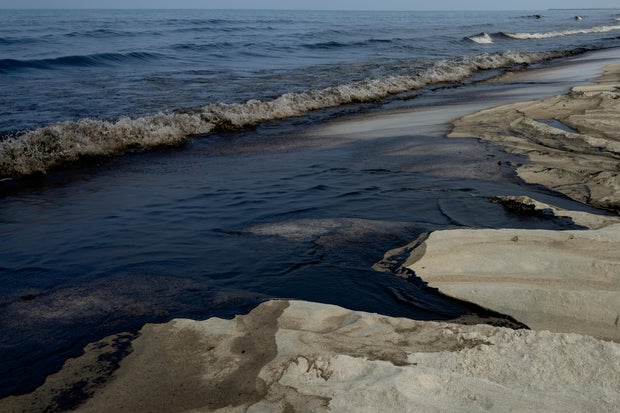
UAE closes beaches after oil spill from tanker
The United Arab Emirates has closed beaches and warned fishermen to avoid parts of its Gulf shores after an oil spill from a tanker.
The spill impacted the beaches of Umm Al Quwain, one of the seven emirates making up the federation, and cleanup efforts were underway, the Climate Change and Environment Ministry said. Images obtained by AP showed oil washing up along the beach in Umm Al Quwain.
The ministry said the spill poses no health risks but did not provide details about the scale of the leak.
The spill came two weeks after Iran's state-run broadcaster reported an oil tanker had struck a naval mine and caught fire while attempting to transit through the Strait of Hormuz without coordinating with Iran.
Airstrikes kill 9 people in Yemen, including women and children, Houthis say
Two days of strikes on Yemen have killed nine people including women and children, according to the Iranian-backed Houthi rebels.
Two separate strikes killed five people, including a woman and child, in the Yemeni capital of Sanaa on Saturday, according to the Houthi-run Health Ministry.
Also Saturday, the Houthi media center said a wave of strikes struck the coastal city of Mokha in Taiz province, which the Houthis captured in early September. The center didn't provide details on what was struck and The Associated Press couldn't independently verify the Houthi claims.
On Friday, an airstrike killed four people — two women and two children — from the same family when it struck a house in the town of Hiba near the city of Taiz, a hotbed of violence in the country's revived civil war.
The Houthis blamed Saudi Arabia for the strikes, which came as fighting between the kingdom and the Iranian-backed rebels has escalated. Saudi Arabia did not respond to a request for comment.
Saudi forces intercept Houthi missiles targeting oil hub Yanbu, Taif
The Saudi-led coalition fighting in Yemen announced on Saturday it had intercepted two missiles fired by the Houthis toward Taif and Yanbu, in the kingdom's west.
It came shortly after Riyadh's civil defence agency broadcast warnings of "potential danger" for four western regions, including Taif and Yanbu as well Mecca, home to Islam's holiest city, and Yanbu.
The alerts were all rescinded minutes later.
Residents were instructed to "proceed to the nearest safe place" by the agency. The agency also repeated a legal warning against sharing images or information related to "countering missiles and drones."
The Gulf kingdom has come under repeated attack from Yemen's Iran-backed Houthis in recent weeks as part of the latter country's revived civil war.
Yanbu is a major oil export hub on the Red Sea coast that has allowed Riyadh to bypass Iran's blockade of the Strait of Hormuz for much of its crude exports.
Iran warns U.S. ships would never be allowed in the Gulf
Iran said on Saturday that U.S. ships would never be allowed to enter the Gulf "under any circumstances" and President Trump will "take that dream to his grave".
The remarks came amid mounting US and Israeli threats of renewed attacks on Iran, as U.S. ambassador to Turkey Tom Barrack warned that Washington could "absolutely" strike Iran as soon as this weekend.
"We will not allow U.S. military ships in the Persian Gulf under any circumstances and at any time," said Iran's armed forces chief of staff Ali Abdollahi, according to Iranian state television.
"The US president must dream of seeing the armed forces enter the Persian Gulf. He will take that dream to his grave."
CBS/AFP
Iran has "increased efforts to target U.S. personnel," intel chief warns
Director of National Intelligence Jay Clayton warned Friday that Iran has "substantially increased efforts to target U.S. personnel" abroad, with plots to kill Americans reaching "advanced stages" in the Middle East and other countries.
The warning, contained in an unclassified memo that was sent to Secretary of State Marco Rubio and obtained by CBS News, comes as the State Department adjusts staffing at diplomatic posts across the Middle East, and the U.S. military pares back its footprint in the region, amid concerns about direct threats from Iran and threats from the Iranian-backed Houthi movement in Yemen.
"The lethal plotting efforts by the Iranians against U.S. citizens have reached advanced stages in both the Middle East and certain other countries," Clayton wrote.
The memo, which was issued as the Trump administration weighs resuming military strikes against Iran, does not identify specific targets or countries where the alleged plots are underway, or indicate whether attacks may be imminent.
Clayton said the U.S. intelligence community is working to downgrade sensitive intelligence — received through various channels — so it can be shared more broadly with State Department personnel. CIA Director John Ratcliffe was copied on the memo.
U.S. to reduce staffing at 4 embassies in Middle East
The U.S. State Department says it will reduce staffing at four U.S. embassies in the Middle East, not including Saudi Arabia, where nonessential diplomats and family members were ordered to leave earlier this week.
The staffing changes — driven by concerns that Yemen's Iran-backed Houthi militants may escalate rocket, missile and drone attacks around the region — will affect the embassies in Jordan, Lebanon, Qatar and the United Arab Emirates, but do not entail an order to leave, the department said.
The embassies involved are all under what is known as "restricted operations" status that has already reduced the size of their personnel footprints. The embassies will remain open.
On Wednesday, a U.S. official and a senior U.S. military official told CBS News that the U.S. military had been quietly reducing its footprint at posts in the Middle East due to ongoing regional threats from the Houthis and direct threats from Iran.
CBS/AP
Iranian president to meet with Putin next week in Moscow
Iranian President Masoud Pezeshkian will travel to Moscow next week for talks with Russian President Vladimir Putin, Iranian Foreign Minister Abbas Araghchi said, according to a report by Reuters.
It hasn't been long since Pezeshkian spoke to Putin in person, but this will be the first meeting between the two in Russia during the ongoing war.
The two leaders met with each other on the sidelines of the Caspian Environmental Summit in Turkmenistan on Oct. 8. The two also met at a summit in Kyrgyzstan in September.
Russian Foreign Minister Sergey Lavrov visited Tehran earlier this week as the two sides continue to strengthen relations. Araghchi said Russia and Iran were closer than ever, despite President Trump saying Russia was doing little to help Iran a day prior.
U.N. sounds alarm on besieged Yemen city of Taiz
Time is running out to get aid into Taiz, besieged by pro-Iran Houthi fighters who are preventing supplies from reaching Yemen's third-largest city, the United Nations said Friday.
Houthi fighters have encircled Taiz since early October, blocking the road that links it to Aden, interim capital of the Saudi-backed, internationally recognized government.
"Safe, sustained and unimpeded humanitarian access is urgently needed so that essential supplies and life-saving assistance can reach people in need," said the U.N. humanitarian agency OCHA.
"It's 20 days and counting since Taiz has been cut off," said OCHA spokesman Jens Laerke.
"We are seeing increasingly that the fighting makes it impossible for us to get in and impossible for people to get out," he told a press conference in Geneva.
Laerke said the dwindling water supply was a growing concern, as most residents depended on water brought in by trucks.
"With the roads closed and the diesel to run the trucks very scarce, water production in the city has fallen by about half," he said.
U.S. envoy leaves open possibility of striking Iran this weekend, despite Trump's prior midterm promise
A U.S. official left open the door for the possibility of a strike on Iran this weekend, despite President Trump previously saying there would be none before the midterm elections in less than two weeks.
"Could there be a strike this weekend? Absolutely," Tom Barrack, the U.S. ambassador to Turkey and point man on Syria, who does not have a direct role on Iran policy, told Israeli army radio in response to a question.
"(President Trump) is very clear. He's open and available and accessible to a deal and we've been at the table for months and months and months," Barrack said.
Israeli Prime Minister Benjamin Netanyahu, who faces elections Tuesday, in recent days has repeatedly vowed to topple the clerical state in Iran, following two major bombing campaigns against Iran since last year.
Mr. Trump has also signaled an openness to resuming strikes on Iran after a long deadlock in diplomacy although he earlier said it would not happen before midterm elections on Nov. 3.
Earlier Friday, Mr. Trump repeated a common refrain that the U.S. could choose to end the war anytime it wants through a renewed military campaign, but could also let the country "wither" under sanctions.
AFP/CBS
European, Mideast foreign ministers push peace and diplomacy at Istanbul talks
Foreign ministers from eight European and Middle Eastern countries met in Istanbul on Friday in an unprecedented format, urging diplomacy and peaceful solutions to prevail across the Middle East as well as the reopening of the Strait of Hormuz.
Ministers from Britain, France, Germany and Italy met counterparts from Turkey, Saudi Arabia, Pakistan and Egypt to discuss Hormuz — a crucial trade route blocked in the Iran war — as well as Yemen and ways to end the Russia-Ukraine conflict.
At the heart of the talks was the situation in the Straits of Hormuz and Bab el-Mandeb, which is paralyzing global trade and driving up energy prices as well as the attacks on Saudi Arabia by Houthis from Yemen, allies of Tehran.
French Foreign Minister Jean-Noel Barrot said a new escalation between Iran and the United States "would create nothing but losers and would undoubtedly have very serious consequences for hydrocarbon prices."
"The first thing this group of eight countries ... will do is call on both sides to exercise the utmost restraint, because we cannot afford another escalation in the region," he told journalists.
Italy's Antonio Tajani said the regional problem cannot be solved "from a purely military standpoint."
Wall Street mostly loses ground under pressure from rising oil prices
Stocks slipped Friday on Wall Street under increasing pressure from rising oil prices.
The S&P 500 fell 0.2%, adding to its decline from a day before. The index is on track for a second-straight week of losses. The Dow Jones Industrial Average fell 550 points, or just over 1%, as of 11:50 a.m. Eastern time.
The Nasdaq composite rose 0.2%, bolstered by gains for several big tech stocks that also helped ease losses elsewhere.
Rising oil prices weighed heavily on the broader market, where three out of every four stocks within the benchmark S&P 500 index fell. The price for a barrel of Brent crude oil rose 3.5% to over $117. It has surged from less than $97 at the start of October and is now at its highest level since March.
Trump says U.S. could take all of Iran's oil: "We could take the whole country"
President Trump delivered a familiar message on Iran as he left the White House for a trip to rally voters in Florida, but also added the U.S. could take all of Iran's oil if we wanted to.
"Iran is not able to do much now. And we could, if we wanted to, just take all of the oil," Mr. Trump said. "We could take the whole country."
"And as you know, the Hormuz Strait is ours, and that's the way we'll keep it," the president added.
Mr. Trump was also asked about U.S. Ambassador to the United Nations Mike Waltz saying the war with Iran could drag on for another year, while the president has said for months the war will end "very soon."
"We could end it very quickly," Mr. Trump said. "But Iran is a failing nation. We're taking all the oil out that we want."
"The question is, 'Do we want to finish it off or do we just want to let it wither?' Because we're getting everything we wanted," he said.
Tanker involved in UAE oil spill identified, analysts say
The tanker involved in an oil spill off the coast of the United Arab Emirates has been identified, according to analysts who spoke to the Reuters new agency.
Emirati authorities have not named the vessel, but Martin Kelly, CEO of Orbital Risk Intelligence, told Reuters the oil slick was coming from a vessel called the Gem No. 2.
Another analyst told the news agency that satellite imagery appears to show a large spill coming from the tanker.
"The slick is considerably larger, covering approximately 160 square km (60 square miles), and looks to be coming from the ship," Leon Moreland, a researcher at the Conflict and Environment Observatory, said.
"Furthermore, a slick this close to shore increases the chance it could impact nearby beaches and ecologically sensitive habitats," he said.
The Gem No. 2 was hit by an unidentified projectile 13 nautical miles west of Al Jazeera in the UAE on Oct. 9, shipping sources told Reuters.
No group claimed responsibility for the incident at the time, but maritime security sources told the news agency that it took place outside of the Strait of Hormuz.
Further escalation between Iran and the U.S. "would leave no winners," French foreign minister says
Any further escalation between Iran and the U.S. "would leave no winners," France's foreign minister said Friday.
Speaking to reporters in Istanbul after a meeting with foreign ministers from the U.K., Germany, Turkey, Egypt, Pakistan and Saudi Arabia, Jean-Noel Barrot said that "a further escalation between Iran and the United States would leave no winners and would likely have very serious consequences for hydrocarbon prices," according to remarks reported by the Reuters news agency.
UAE resident describes smelling gas after oil tanker spill
Residents in the north of the United Arab Emirates have described smelling gas after an oil spill off the country's coastline.
Many Emiratis have reported chemical smells on social media in recent days, including residents in northern districts of Dubai, the largest city in the UAE.
"For the past two days it smelled like 10 gas stations spilled their gas everywhere," a Sharjah resident told the AFP news agency, asking to remain anonymous.
"I was on my balcony and panicked thinking gas was leaking in my house and I will blow up everyone."
Emirati authorities "detected a tanker oil spill affecting Umm Al Quwain's beaches," the Ministry of Climate Change and Environment said in a statement Friday, referring to an emirate north of Dubai.
News of the spill came a day after Iran claimed to have struck four commercial vessels in Persian Gulf waters and said three others had hit sea mines in the region, though President Trump has accused Tehran of making up the incidents to drive up oil prices.
CBS/AFP
Iranian state TV claims movement of "non-compliant" vessels in Strait of Hormuz completely halted
Iranian state TV claimed Friday, citing an unnamed source close to the Islamic Revolutionary Guard Corps (IRGC) Navy, that all movement of "non-compliant" vessels through the Strait of Hormuz had been completely halted following a series of Iranian attacks on ships and navigational support systems.
The report cited the source as saying that if U.S. military escorts and ship-to-ship transfers - all of which the Iranian regime refers to as "oil smuggling" - resumes, action against the vessels and technical systems supporting them will be "much more forceful."
Iran has repeatedly warned commercial ships not to use the long-established shipping lanes through the strait, through which about 20% of global oil supplies passed before the war. Tehran demands that all vessels seek authorization and use a northern route, close to its coast, and it has attacked ships for months that refuse.
The Trump administration, however, has encouraged shippers to use an alternative southern route, close to Oman, to avoid Iranian tolls.
Iran claimed Thursday to have struck four ships that used that route, and said three others hit sea mines in the U.S.-designated shipping lanes.
President Trump on Thursday dismissed Iranian claims about striking vessels as lies aimed at increasing global oil prices ahead of the looming U.S. midterm elections.
Both Iran and the U.S. have claimed at various times during the war to have completely halted traffic that violates their respective blockades of the waterway.
Iran's foreign minister calls Israel's relationship with the U.S. "parasitic"
Iran's foreign minister has called Israel's relationship with the United States "parasitic," citing alleged American taxpayer funding for missile defense in Israel.
"The U.S. has over the past three years spent $11 BILLION in taxpayer money on missile defense for Israel," Abbas Araghchi wrote Friday in a post on X, citing calculations by independent policy analyst Stephen Semler, who said he arrived at the number using Pentagon budget documents, media reports, and open-source intelligence.
CBS News has not been able to independently verify the figures.
Semler is the founder of the Security Policy Reform Institute, a think tank that, according to its website, is "driven by empiricism and guided by progressive values" to promote "the meaningful reform of U.S. foreign policy to break the cycle of endless war and serve the most pressing economic, social, and political needs of working-class Americans."
Araghchi also said the U.S. had "fired more interceptors defending Israel than Israel has," a claim supported by a Washington Post story from May that cited U.S. Defense Department data and U.S. officials.
"That is not a symbiotic relationship," Araghchi said. "It is a parasitic one."
UAE reports oil spill from tanker
The United Arab Emirates reported an oil spill from a tanker off its coast Friday, a day after Iran claimed to have struck four commercial vessels in Persian Gulf waters and said three others had hit sea mines in the region.
Emirati authorities "detected a tanker oil spill affecting Umm Al Quwain's beaches," the Ministry of Climate Change and Environment said in a statement, referring to an emirate north of Dubai.
It said "teams immediately began containment, cordoning, clean-up and remediation ... to limit environmental impacts," adding that Umm Al Quwain beaches had been closed.
Many residents in the north of the UAE have reported oil smells on social media in recent days, including residents in northern districts of Dubai.
Frequent attacks on ships have been reported in recent weeks near the Strait of Hormuz, the vital waterway at the heart of the conflict between Iran and the United States.
The British maritime security UKMTO reported on Oct. 9 that a vessel was hit by a projectile off the UAE coast, causing a fire that was later brought under control. According to the maritime security company Vanguard, the vessel in question was the Panama-flagged oil tanker GEM NO.2.
Iran's Revolutionary Guard Corps claimed the seven additional incidents on Thursday, but none have been corroborated thus far, and President Trump accused Tehran of inventing strikes on ships to drive up oil prices.
CBS/AFP
Saudi Arabia postpones U.N. summit in Riyadh amid Houthi strikes
Saudi Arabia has postponed the sixth U.N. World Data Forum and the second Saudi Statistical Forum, which had been scheduled to take place in Riyadh next month, until 2027.
The kingdom's General Authority for Statistics said the delay was intended to ensure broad international participation.
It comes after the recent rescheduling of Saudi Arabia's Future Investment Initiative, known as "Davos in the Desert," which was also pushed back to 2027 amid escalating regional tension and deadly Houthi attacks on the kingdom.
U.S. ambassador to the U.N. says Iran war could last another year
U.S. Ambassador to the United Nations Mike Waltz has said the war with Iran could drag on for another year.
In an interview with the Financial Times published Friday, Waltz said the U.S. could still be fighting the war President Trump initially said would last "four to five weeks" 12 months from now.
Waltz told the FT the U.S. will not have achieved its key goals in Iran until the country disposes of its highly enriched uranium and accepts a "meaningful agreement on their domestic enrichment."
"I'm not going to put out hypotheticals. One would hope that they'll come to the table in a meaningful way before that," Waltz said, referring to the possibility of another year of war.
He added that Mr. Trump "and the U.S. Navy can maintain this blockade [on Iranian ports] for the foreseeable future," and said the administration was still "tightening" its economic pressure campaign against Iran.
Mr. Trump and Israeli Prime Minister Benjamin Netanyahu have renewed their threats to launch new strikes on Iran after the U.S. midterm elections on Nov. 3.
Foreign ministers from Europe and Gulf region to discuss Strait of Hormuz and Iran conflict
Foreign ministers from seven nations in Europe, the Middle East and elsewhere will hold talks in Istanbul Friday focused on the Strait of Hormuz and the interlinked crises in the Middle East, as well as the Ukraine war.
Ministers from the so-called E3 group – Britain, France and Germany – will meet counterparts from the newly created R4 group, composed of Turkey, Saudi Arabia, Pakistan and Egypt, to discuss the Israel-Palestinian crisis, developments in Yemen and the Strait of Hormuz, and ways to end the Russia-Ukraine war, a Turkish foreign ministry source told AFP.
British Foreign Minister Ed Miliband's office said the talks would revolve around "the Strait of Hormuz and the situation in Saudi Arabia," as the Saudis back Yemen's beleaguered government in its decade-long civil war, which has flared up amid the U.S. war on Iran.
"Despite positive progress from the U.S. and regional partners, passage through the Strait remains under threat, with traffic through the waterway sharply down on pre-war levels," a U.K. foreign ministry statement said.
It said Miliband would "advocate for a diplomatic solution to the crisis that restores full navigational rights and freedoms" and stress "how Iranian tactics are being replicated across the region, with attacks on Saudi Arabia further destabilizing the region and increasing pressure on vital waterways and global chokepoints, such as Bab el-Mandeb and the Suez Canal."
"The U.K. is stepping up to help stabilize the region, having this week committed RAF Typhoons to defend Saudi Arabia from Houthi attacks in their airspace," it added.
CBS/AFP
Saudi Aramco says volume bypassing Strait of Hormuz via pipeline has surged
The president of Saudi state-owned oil company Saudi Aramco, whose facilities have been targeted by Yemen's Iran-backed Houthi militants repeatedly for weeks, says the amount of oil moving through a pipeline that bypasses the Strait of Hormuz has more than tripled.
The East-West pipeline's capacity has surged from 2 million to 7 million barrels each day, President and CEO Amin Nasser said in an interview with Saudi-owned television Al Arabiya Business.
Built in the early 1980s, the pipeline has played a crucial role in Saudi Arabia's ability to export oil amid disruption to shipping via the Strait of Hormuz during the Iran war. It carries crude from Saudi oil fields and production facilities in the east, on the Persian Gulf, to the Yanbu oil terminal on the Saudi Red Sea coast on the other side of the vast kingdom, from which it can be shipped to global markets.
That route, which, unlike the Gulf, has two available exits, has also been threatened and attacked by the Houthis, who have vowed to stop Saudi shipments via the Red Sea's southern gateway, the Bab el-Mandeb Strait.
Nasser said Saudi Aramco has used drones to assess damage caused to infrastructure, including sites key to the East-West pipeline, by Houthi attacks, and to help with firefighting.
CBS/AP
Trump accuses Iran of lying about strikes on ships to drive up oil prices
As crude oil prices hit their highest levels since May, President Trump accused Iran on Thursday of lying about attacks on tankers in the Strait of Hormuz to drive up global energy prices.
"Iran is doing everything they can to drive up the price of Oil prior to the U.S. Midterm Election," Mr. Trump wrote on Truth Social. "They are even making up fake hits, mines, and everything else, because more Oil is coming through the Hormuz Strait now than it did even prior to the beginning of the Conflict."
Brent crude, the international standard for oil, hit $112 a barrel Thursday morning, its highest price since May 18.
Iran claimed to have struck four vessels in the Persian Gulf Thursday after they transited the Strait of Hormuz using a U.S.-endorsed route that Tehran rejects, and it said three others hit sea mines in the region after using the same shipping lanes. All of the ships were damaged along or after using southern shipping lanes in the strait near the Omani coast, which the Trump administration has insisted for weeks is open to traffic.
The U.S. military has escorted tankers out of the Persian Gulf using that route, boosting the quantity of oil leaving the region, but it is a costly process. Overall instability in the Middle East has kept energy prices high despite the recently increased supplies.