Women and the Vision Thing
The Idea in Brief
Women are still a minority in the top ranks of business. The reason? Their perceived lack of vision, according to Ibarra and Obodaru. In 360-degree feedback, women score relatively low on key elements of visioning — including ability to sense opportunities and threats, to set strategic direction, and to inspire constituents.
The authors' research suggests three explanations for women's low visioning scores:
- Some women don't buy into the value of being visionary.
- Some women lack the confidence to go out on a limb with an untested vision.
- Some women who develop a vision in collaboration with their teams don't get credit for having created one.
Regardless of the cause, women seeking more senior roles must be perceived as visionary leaders. They can start by understanding what "being visionary" means in practical terms — and then honing their visioning skills.
The Idea in Practice
What "Being Visionary" Means
Being visionary is a matter of exercising three skills well:
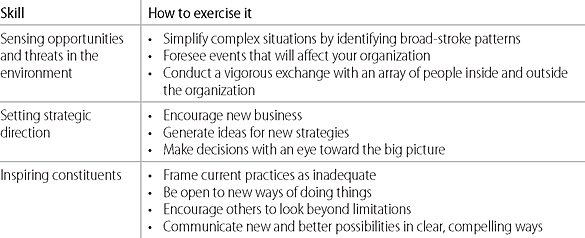
How to Strengthen Your Visioning Skills
-
Appreciate the importance of visioning. Recognize vision as a matter of not just style but substance. It's not about meaningless vision statements but about strategic acumen and positioning your know-how.
- Leverage (or build) your network. Formulating a vision demands a solid grasp of what's happening outside your group and organization. A good external network is the first line of defense against the insular thinking that can hurt your visioning ability.
- Learn the craft. Much of visioning can be learned the old-fashioned way: at the elbow of a master. Find role models and study how they develop and communicate strategic ideas. Then work with a coach to identify training and tools to build your capabilities.
- Let go of old roles. When you're very good at a needed task, the whole organization will conspire to keep you at it. For instance, even if delivering on the details has always been your ticket to advancement, it won't help you with visioning. Resist the urge to stay in the weeds.
- Constantly communicate. As you develop a vision, find opportunities to articulate it. Don't wait until it's perfect. Try out draft versions along the way, even after the vision has come into sharp focus. You won't be seen as a visionary unless you get the word out.
- Step up to the plate. A vision comes not only from the outside but also from greater self-confidence. Believe in your ability, and assume responsibility for creating a new and better future for others in your organization.
- Purchase the full-length Harvard Business Review article here.
- Visit Harvard Business Online.
- See more on Leadership and Managing People at Harvard Business Online.
Further Reading
Articles
Building Your Company's Vision
Harvard Business Review
February 2000
by James C. Collins and Jerry I. Porras
Companies that enjoy enduring success have a core purpose and core values that remain fixed while their strategies and practices endlessly adapt to a changing world. The rare ability to balance continuity and change — requiring a consciously practiced discipline — is closely linked to the ability to develop a vision. Vision provides guidance about what to preserve and what to change. A new prescriptive framework adds clarity and rigor to the vague and fuzzy vision concepts at large today. Managers who master a discovery process to identify core ideology can link their vision statements to the fundamental dynamic that motivates truly visionary companies — that is, the dynamic of preserving the core and stimulating progress.
Power of Talk: Who Gets Heard and Why
Harvard Business Review
September 1995
by Deborah Tannen
Most managerial work happens through talk — discussions, meetings, presentations, negotiations. And it is through talk that managers evaluate others and are themselves judged. Using research carried out in a variety of workplace settings, linguist Deborah Tannen demonstrates how conversational style often overrides what we say, affecting who gets heard, who gets credit, and what gets done. Tannen's linguistic perspective provides managers with insight into why there is so much poor communication. Gender plays an important role. Tannen traces the ways in which women's styles can undermine them in the workplace, making them seem less competent, confident, and self-assured than they are. She analyzes the underlying social dynamic created through talk in common workplace interactions. She argues that a better understanding of linguistic style will make managers better listeners and more effective communicators, allowing them to develop more flexible approaches to a full range of managerial activities.
Copyright (c) 2008 Harvard Business School Publishing Corporation. All rights reserved.