U.K. and Israel appear to reach tense truce, but diplomatic feud highlights Israel's strained ties with Europe

London and Tel Aviv — The U.K. and Israel appeared Thursday to have narrowly avoided a major diplomatic confrontation, reaching a compromise to allow Britain's nearly 200-year-old consulate in east Jerusalem to remain open, but under a new name and with a significantly reduced staff.
Israel had threatened to shut the facility down completely in a dispute over British sanctions barring the import of goods from Israeli settlements in the occupied West Bank.
The agreement — which has been framed very differently by London and Tel Aviv — may prevent the tension between the two longstanding allies from escalating, but it has highlighted how strained ties have become between Israel and several European governments over Israel's ongoing actions in the Palestinian territories.
Israeli Foreign Minister Gideon Saar said talks with the U.K. had taken place "with the aim of preventing further deterioration in relations," following weeks of escalating tension.
The dispute began in September when London announced sanctions — along with 11 other Western nations — targeting Israeli settlements in the West Bank. The measures include a ban on goods produced in the settlements and sanctions against companies and individuals involved in facilitating settlement expansion.
British Foreign Secretary Ed Miliband described the measures as the "beginning of a new approach" to the Israeli-Palestinian conflict.
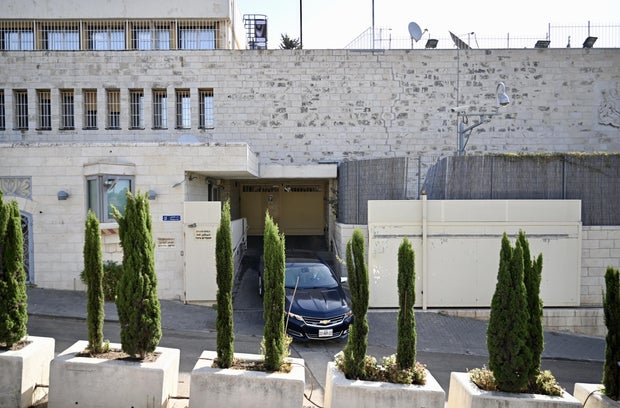
Israel retaliated by giving Britain 30 days to close its east Jerusalem consulate. The facility has been operating since 1839, when Jerusalem was still part of the Ottoman Empire, predating the founding of Israel by more than a century. The consulate has historically operated independently of the U.K. Embassy in Tel Aviv, as Britain's principal diplomatic link with Palestinian officials in east Jerusalem, the West Bank and the Gaza Strip.
On Thursday, both governments sought to claim the diplomatic high ground.
Saar, in his statement, presented the agreement as a demonstration of Israel's willingness to respond to measures taken against it.
"It is not possible to act against Israel without Israel taking appropriate measures in response," he wrote. "We did not want to reach this point, but the actions of the UK Labour Government brought us here."
Saar insisted Israel had followed through on its September vow to retaliate for the sanctions, including by lifting the U.K. consulate's previous diplomatic status.
Under the new arrangement, Britain's consul general and 19 diplomats will leave Israel, while no more than seven diplomats will remain at the renamed mission, according to Saar.
Israeli officials have not said explicitly whether the remaining diplomats at the mission would retain their accreditation and diplomatic immunity, but Britain's top diplomat Miliband said in his statement that, "without an understanding, we would not have the necessary assurances for the security and protections of our staff and premises," indicating that those protections were likely part of the negotiations.
Miliband also said in his statement that the U.K. did "not accept that the Government of Israel has the legal right to close the British Consulate General in Jerusalem," reaffirming Britain's longstanding position that "East Jerusalem is occupied territory."
Miliband said the newly renamed U.K. Mission would remain independent and operational, continuing to work with Palestinians. He also pledged to rebuild Britain's diplomatic presence in the coming months and ruled out any retaliatory measures — as long as "credible" discussions with Israel continue.
Both sides appeared to have moderated their responses because their bilateral security and business ties are too important to risk, Israeli political scientist Jonathan Rynhold told CBS News on Thursday.
The U.K. is an important economic market, and it punches above its weight diplomatically on the global stage, said Rynhold, a senior researcher with the Begin-Sadat Center at Israel's Bar Ilan University.
"They found something to do without blowing the whole relationship up," Rynhold said of the compromise.
Israel regards Jerusalem as its capital, while Britain and much of the international community do not recognize Israeli sovereignty over east Jerusalem, which Israel captured from Jordan in the 1967 Six-Day War and subsequently annexed.
The dispute comes amid a broader deterioration in Israel's relations with several European governments.
Spain has withdrawn its ambassador from Israel and imposed an embargo on arms sales to the Jewish state, while France formally recognized Palestinian statehood last year, drawing rebukes from the U.S. and Israel. Israel has also clashed with Ireland and Norway over their recognition of a state of Palestine.
The other nations that joined the U.K. in September in announcing sanctions or plans to impose sanctions targeting West Bank settlements were Canada, Denmark, Finland, France, Iceland, Ireland, Norway, Poland, Portugal, Spain, Sweden.