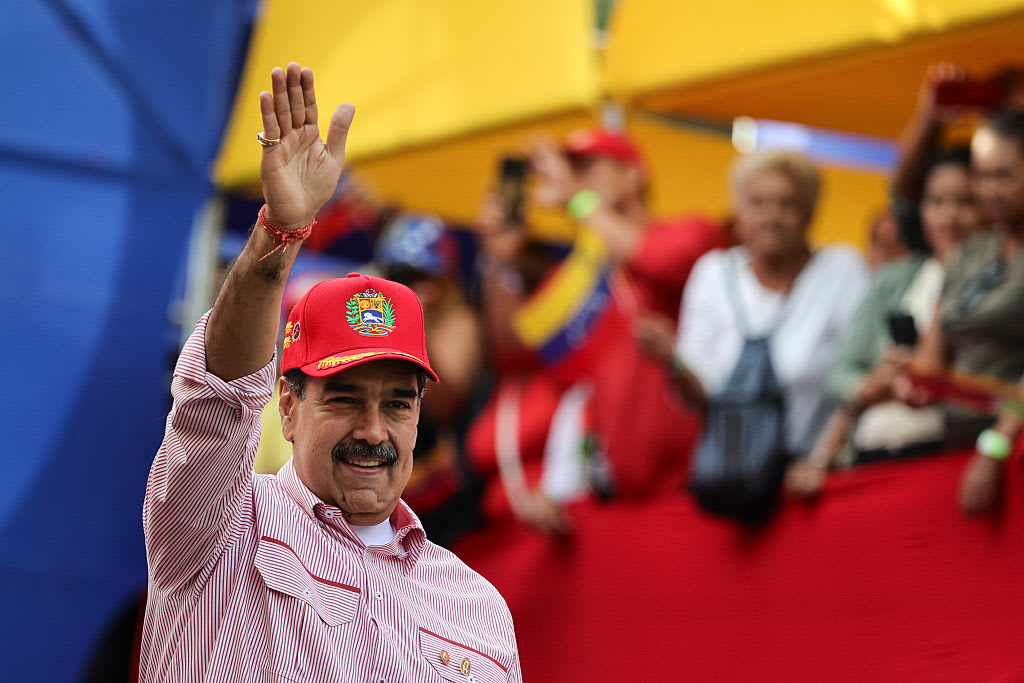
U.S. allows Mexico to provide oil to Cuba despite Trump's vow to cut off supply

Despite President Trump's social media pronouncement Sunday that "there will be no more oil or money going to Cuba — zero," the current U.S. policy is to allow Mexico to continue to provide oil to the island, according to Energy Secretary Chris Wright and another U.S. official.
Cuba desperately needs the oil, since Venezuela is no longer supplying it, after Nicolás Maduro's ouster just over a week ago.
Mr. Trump spoke with Mexican President Claudia Sheinbaum Monday morning. The White House and Mexican government have not yet said whether Mexico's oil supply to Cuba was discussed.
Mexico, which was providing some oil to Cuba before Maduro's capture by the U.S., has become an especially key fuel supplier to the island since the Venezuelan leader's arrest, which was accompanied by the U.S. interception of vessels carrying oil to Cuba. Sheinbaum has referred to oil as "humanitarian aid."
The U.S. does not seek to trigger a collapse of the Cuban government, but rather seeks to negotiate with Havana to transition away from its authoritarian communist system, according to a U.S. official. Mr. Trump's post Sunday morning threatened Cuba, advising the island to make a deal "before it is too late." It was not immediately clear what kind of deal Mr. Trump is seeking from Cuba or who would lead them. A little later, he reshared a post predicting Secretary of State Marco Rubio would be the next president of Cuba. "Sounds good to me," Mr. Trump commented.
The Cuban regime had a series of defiant responses to Mr. Trump's social media threats.
"As history demonstrates, relations between the U.S. and Cuba, in order to advance, must be based on International Law rather than on hostility, threats, and economic coercion," Cuban President Miguel Díaz-Canel Bermúdez said on X Monday.
He also denied any current talks were underway.
"There are no conversations with the U.S. government, except for technical contacts in the migration field," Díaz-Canel said in another X post.
The U.S. assesses that a total cutoff or embargo of Cuba would be a shock to Havana's already overtaxed and decrepit electrical grid, which has been suffering from rolling blackouts. Cuba's economic condition is dire — a U.S. official confirmed to CBS News that the regime has been so cash strapped that its leaders were reselling some Venezuelan oil to China, the New York Times first reported. This was exacerbating the ongoing energy shortage on the island even before Maduro's arrest.
That economic strain on Havana intensified, now that it has lost virtually all its patrons, and Russia has been tied up in Ukraine.
The regime was intricately tied to Venezuela: It recently acknowledged the deaths of at least 32 Cubans who were protecting Maduro and were killed in the U.S. raid to capture him. Until now, Cuban officials have denied that its intel and security forces provided personal protection to Maduro, even protecting him from his own people as part of the oil-for-security arrangement between the two governments.
The regime in Havana is under intense strain but has had tremendous staying power to date. That appears to be behind the CIA's mixed assessment of its stability.
In October, the U.S. offered humanitarian aid to Cuba, which would be delivered by local partners, rather than through the government. Cuban and U.S. officials told CBS News it still has not yet arrived.