100 years later, the mystery of Houdini's death endures

Harry Houdini, the greatest escape artist who ever lived, has been the subject of hundreds of books and movies. A pop icon, even today. He died 100 years ago this week, on Halloween – a coincidence that did nothing to diminish his mystique. But we'll get to that.
Erik Weisz was born in Hungary, in 1874. When he was four, the family moved to Wisconsin. As a teenager, he performed magic tricks in sideshows and beer halls. "He was a skinny kid, and he built himself up," said New Yorker staff writer David Denby. "He became this beautiful, incredible body, and he was a handsome man."

But according to Denby, he wanted a catchier name. He turned to his idol, Houdin, the great French magician of the 19th century: "So, he took the name Houdin and added an i and pronounced it as Houdini. But the name always sounded funny. It's vaguely Italian, but it's not. What is it?"
Houdini historian Roger Dreyer owns one of the world's largest collections of Houdini artifacts, such as the Metamorphosis Trunk. He says Houdini's magic tricks didn't exactly bring the house down. "If he was to perform it today, he wouldn't even make it past the second round on 'America's Got Talent,'" Dreyer said. "It wasn't until his Metamorphosis Trunk that Houdini really became bookable; theaters wanted to see his act. People today, over 100 years after Houdini's death, still perform this exact same trick."
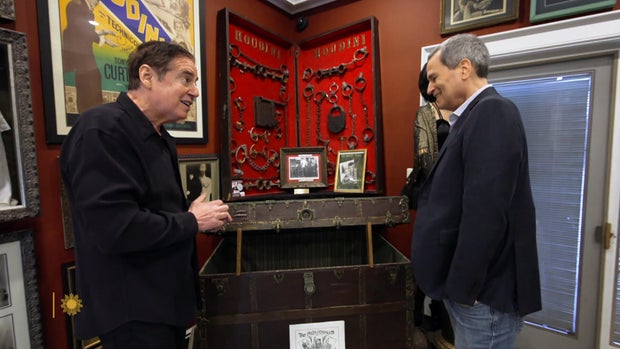
After being locked in a trunk, Houdini switched places with his new wife, Bess, instantly. But once he added handcuff escapes to his show, Houdini became a sensation. Denby said, "He would be put in a cell, virtually naked, shackled. He'd come out 20 minutes later holding the handcuffs. The specialists were called out of their corners to produce the most complicated locks for him. He'd lick it every time. There's no record of his failure."
Denby says there was symbolism in his escapes: "He would defeat those police forces all over the world. And so, there was definitely a kind of anti-authoritarian message that people liked."
In time, the act was more than escaping shackles. It became about escaping death. "He always reinvented himself," Dreyer said. "Initially, he got out of a trunk. Then Houdini got out of a straitjacket. Then Houdini would get out of a straitjacket hanging from a crane. Then Houdini would go inside a live jumbo water tank upside down."
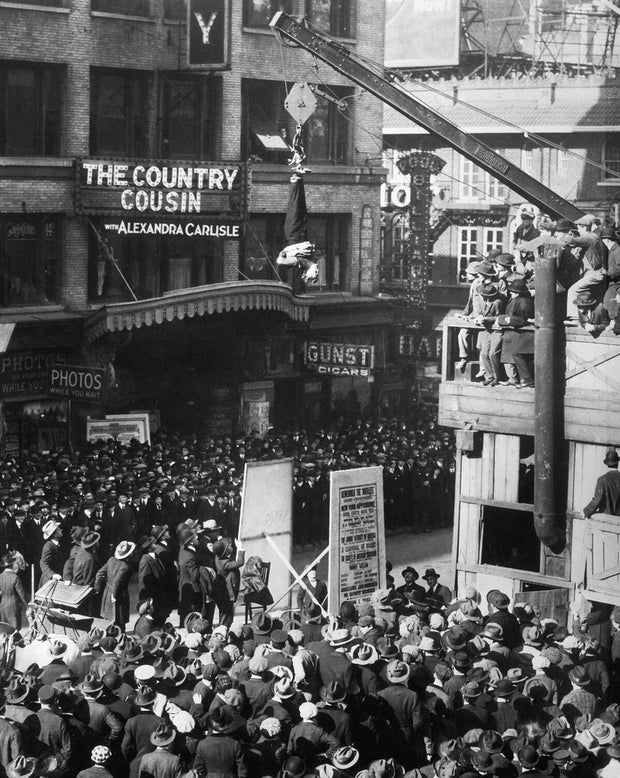
Denby said, "Curtain closed, one minute, two minutes … was he drowning? What happened to him? They'd finally open the curtain, and he'd come out and his eyes would be all bloodshot and he would be gasping. He had to risk death."
In 1904, at age 30, Houdini bought a townhouse in Harlem. He moved in with Bess, his mother, and his brother. Today, Vincent Toms lives in that house. He even gives tours. "People, when they come to the house, you know, this is Graceland for them, for all intents and purposes," he said.

After World War I, a new industry sprang up: fake spiritualist mediums. Dreyer said, "Ninety percent of the people that were attending séances back then were women trying to contact their loved ones that might have died in World War I."
In the final act of his life, Houdini became a debunker of fake mediums, exposing the tricks they used once the lights were out.
By the mid-1920s, Houdini was the man who cheated death. But that was one escape he couldn't perform forever. He died at age 52. But how he died is yet another mystery.
The usual account involves college kids visiting him backstage. Dreyer said, "One of them asked Houdini, 'Is it true that you can withstand a blow to your stomach?' Houdini said, 'Yes.' And before Houdini could brace himself, that gentleman threw not one, but a series of punches."
But most experts believe that the punches didn't act alone. Houdini had a precondition of appendicitis. "And the punches in the stomach might have aggravated it," said Dreyer.
But a new book, "Houdini: The Man Who Died Twice" by surgeon and medical researcher Larrian Gillespie, documents a very different telling of the story.

"There's something very wrong with this death certificate," Gillespie said. "I see numbers were copied and then rewritten over. This was a cover-up."
She says that ultimately what killed him was an intestinal blockage and an unreported last-minute surgery. Houdini's team favored the stomach-punch story, in part to get a bigger insurance payment. "Houdini had a double indemnity policy," said Gillespie. "The first policy would pay for his death, but if he died from an accident, it paid an additional – in today's money – $500,000."
According to documents Gillespie found, there's even doubt about when Houdini died. "I can put forth a very strong case that he died on October 30th and not the 31st," she said. "By moving the date over to the next day, every time Halloween came up, you would remember that Houdini coincidentally died that day."
But Gillespie does not believe this version of events would in any way tarnish Houdini's reputation and legacy: "Oh, not at all. Houdini was gifted, and that will never change."
But whatever the details of his death, Houdini never completely ruled out the possibility of an existence beyond. Vincent Toms said, "He did make a pact with Bess that after he died, he would try to communicate with her, if there was any way possible. And so, for the 10 years after he died, they held a séance in this room every year on the anniversary of his death."
Every Halloween since, Houdini's fans have tried to reach him. Toms will try this weekend, hosting a séance in the house at 1:26 p.m.
So many mysteries. How did Houdini do his escapes? How did he really die? Is there an afterlife? But this much, we know for sure: "If Houdini was around today," said Dreyer, "he still would be a household name, because of what he signified: the idea of hope, escape, the power of possibility, the idea of becoming an immigrant going from poverty to stardom to fortune."
And the fact that this charismatic performer, dead 100 years, is still getting new fans is, to Toms, "just mind-boggling."
Denby describes Houdini as "the ultimate symbol of liberation over death, over imprisonment. What a guy! I mean, an amazing man!"
Story produced by Gabriel Falcon. Editor: Steven Tyler.
For more info:
- "Harry Houdini and the Art of Escape" by David Denby (newyorker.com)
- New Yorker staff writer David Denby
- Historian and collector Roger Dreyer (Houdini Revealed)
- "Houdini: The Man Who Died Twice" by Larrian Gillespie (Cipher House Books), in Trade Paperback and eBook formats, available via Amazon
- Larrian Gillespie