"The Last Great Senate: Courage and Statesmanship in Times of Crisis," by Ira Shapiro
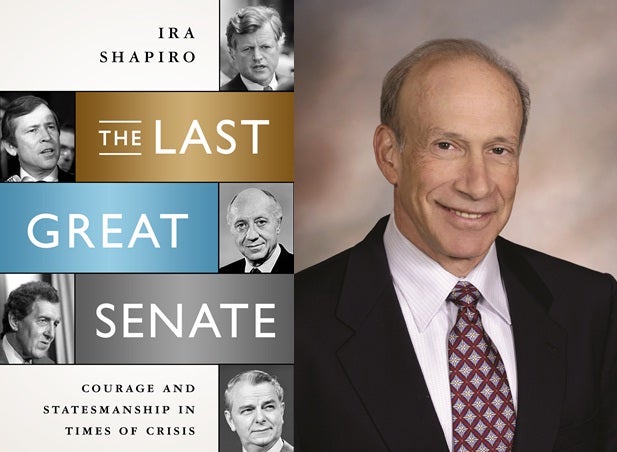
Jeff Glor talks to Ira Shapiro about "The Last Great Senate: Courage and Statesmanship in Times of Crisis"
Jeff Glor: What inspired you to write the book?
Ira Shapiro: The Senate has been an important part of my life for over 40 years, starting with a summer internship with Jacob Javits after I graduated college in 1969. I returned in 1975 to work there for 12 wonderful years. Fast forward to 2008. A group of old friends who had worked together in the Senate 30 years before started having breakfast regularly to discuss the excitement of the presidential campaign. After reviewing the latest developments about Obama, Hillary, McCain and Palin, we would often turn to the Senate: how much we had loved our time there, and how it had become virtually unrecognizable to us----polarized, paralyzed, dysfunctional. After one of the breakfasts, I decided I would try to capture the Senate when it was great. I didn't want the memory of those senators and that Senate to be lost. And I wanted the generation of my children to know that not too long ago, we had a government that worked.
JG: What surprised you the most during the writing process?
IS: How much I loved every aspect of it! I had heard the saying that it's wonderful to have written a book, but an ordeal to write one. That wasn't the case for me; it was truly a joy. My publishers urged me to write narrative history, rather than political science, and that advice proved liberating----it freed me up to "tell the story." I enjoyed the process of absorbing an enormous amount of information from research and interviews, in order to get the big picture in mind, and then making choices about the issues, incidents and personalities that revealed the most about the Senate during the years that the narrative covered. It surprised me that even after I thought I knew a lot, and had written most of the book, I would still get new insights that were valuable. .
JG: What would you be doing if you weren't a writer?
IS: I still have a "day job," practicing international trade law, and I remain deeply interested in global economic and diplomatic issues. I had 17 years in government and politics; I have always regarded public service as my calling, and perhaps the highest calling. I certainly would welcome another opportunity to serve, but there are long odds against that happening. I hope to do more speaking and teaching about politics, government and the global economy. But having finally written my first book, I hope to be a writer for the rest of my life.
JG: What else are you reading right now?
IS: I'm enjoying John Farrell's Clarence Darrow: Attorney for the Damned and Tim Gay's Assignment to Hell, the story of Walter Cronkite and the other leading World War II correspondents. I'm looking forward to starting Robert Caro's latest volume on Lyndon Johnson, Madeleine Albright's Prague Winter, and David Sanger's upcoming book on the foreign policy of the Obama administration. One humbling thing about having written a book is focusing on just how many other wonderful books are out there, competing for readers' attention.
JG: What's Next for You?
IS: I'm a fan of Scott Turow, and always admired the fact that he produces a book every three years. I'm starting much later and with much less talent, but that seems like a good schedule. I get asked regularly whether there can be a "next great Senate," and it's natural to consider another book about the Senate. After that, I hope to tackle other subjects in the realm of American political history, perhaps a biography. One thing is for sure; I don't foresee writing a novel. When reading fiction, I absolutely never come away thinking that I could write it!