Spain's leader says Russia and Israel fueled Ceuta migrant crisis "disinformation"

Spanish Prime Minister Pedro Sánchez has accused networks linked to Russia and Israel of spreading disinformation around the migration crisis in Ceuta, claiming the two countries were exploiting the issue in retaliation for Madrid's position on the war in Ukraine and Israel's actions in the Palestinian Territories.
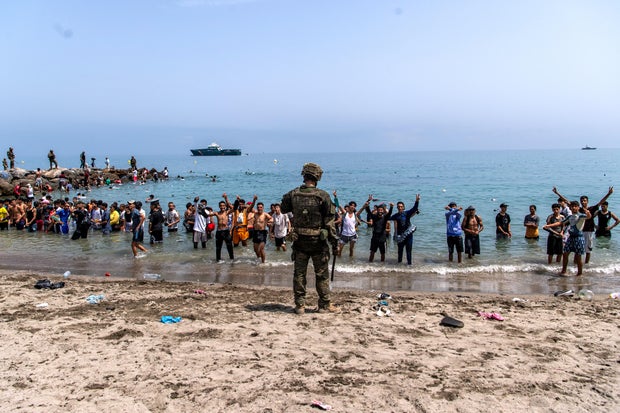
More than 72,000 migrants rushed across the border from Morocco into Ceuta, an autonomous Spanish territory on the North African coast, between July 30 and 31. At least 70 people died during the attempted mass-crossings, according to Spain's national EFE news agency.
The vast majority were returned to Morocco, but around 5,000 migrants remained in Ceuta at the end of August, including 1,200 minors, according to Sanchez.
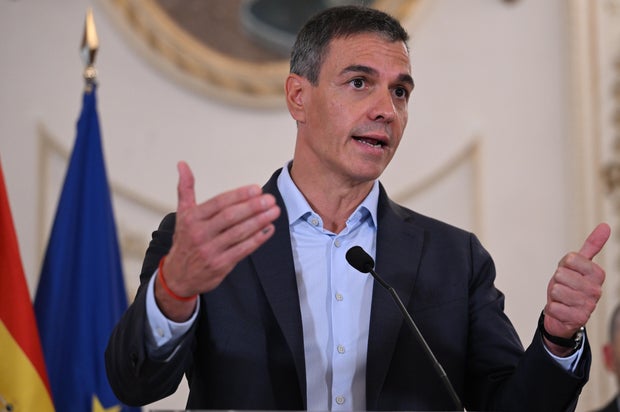
"After July 30 and 31, there was a spread of rumors and disinformation from social networks linked both to Russia and to Israel, and the international far-right that always uses migration not only to attack Spain, but also to attack Europe and divide it," Sanchez told Spanish radio network Cadena SER on Monday.
He said research by the European External Action Service (EEAS), the European Union's diplomatic service, indicated links with Israeli and Russian networks, but he gave no further details.
"It is evident that if Russia gets involved in spreading disinformation on this issue, or Israel also spreads disinformation on this issue, criticizing the Spanish government, it will not be because they are concerned about migration in Spain or Europe, but precisely because of the political positions we are taking — courageous ones, I believe — regarding the genocide in Gaza or Putin's invasion of Ukraine," Sánchez said.
The EEAS did not immediately respond to a CBS News request for comment on the research cited by Sánchez.
Spain has strongly supported Ukraine since Russia launched its ongoing full-scale invasion in February 2022, and Sánchez has been one of the most outspoken European critics of Israel's conduct in Gaza and the occupied West Bank.
"Spain condemned the Hamas attacks and, immediately afterward, condemned the genocide being perpetrated by the Israeli authorities in the Gaza Strip," Sánchez said during a news conference in May.
On Monday, the Spanish leader rejected speculation that Moroccan authorities had encouraged the rush on the border at the end of July, calling his country's cooperation on immigration matters with Morocco "frankly very positive," and adding that the crisis "can only be resolved through cooperation."
Sánchez made the remarks after semiautonomous Ceuta's Mayor-President Juan Jesús Vivas said in an interview with El País that the crossings appeared to have been, "if not orchestrated, at least encouraged or permitted by Morocco."
"When people talk and speculate about the participation of Moroccan authorities, I deny this outright," Sanchez told SER.
In the days immediately following the surge of migrants into Ceuta, a Moroccan official attributed the sudden rush to a variety of factors, including "malicious exploitation of digital platforms" and the spread of misleading information online.
Israeli official says Sánchez "lying shamelssly"
Israeli Foreign Minister Gideon Saar blasted Sánchez's remarks as "brazen lies" on Monday.
"Prime Minister @sanchezcastejon is lying shamelessly," Saar wrote in a post on X. "In his interview with Cadena SER today, he lied again, astonishingly accusing Israel of disseminating misleading information regarding the events in Ceuta. This is a blatant lie."
"Continuing to spread defamatory lies will not distract from Sánchez's shameful failure in managing his country's affairs," added Saar.
Senior Israeli officials have publicly attacked Spain over its handling of the Ceuta crisis.
"Spain, which never misses an opportunity to lecture Israel, has declared a state of emergency in Ceuta following the crisis over its immigration policy," Israel's Ambassador to the United Nations Danny Danon, who is a member of Prime Minister Benjamin Netanyahu's Likud Party, wrote on X on July 30. "Maybe before it continues lecturing us, it's time it explained to the world why it still maintains colonial enclaves in Africa."
Russia's government also rejected Sánchez's allegations, according to Russia's independent RBC Newspaper and Spanish news agency Europe Press, which both cited anonymous officials with the Kremlin.
Spain's migration policy under scrutiny
The scale of the rush across the border into the Spanish enclave prompted alarm across Europe.
On Aug. 1, leaders of 22 of the EU's 27 member states — including German Chancellor Friedrich Merz and Italian Prime Minister Giorgia Meloni — signed a joint letter citing European nations' "duty to effectively deter and relentlessly combat illegal migration, by coordinating our action, strengthening our external borders and addressing all policies that can serve as pull factors."
The letter mentions "the regularization of [a] very large number of irregular migrants" as an example of a possible "pull factor" — a reference to the Spanish government introducing a large-scale regularization program for undocumented migrants earlier this year.
More than 1.1 million applications were submitted under the scheme, which had initially been expected to benefit around 500,000 people.
Applicants are required to demonstrate that they have no criminal convictions and that they were in Spain since before Jan. 1, 2026, to be eligible for the amnesty.
Sánchez has defended Spain's approach to handling the migration pressures facing virtually all Western European nations, arguing that giving undocumented migrants legal status allows them to work formally and thus contribute to the welfare state and more easily integrate into Spanish society.