Setting MLK's words, and likeness, in stone
On the 48th anniversary of Dr. Martin Luther King Jr.'s immortal "I have a dream" speech, America honors the man behind it ... an event, Rita Braver now tells us, literally SET in stone:
It's been 27 years in the making - 27 years since a memorial to Dr. Martin Luther King, Jr. was envisioned, the first major memorial ever built on Washington's National Mall dedicated to a man who was NOT a President.
Situated directly across the Tidal Basin from the Jefferson Memorial ... looking right at the Lincoln Memorial, and the Washington Monument.
Harry Johnson, President and CEO of the Memorial Foundation, says it's not about what job Dr. King had, but about his place in history:
"Here's a man who stood for some lofty goals and actually changed America," said Johnson. "That's why we built this memorial."
Johnson, and others who led the drive to get the memorial built, belong to Alpha Phi Alpha, the fraternity King joined while a graduate student at Boston University.
"The fraternity helped actually bail him out of jail once or twice," Johnson said.
Getting the Memorial built was a struggle in keeping with Martin Luther King's own story.
The project had to be approved by Congress, and supporters wanted it built close to the Mall where King led a quarter of a million people in the historic 1963 Civil Rights March.
But space on the mall is in high demand, and it took a battle with the commission that decides where monuments can be built in Washington to secure this 4 acre site near the Tidal Basin...
"We persevered and actually had to come to them as you have to do say, 'Here's why it could be done, here's where it could be done, and here's how it should be done,'" said Johnson.
In 1999 a design completion for the memorial was announced: 900 entries from 52 different countries, and an international jury pool decided which would be the winning solution.
The prize went to the ROMA Design Group from San Francisco. The design - a park setting with a major sculpture work in three pieces; The first two looking like a mountain that has split apart, echoing a line from King's I have a dream speech ...
"With this faith we will be able to hew out of the mountain of despair a stone of hope. With this faith we will be able to transform the jangling discords of our nation into a beautiful symphony of brotherhood."
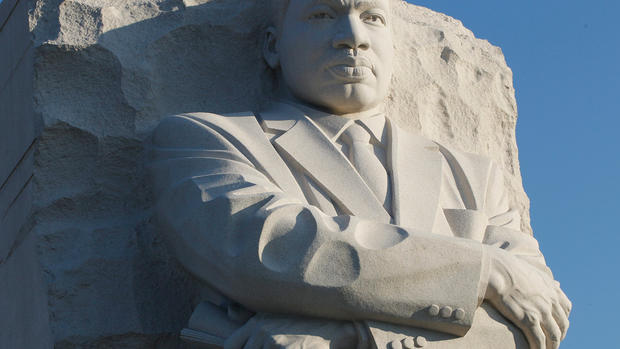
And the third piece IS the Stone of Hope ... a statue of King himself, 28 feet tall. The man chosen to create all three pieces is Lei Yixin. He holds the title of Master Sculptor in his native China, where he did most of the work with a team of helpers.
The works were then shipped to the U.S. in 159 pieces and reassembled - more than 1,700 tons of granite in all.
Lei says he tried to present King as an unyielding man of courage who fought to give people power.
"Dr. King belongs to the world," Lei said through an interpreter. "He's a world-wide hero, and his spirit is universal."
But like so much of King's life, this sculpture has been a source of controversy, with some critics charging the work makes him look too stern - though it's based on the cover photo of King's autobiography.
There's also some resentment that the job went to a sculptor from China.
"What do you say to those who say it should've gone to an American, and preferably an African-American?" Braver asked.
"I say simply that Dr. King talked about how you should judge a person," Johnson replied. "He said, in his own words, we should not judge a person by the color of his skin but by the content of his character."
In fact, though King is best known for his crusade to bring equality to African-Americans, the panel of historians that chose the quotes carved into the memorial's 450-foot granite wall deliberately selected words that apply to ALL people:
"I have the audacity to believe that peoples everywhere can have three meals a day for their bodies ... "
"Injustice anywhere is a threat to justice everywhere ..."
Nick Benson, a third-generation stone carver and calligrapher, supervised this part of the project.
"I think they're some of the finest words I'll ever carve," he said.
A winner of the MacArthur so-called Genius Grant for his craftsmanship, Benson created a new lettering style, a font he calls "The King."
"It really had to be a bold, bold character to carry in this large, large monumental space," Benson said.
The mood here is one of serenity...
Johnson said 165 cherry trees had been planted at the site, "so people from all over will come and see them bloom typically the week Dr. King was assassinated. But other symbolisms as well: Our address, 1964 Independence Avenue. That's the year President Johnson signed the civil rights legislation with Dr. King standing over his right shoulder.".
"Wow, was that a coincidence, or did you ask for that?" Braver asked.
"It just kind of worked out that way," Johnson said.
Paying for all of this was another challenge. While the government donated the land, the foundation had to raise most of the money to build the memorial privately: $120 million.
In yet another controversial move, the King family reportedly charged the MLK Foundation some $800,000 to license King's image and words for use on fundraising materials.
Neither the King family nor the foundation will comment on that now, the foundation saying it's time to celebrate Dr. King's life.
And it will be a celebration!
The dedication is set for next Sunday, August 28, the 48th anniversary of the march on Washington. The crowd could be even bigger this time:
"We're saying 250,000, but the numbers keep growing," Johnson said. "We think they're going to get up to 400,000 for them. We're ready for them. The city of D.C. is ready for them. The country's ready for them. And you can see, Martin Luther King is ready for them."
With members of the King family taking part, and President Barak Obama set to speak here, it will be a day to reflect on how far the nation has journeyed since the days of Martin Luther King ... a journey that continues, even today.
For more info: