From the ashes arise origami koi

Starting when he was six years old, Robert Lang has folded life out of paper. Now, at 65, Lang is recognized worldwide as one of today's masters of origami, responsible for more than 800 origami designs.
Asked if he is comfortable being an origami rock star, Lang replied, "Yeah, I guess I've been that long enough that I've gotten used to it."
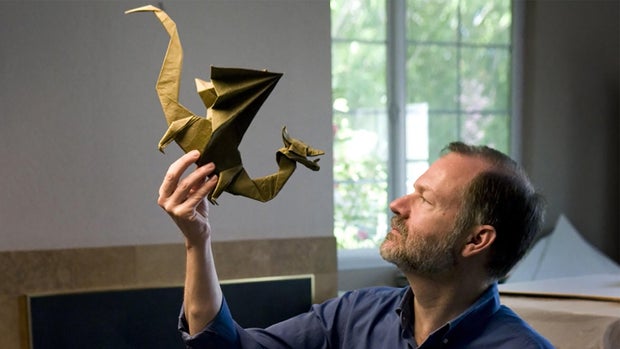
Origami originated in Japan more than three centuries ago, but Lang led its renaissance in the 1990s.
He showed off some of his proudest patterns to "Sunday Morning" back in 2007 at his California home. By then, a physicist who once designed lasers for NASA had designed a full-time origami career combining math and art to create magic.
WATCH, FROM 2007: Origami artist Robert Lang (YouTube Video)
Is it still magical? "Absolutely," he said, "creating something that seems impossible, then making it possible."
But the unthinkable became possible at the start of 2025, when the Eaton Fires hit Altadena, Calif. Both the home Lang shared with his wife, Diane, and the studio that paper built, were destroyed.
He said, as he videotaped his studio going up in flames, he realized that his life was going to be completely different.
Gone: hundreds of pieces, that took hundreds of hours to create. "It's weird to say, 'I lost all my bugs,' but all my insects and arthropods, which are some of my favorites, some of the most complex, and very hard to fold," Lang said.
An origami cuckoo clock from 1987 was the only finished figure of his that he saved. "Everything I had envisioned for the next stage of my life is going to be a completely different plan," he said. "If I'd had more time, or if I'd given myself more time, there's a lot more I wish I'd shoved, crammed into the back of the car somehow."
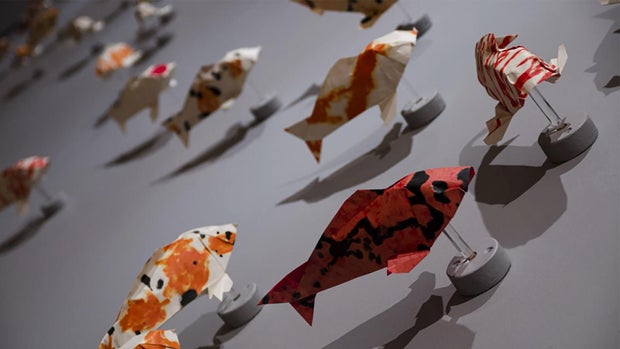
Including his prized koi, which had exhibited in 15 museums over five years before they met their end. They had just come back from a show in Denmark.
The koi were created from paper handmade by Richard Alexander and Michael LaFosse of Origamido Studios in Haverhill, Mass. To have them make paper is like having Antonio Stradivari make a violin. So, when they'd heard the Langs lost everything to the fire, they were among the first to pitch in. "It is a family, so we were very glad to help," Alexander said.
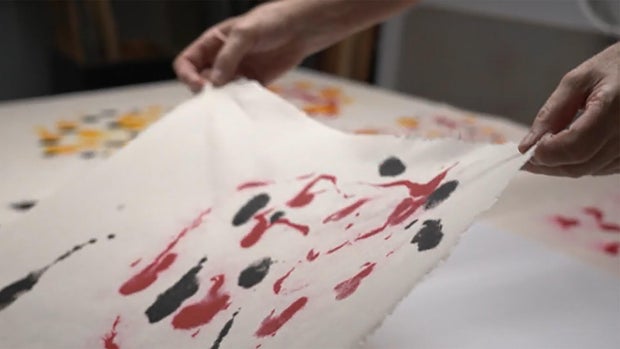
Lang told us, "It was almost embarrassing that there was such an outpouring of support. 'Do you need paper? Do you need books?' Which practically brought me to tears, because origami people are not rich. And that people were willing to help in all these different ways was really moving."
With Lang's help, Alexander and LaFosse made new paper using ashes collected from Lang's studio, from exactly the spot where the koi exhibit was stored.
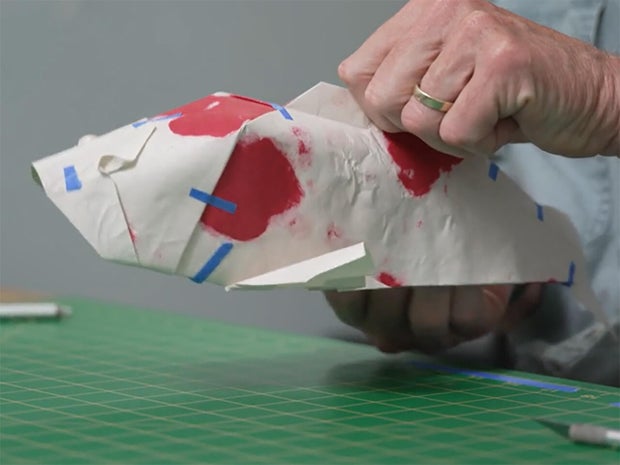
And at his temporary home in Altadena, Lang began folding a new wall of koi – his work, and his studio, embedded into the paper.
"Vertical Pond III" made its first splash earlier this year at Descanso Gardens, near Altadena.
"I love to see them swimming around," Lang said upon visiting the exhibit. "And it is the culmination of this vision of bringing origami, bringing a little bit of my studio, back to life."
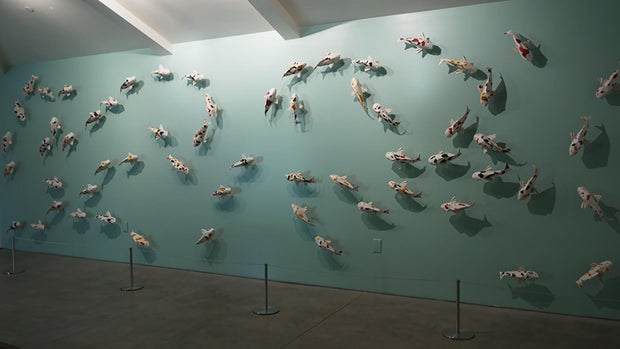
The fish are swimming again in San Diego's Mingei International Museum until November.
And in his makeshift workspace and temporary home, Lang and his wife, Diane, are finding beauty among the ruins of their lives. After all, origami teaches patience. And Robert Lang, who made fish rise from the ashes, will continue to rebuild, one crease at a time.
"Origami keeps my mind going, and it tickles a lot of the pleasure centers," he said. "There's just something really satisfying about solving a really hard problem, and that the solution results in something beautiful. I long to have that experience again."
For more info:
- Robert J. Lang Origami
- Exhibition: "To Catch a Fish," at Mingei International Museum, San Diego (through Nov. 1)
- Origamido Studios, Haverhill, Mass.
- Descanso Gardens, La Cañada Flintridge, Calif.
- Origami USA
Story produced by Young Kim. Editor: Carol Ross.