Obama Eyeing Non-Nuclear Missile Defense
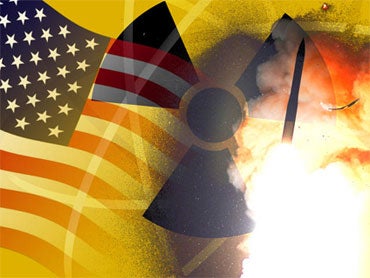
The New Start treaty signed by U.S. President Barack Obama and Russian President Dmitri Medvedev two weeks ago, aimed at cutting each country's nuclear arsenal, contains a provision demanding the United States decommission one nuclear missile for every missile it deploys under a new program called Prompt Global Strike.
These Minuteman missiles would be armed with 1,000-lb. conventional warheads, but would be designed to strike targets anywhere in the world within an hour of launch with incredible accuracy — ideal, perhaps, for striking a cave if intelligence hears that a certain terrorist is momentarily hiding there, or destroying a North Korean missile before it is fired.
But the weapons' capabilities are enough to raise fears in other nations of a nuclear strike.
David E. Sanger and Thom Shanker of The New York Times write today that the idea was considered, and then shelved by the administration of President George W. Bush, only to be picked up again by Obama officials.
Earlier this month, in an interview with The Times, Mr. Obama said that he wanted America's defense strategy to rely less on a nuclear deterrent.
Maintaining such a weapon in the American arsenal would require reassuring Russia, China or other nations that a U.S. missile being fired does not represent the beginning of a nuclear attack upon them, sparking a nuclear retaliatory launch against us.
It has been suggested also that using intercontinental ballistic missiles as a delivery vehicle for weapons other than nuclear bombs runs the risk of starting an arms race of ICBMs — good, perhaps, for missile manufacturers, but bad for proliferating missiles among non-nuclear states.
The White House is requesting funding of $250 million next year to study and develop the new system.
The State Department said three concepts being studied for Conventional Prompt Global Strike (CPGS) systems include a hypersonic technology vehicle, managed by the Defense Advanced Research Projects Agency (DARPA); a conventional strike missile, managed by the U.S. Air Force Space and Missile Center; and an advanced hypersonic weapon, managed by Missile Defense Command.
The Defense Department will conclude its studies of these options as part of its land- and sea-based, non-nuclear long-range strike capabilities this summer.