Mars Voyage Muscles: Don't Like Your Workout? Try it in Space
(CBS) If you thought working out on Earth was tough, try it on Mars.
Turns out astronauts on a Mars mission might lose about 40 percent of their muscle strength during the long voyage, leaving them as weak as 80-year-olds, according to a study published in the Journal of Physiology.
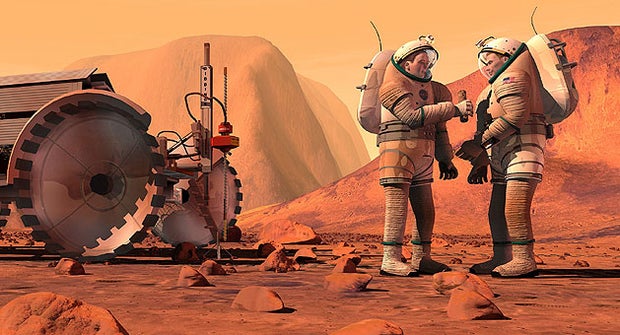
That could make it hard to perform even simple tasks, let alone move around on the Martian surface in bulky spacesuits, MSNBC reports.
And forget about palates or spin class.
Returning to Earth could be even more perilous, as the astronauts might be too weak to evacuate their spacecraft in the event of an emergency.
"Muscle wasting is a real concern," study author Robert Fitts of Marquette University in Milwaukee, told USA Today. "Mars is a three-year trip."
The distance between Earth and Mars depends on the positions of the two planets in their orbits. At its closest point, Maris is about 34 million miles from Earth.
Why would spaceflight cause muscle wasting? The problem is the zero gravity environment.On Earth, muscles stay strong because people have to use their muscles to overcome the force of gravity. In zero G, the muscles don't have much work to do - so they gradually grow weaker. The longer the time in space, the greater the loss of strength.
To conduct their study, Fitts took muscle tissue samples from nine astronauts and cosmonauts who had spent 180 days on the International Space Station. He found significant muscle atrophy even in the strongest astronauts.
In fact, the astronaut with the biggest muscles experienced the most severe deterioration.
NASA does what it can to keeps astronauts strong, requiring them to stick to demanding workout schedules while in space. But running while strapped to a treadmill just doesn't seem to go very far.
Even on a journey of 34 million miles.