Robotaxis are on the road to London. Cabbies, who pass a grueling test, aren't about to hand over their keys.
This is an updated version of a story first published on May 17, 2026. The original video can be viewed here.
On ancient roads and in medieval alleyways in London, a very modern battle is brewing. Black cabs, which are as synonymous with that city as Buckingham Palace, will soon be competing with artificial intelligence-powered, autonomous taxis. Tech companies promise these AI inventions, some of which are already operating in several American cities, are safer and smarter than human drivers. But as we first told you earlier this year, London's cabbies aren't about to hand over their keys. After all, just to get a license, they've already proven their own kind of intelligence, studying, often for years, to pass a 161-year-old test called "the Knowledge." There's nothing artificial about it. They just have to memorize 25,000 streets, and thousands of landmarks and businesses — and know the shortest routes between them all.
Tom Scullion: Look, we're the oldest form of transport in the world, fact. We come before buses, and trains, and stuff. Yeah, we are the icons of London.
Tom Scullion has been driving one of London's famous black cabs for the past 34 years.
Anderson Cooper: What's the weirdest request you've gotten from-- a passenger?
Tom Scullion: What, this week? Or-- you-- wouldn't believe.
Tom Scullion: There's a guy-- it's a regular ride, and he's got an Irish wolfhound, dog. Gives you a bit of paper where the dog lives. Dog jumps in the back. One of the best customers I've got. Never says a word, never complains about it, right? But we get people-- hailin' us down in the morning, "Take my kid to school." Never seen me before in their life, probably never see me again. That's the trust we get.
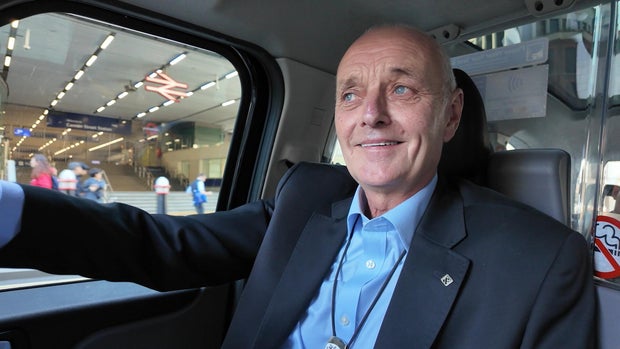
The trust and confidence in cabbies here dates back to 1865 when the Knowledge exam was first introduced to London's horse drawn cabmen.
Anderson Cooper: Do you have riders testing your knowledge?
Tom Scullion: Every ride. Which way you goin', mate?" And, "Google says this, and this Google says that." You're never gonna beat the Knowledge.
Anderson Cooper: Your knowledge is better than what a Google map will tell you to go?
Tom Scullion: Oh, don't make me laugh. Seriously, you know, it's like comparin'-- a hot dog vendor to-- Gordon Ramsay.
At the Transport for London office, nervous, aspiring cabbies dress up in their Sunday best to take a series of oral exams known as appearances.
Mark Hansford: Whenever you're ready sir we'll go from Soho House at 40 Greek Street, to the Chancery Rosewood, please.
Candidates are quizzed on how to get between two random points…
Tommy Simmons: Leave on left Greek Street, right Shaftesbury Avenue, left Great Windmill Street, forward Haymarket
…as examiners measure the distance, ensuring they're calling the shortest route.
Mark Hansford: Unfortunately, sir, I can't score you today
He failed this round. But for those who do pass the Knowledge, this memorization has proven to be so challenging it can change the structure of their brains. A study from University College London found cab drivers' posterior hippocampi, the part of the brain linked to memory, got bigger throughout their careers.
Steven Fairbrass: Everyone in their profession has had to train their self with knowledge to be the best at what they are. And that's what we're doing.
Steven Fairbrass has been trying to pass the Knowledge for eight years. Anshu Moorjani for five. They showed us the official study guide known as "the Blue Book."
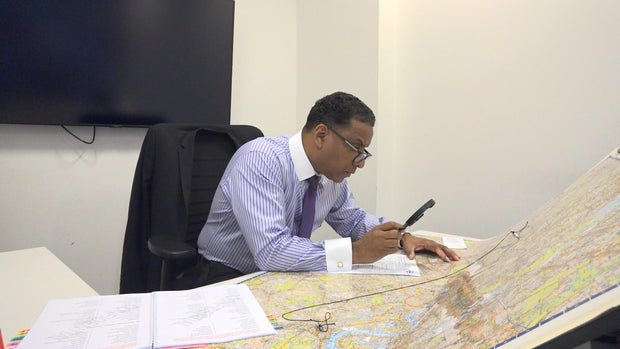
Anshu Moorjani: These are like, the points–
Steven Fairbrass: Points of interest for any--paying customer would want you to take them to.
Anderson Cooper: I mean, there's--
Steven Fairbrass: Thousands.
Anderson Cooper: Thousands of them.
Anshu Moorjani: Yeah, 6,000 of them.
Anderson Cooper: I just have to look at this.
Anderson Cooper: The Last Judgment PH, the Law Society Hall, the Londoner Hotel, the Marquis, the Maughan Library, the National Gallery, I mean, this is crazy that you have to know all this. You have to learn individual restaurants?
Anshu Moorjani: Individual restaurants.
Steven Fairbrass: Public houses.
Anderson Cooper: What if a restaurant goes out of business?
Steven Fairbrass: Then it changes names and then you learn the new name.
Anshu Moorjani: Then it comes on the list. Comes on the list.
Steven Fairbrass: Yeah it goes on the list.
Now their knowledge is being tested like never before. Autonomous vehicles haven't been approved to pick up passengers in London yet, but several companies are already trying out their cars here. Wayve, a British startup, backed by Nvidia and Microsoft, hopes to be operational later this year, as does Waymo, which is owned by Google's parent company, Alphabet.
Tekedra Mawakana is Waymo's co-CEO. She says putting more of its robotaxis on the roads can save lives by reducing the million traffic deaths worldwide each year.
Anderson Cooper: You believe driverless cars are safer than a human driven vehicle?
Tekedra Mawakana: In the case of Waymo, we actually have the data that shows us that we're five times safer than a human driver.
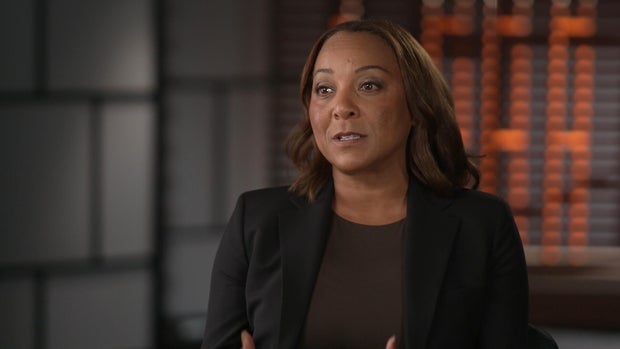
Waymo has already made significant inroads in the U.S.
It first began offering rides to customers in a Phoenix suburb in 2020. Now millions of riders across 11 major U.S. cities are being driven by Waymos each month.
Tekedra Mawakana: Humans want to get in the car, send that last email they didn't get to send and check on the kid that's screaming. But we're trying to drive and do that. So this really gives you the chance to take care of all of those things, and then let the Waymo driver safely get you to-- from Point A to Point B.
Anderson Cooper: You call it a Waymo driver, but there's no driver.
Tekedra Mawakana: We really think it's important to think of it as there is a driver, right. This driver is the most experienced driver in the world. We travel over 2 million miles a week. So humans drive about 700,000 miles in a lifetime. So this is almost three lifetimes per week that our fleet is driving.
Anderson Cooper: Because it's been trained on every other ride that Waymo's given?
Tekedra Mawakana: The whole fleet, yes.
Waymo's AI has also driven billions of miles in simulation to train for the countless rare scenarios it might face on roads, like snow on the Golden Gate Bridge or even an elephant stopping traffic.
Chris Ludwick:. Start ride whenever you're ready.
In San Francisco, we took a trip in one of its robotaxis with product manager Chris Ludwick.
Waymo: Happy Friday
Anderson Cooper: It's a little freaky not to have a driver.
Anderson Cooper: You must hear this all the time, but like, I'm watching the wheel very, very carefully.
Chris Ludwick: Yup.
But after a few minutes, the ride felt strangely normal.
Anderson Cooper: It feels like a very careful driver.
Chris Ludwick: Exactly, yeah. Our goal is kind of-- blissfully boring.
The car is outfitted with 29 cameras, six radars, five microphones, and five lidar sensors, which continuously pulse to measure distances, objects, and people as far as three football fields away.
Inside a screen shows riders what the car is seeing.
Anderson Cooper: It sees an intersection, I don't know, 300 feet away. But because there's other cars, I can't see it. But it sees around these other cars.
Chris Ludwick: That's right. And that's partly the design of the placement of the sensors. Makes it superhuman compared to what a human would be able to do.
Waymo says the data gathered from these sensors enables the AI to respond faster than a human. We saw that when a woman talking on her phone crossed right in front of us.
Anderson Cooper: It's kinda crazy to see-- a person change their mind and how quickly the Waymo responded to like, a slight motion of them moving forward.
Chris Ludwick: Exactly. The system has learned to react to those subtle cues because that's what's necessary.
Waymo's AI may have a lot of training, but it still makes some rookie mistakes.
In Los Angeles, a Waymo drove through an active police scene. There's also been incidents of the robotaxis getting in the way of emergency responders and illegally passing stopped school buses, leading to a software recall and a federal investigation.
Back in London, Waymo's robotaxis have been driving the streets to build a detailed 3D map to train its AI, a company standard before operating in a new area. But it does have competition.
Alex Kendall: We want to make sure our AI can understand every concept it might encounter
Alex Kendall is Wayve's CEO. Unlike Waymo's, his artificial intelligence doesn't map out a city before driving in it.
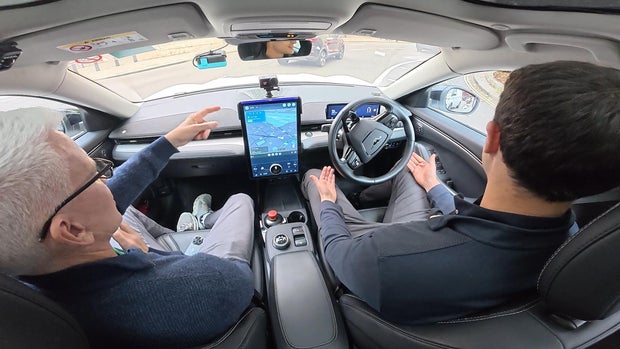
Anderson Cooper: How is it possible you don't need to map a city entirely before-- getting your vehicles to drive autonomously in it?
Alex Kendall: Well, think about how-- you and I learned how to drive. I learned how to go through a few traffic lights, and that taught me how the concept of traffic lights works. In a similar way, that's how our AI learns. We train it on millions of hours of experience driving all around the world. So this means when it goes somewhere it's never seen before or that's never been mapped-- it can understand what's in front of it and make decisions in real time.
Wayve's robotaxis are still in testing and not yet available to the public, but Kendall believes his AI will be able to more easily adapt to new environments.
He took us to Westminster, a district in London that's home to some of the city's most historic landmarks, to show us where he's been training his fleet since Wayve's early days in 2019.
Anderson Cooper: And your foot is not– you're not - you're not touching it at all.
Alex Kendall: So I'm not touching the controls. The AI is controlling the steering, the speed, the indicators, the brake.
Until robotaxis are approved by the government here, a human has to sit in the driver's seat for safety.
Alex Kendall: Here's-- one of the busier roundabouts in front of Westminster. Right in front of Parliament.
Alex Kendall: Lotsa tourists around, different vehicles.
Anderson Cooper: This guy just crossed into our lane.
Alex Kendall: Oh. Now back to another lane. There's a bike that we have to wait for before making the lane change. There's just such a long list of things that can happen on the road. I think that's the main advantage of an AI driver here, is that it can have the intelligence to deal with things that you may never expect on the roads.
Aspiring cabbie Steven Fairbrass didn't seem too concerned about that.
Anderson Cooper: Do you worry about the future of this? You know--autonomous vehicles driving around?
Steven Fairbrass: No.
Anderson Cooper: Why don't you worry?
Steven Fairbrass: To me, the human brain will always be the strongest tool. Can you imagine you're trying to hail down a vehicle with no driver in it? You're standing there in the rain, trying to get home? And that vehicle just drives straight past you because it hasn't got a sensor or a human brain or an eye to turn. So to me, human beings, drivers, always gonna be needed. Always.
Anshu Moorjani, however, didn't seem so sure.
Anshu Moorjani: Every profession-- is being affected by AI. I don't know what it's going to do in the near future, but it's always there on your mind that yes -- you're doing-- you're getting into a career not knowing what--
Anderson Cooper: The future is.
Anshu Moorjani: --the future is.
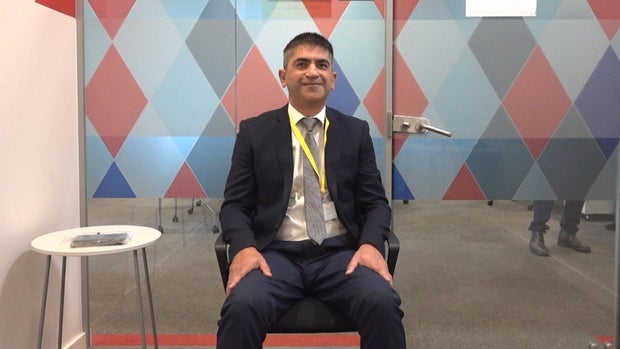
Over the last decade, London's black cab industry has seen a steep decline - the number of drivers has fallen from 25,000 to 16,000 today. So has their income, as Uber and other ride-hailing companies have been cutting into their business.
Even so, hundreds still sign up for the Knowledge each year.
This was Steven Fairbrass' 20th attempt.
Ryan Wloskowicz: We're gonna go to the Riding House Café, please.
Steven Fairbrass: Riding House Café, sir, is on-- Great Titchfield Street, sir.
Ryan Wloskowicz: Ok sir.
Steven Fairbrass: Go right into Morti-- Mortimer Street, right into Nassau Street, left into Riding House Street. Left into-- Portland Place. Great Titchfield Street, said that.
Steven Fairbrass: Sorry, sir. I can't remember that other name of the-- after Portland Place.
Ryan Wloskowicz: All right, calm down, okay? Deep breaths, yeah?
Fairbrass failed this round and will have to try again. For Anshu Moorjani, this was his 41st try.
Mark Gunning: Run me down to Ladywell Station, please.
Anshu Moorjani: Leave by Brockley Road. Left Adelaide Avenue, come down on Maudley, by Ladywell Road, right Railroad Terrace, set down left.
Mark Gunning: Today I'm gonna score you, okay?
Anshu Moorjani: Oh, thank you, sir.
He passed. And in May, after five years of trying, Moorjani finally completed the Knowledge and will now earn his license.
Anderson Cooper: There's probably some people gonna be watching who think, you know, why spend years of your life studying for this exam, when you could be Uber drivers much faster.
Steven Fairbrass: You wanna drive around in one of them famous cabs out there.
Anshu Moorjani: It's hundreds--hundreds of years of all of history.
Steven Fairbrass: It means a lot to the people of London. It's like London without the queen, I would say.
Anderson Cooper: You can't have a London without a king or queen, you can't have London without a black cab.
Steven Fairbrass: Correct.
Anshu Moorjani: No. Impossible.
Produced by Katie Brennan. Associate producer: Matthew Riley. Broadcast associate: Grace Conley. Edited by Jorge J. García.