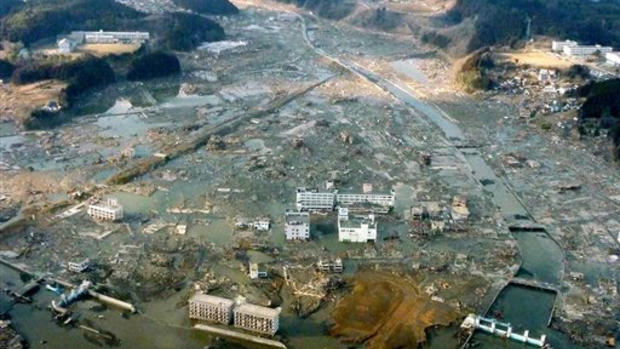
Japan quake causes day to get a bit shorter
WASHINGTON - You won't notice it, but the day just got a tiny bit shorter because of Friday's giant earthquake off the coast of Japan.
NASA geophysicist Richard Gross calculated that Earth's rotation sped up by 1.6 microseconds. That is because of the shift in Earth's mass caused by the 8.9-magnitude earthquake. A microsecond is one-millionth of a second.
Complete coverage: Disaster in Japan
That change in rotation speed is slightly more than the one caused by last year's larger Chile earthquake. But 2004's bigger Sumatra earthquake caused a 6.8-microsecond shortening of the day.
Japan awakens to fears of climbing death toll
The Japan quake is the fifth strongest since 1900. The magnitude 8.9 offshore quake unleashed a 23-foot tsunami and was followed by more than 80 aftershocks greater than magnitude-5 -- a number that scientists say is normal for a quake this size.
State of emergency declared at Japan nuke plant
The "megathrust" quake was similar to what happened during the 2004 Sumatra quake and the one last year in Chile. In all these cases, one tectonic plate is shoved beneath another.
Such earthquakes are responsible for the most powerful shifts in the Earth's crust.
U.S. Geological Survey seismologist Lucy Jones said a friend who was in Tokyo for a tsunami planning meeting noted the shaking after the initial shock lasted for about five minutes.
In comparison, the Northridge quake in Los Angeles in 1994 lasted six seconds. Jones said the Japan quake was approximately 3,000 times more powerful than Northridge. It was 30 times stronger than the quake that devastated San Francisco in 1906.