This teen had no place to go, so a hospital became his home
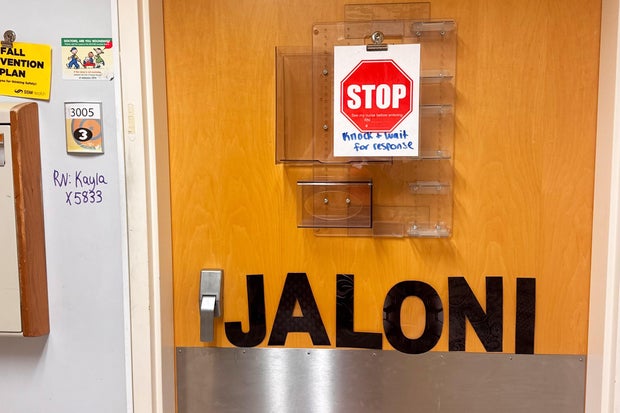
St. Louis — The teen's hospital stay began in room 3005.
The room didn't feel like home at first. Back then, Jaloni didn't have posters on the wall or snacks on the shelf, and he hadn't learned about the morgue yet.
He just wanted to survive. Fresh gunshot wounds filled the 14-year-old's body with unbearable pain. That first night, Jaloni said, he could barely move.
But in his own way, Jaloni could fly. His pain medication was so strong that the teenager said he felt like he was soaring in a dream.
In reality, though, Jaloni was a teenager caught between two worlds. Around his friends he had been a fearless risk-taker who knew how to steal without getting caught. Inside the hospital, Jaloni was now a boy who needed his grandmother to tell him that everything would be OK and that somehow life would get better as soon as he was released from the hospital.
But she couldn't make that promise. No one could.
He ended up staying in the SSM Health Cardinal Glennon Children's Hospital for more than 475 days over the next three years, his medical records show. Some of that time was not because he needed the hospital's medical care but because he had no safe place to go. The now-18-year-old asked KFF Health News to use only nicknames or first names to protect his family's safety.
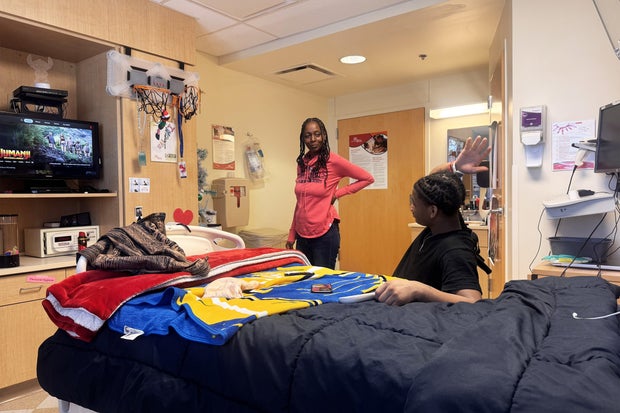
Like thousands of children throughout the country, Jaloni experienced what is called a social stay. The practice also known as hospital boarding, in which children remain in hospitals "beyond medical necessity," has become a costly and intractable issue nationwide.
A shortage of suitable foster care homes can mean children with mental health issues, chronic physical conditions, or disabilities that require special accommodations get stuck in hospitals. One study from Minnesota found that boarding a child with a complex medical condition in a hospital cost about $3,932 a day in 2017.
It is not clear how much of Jaloni's hospitalization was beyond what was medically necessary or how much those extra days in the hospital cost. The hospital system declined to comment on the details of Jaloni's stay. In a statement, SSM Health spokesperson Liz Sharpe-Taylor said that the health system is committed to its "mission of serving those who are in need" and that when "patients remain hospitalized due to an absence of discharge options, hospitals like ours often bear a burden of extensive uncompensated costs."
In the past five years, state records show, Missouri has spent more than $64.7 million boarding children in state custody in hospitals because they had nowhere else to go. But Missouri Hospital Association spokesperson Dave Dillon said that's a substantial undercount of the problem and that hospitals often don't always have staff to log and request reimbursement for housing children.
And those numbers also don't account for the toll that living in this limbo takes on the kids.
"Well, y'all almost killed him"
Jaloni slept a lot during his first stint at the hospital, starting in June 2023. Bullets had pierced his right arm and the right side of his chest, cutting through his torso. He was glad to be alive.
The teen already knew a lot about death — he had been surrounded by it. An older sister died after getting shot, as did his 17-year-old brother. He'd lost a few cousins to gun violence, as well, in and around St. Louis.
He had continued to walk in the shadow of death for the next few years. "It was a lot of dying going on," Jaloni recalled. "People were dropping like flies."
He didn't want his name added to that list. But he came close one summer evening when the war happening in his community erupted in a gunfight. He was injured, and a 22-year-old died. A 16-year-old was charged in the death.
"I felt like I was Superman with my gun," Jaloni said. "But when you get older, you realize that it's just stupid."
In the hospital, Jaloni tried to focus on healing from the bullet wounds and what his doctors said was a spinal cord injury. After three weeks, he was discharged to a rehabilitation facility, then he was sent home.
There his mother and grandmother struggled with caring for the teen, who now needed a wheelchair.
His grandmother, who had been his legal guardian since he was little, was a double amputee and in a wheelchair herself. His mother was juggling his care and her job as a paid caregiver for another family. Changing Jaloni's bandages, cooking, cleaning, and turning him every four hours as instructed to prevent bedsores was just too much for anyone to handle, his mother said she repeatedly told hospital officials.
"I just couldn't take care of him anymore," said his mother, Quette. "It was something that I was not ready for."
She said she begged hospital officials for assistance that never arrived. Jaloni was in bad shape with what seemed like an infection the November day they called 911 for help. He had bedsores. He felt sick and weak.
Jaloni then found himself back at Cardinal Glennon Children's Hospital, less than five months after he'd been released.
"They were like, 'Well, y'all almost killed him,'" his mom recalled officials telling her.
The family was accused of neglect. Because they lived just across the river from St. Louis in Illinois, Jaloni became a ward of that state.
That meant he couldn't go home to his mother and grandmother. Jaloni's mother thought about asking her ex-boyfriend to watch over her son. She considered asking other relatives, too. A social worker mentioned the idea of sending Jaloni to a home in Chicago where he could get the kind of attention that he needed.
Chicago? "I'm not going," he recalled thinking.
He wanted to go home, not 300 miles away. So he remained in the hospital while the adults in his life sorted out where he could go.
This time, his hospital stay was longer than anyone could imagine: 250 days.
Searching for a place to call home
Jaloni had known life would be different in a wheelchair. But he didn't think about how his new condition would make it harder for him to find somewhere to live. A place with ramps or an elevator for his wheelchair. A place where he could keep all his medical equipment and medicines. A place where someone could care for him safely.
Thousands of kids nationwide are in similar situations. In the fiscal year ending in June 2025, the Illinois Department of Children and Family Services logged 304 young people staying in psychiatric hospitals beyond medical necessity, according to an annual state report, while 312 spent more than 24 hours in hospital emergency departments awaiting a safe place to go.
The problem also is well documented in Missouri: 648 youths in the state's custody were boarded in hospitals during the fiscal year that ended in June, according to data obtained by KFF Health News through a public records request.
Missouri lawmakers have introduced multiple bills over the years to try to end the practice, without success.
Unaware of the politics or the growing costs, Jaloni was stuck waiting on the hospital's third floor, with the busy medical center effectively becoming his new home.
For most of his life, Jaloni's grandmother had provided a safe space for him to land. She taught him how to cook his favorite meal, fried tilapia served with spaghetti. She kept him company in his early days at the hospital. She kept his secrets.
But then in 2024, while he was hospitalized, his grandmother died.
Jaloni wasn't sure what would happen, until his aunt Deborah agreed to be Jaloni's foster parent. Taking on the role brought back memories for Deborah, or Tete, as he called her, because Jaloni lived with her during his first year of life. But this time was different. Jaloni wasn't a baby anymore, and he was harder to bring home than a newborn.
Deborah had to move into a first-floor, one-bedroom apartment with a ramp for his wheelchair. He needed a specialized hospital bed. While his aunt rearranged her life, Jaloni remained hospitalized until she was ready to receive him at their new home.
In the hospital, members of his care team had given him presents, braided his hair, and tried their best to connect with the teen. But for Jaloni, the third floor still felt like a different world.
"If you're in the hospital for a whole year just doing nothing, it's going to be the worst year of your life," Jaloni said. "I was mad I was in there for so long."
"My kingdom"
By his third stint at the hospital — this time for a bone infection, starting in October 2025 — Jaloni had a change of heart. As he healed, Jaloni explored almost every corner of the hospital. He played his favorite video game, Fortnite, at the nurses' station. Sometimes he ate in the cafeteria instead of his room. He occasionally went outside for fresh air. He eventually learned about a place in the hospital that was totally off-limits.
"They have a basement downstairs with a morgue in it, lots of dead bodies," Jaloni said while at the hospital in March. "Somebody just died the other day. She was 13."
The girl made a bracelet for Jaloni before she died. A nurse brought it to him, Jaloni recalled.
A bevy of nurses, a friendly custodian, and a chatty cook decided to look out for the teen while he was there for so long. A teacher who works for Cardinal Glennon visited five days a week to help with his online high school classes.
And, he took care of them, too. "I hear about relationships, dates, Valentine's Day," Jaloni said. "It's like I'm a therapist, for real."
To help him avoid cabin fever and allow for deep cleaning, the hospital moved him into a new room every 30 days. He said he slept in almost every room on the third floor. He said hospital workers once asked whether he wanted to avoid room 3005. After all, it was the first room he slept in after he was shot, and they thought it would bring back too many bad memories.
"Some people think it's like a trauma room, but it's a good room for me," Jaloni said with a smile, noting "how much I accomplished since that day."
Yet he watched the seasons change inside his room as traces of Halloween, Christmas gifts, and Valentine's Day treats piled up, reminding him of what he was missing.
"I don't make friends," Jaloni said while still in the hospital. "I don't have any friends."
He had plenty of stuffed creatures, some with sewn-on smiles.
"This is my favorite: Bruno," Jaloni said, holding a stuffed dog, then pointing out another. "Everybody knows who this is: Snoop!"
A "fish tank" in his room was filled with small plastic neon fish. With the push of a button, he could make it glow.
"This is my kingdom," the teen said from his hospital bed. "I've got a good mindset."
Cologne, Doritos, and a night at the prom
In March, big shiny black letters spelled out "J-A-L-O-N-I" outside the door to his hospital room. Above his name, a "STOP" sign on the door instructed visitors to knock and wait for a response before entering the space that could easily be mistaken for a college dorm room.
He had photographs taped to his bathroom door — including an image of the brother he lost. The sink in his room had everything he needed for grooming: castor oil for his hair, a jar of Shea Moisture mud mask for his face, Old Spice deodorant, and a small bottle of Dior cologne.
He doesn't wear the cologne often, but he did the night this spring that Cardinal Glennon staffers put on a prom for patients past and present. He found a YouTube tutorial and taught himself how to tie the necktie someone gave him for the occasion. His cousin came to the hospital to twist and style his locs. He invited his aunt to the big dance. She happily confessed it was her first prom, too.
Deborah is the type of person who bounces into the room, filling it with enough positive energy to fix any situation.
"Heeeeey, Jaloni," she sang one afternoon as she visited him. "How you doing today? You hungry?"
While most young patients on his floor ate the regular hospital food on the menu, Jaloni had more options after he had a conversation with a cook. The man wanted to know if Jaloni liked the food there.
"It could be better," he recalled saying.
After that exchange, Jaloni called the cook whenever he wanted to order something special: lemon pepper wings with cheese fries, Philly cheesesteaks with crushed Doritos on top, or a meat-lover's pizza with a tortilla-shell crust.
Another hospital worker gave him an air fryer as a gift. He used it to keep his french fries crispy. And as often as she could, his aunt would bring in his favorite meal from a nearby restaurant: cheese fries, six chicken wings, and a lemon-lime soda.
Many kids stuck boarding in hospitals don't get private rooms, special food, tutoring, fresh air, or such attention. Even so, Jaloni's world felt narrow.
When the door to his room was open, Jaloni observed all the events that unfolded on any given day on the hospital floor. The outside world sometimes intruded, too. On an otherwise quiet Friday in April, he said, he could hear gunshots. A 15-year-old boy was shot at a nearby gas station. Jaloni said the teen ended up at the hospital for treatment.
"He was actually on this floor," Jaloni said. "We hear people shooting all around here."
Still, he felt safer in the hospital than outside it.
Heading to a new home
When he was discharged in May — after his aunt found a larger, two-bedroom apartment — Jaloni needed time to adjust to what he calls "the real world."
To make sure that he had enough room for his bed and plenty of space to move around, his aunt gave him the larger of the bedrooms in their new apartment, a modest place with a homemade wheelchair ramp outside.
His bedroom at his aunt's home is much different than the hospital rooms he rotated in and out of for months. He gave his mom a tour when she came to visit him at the new place. She helped make up his bed, then he showed off a crisp white pair of Nike Air Force 1s that he keeps in a box under his bed. A cluster of prescription drug bottles sat on the shelf under the television in his room. It's his job to keep up with his meds now.
He's become his own chef, too. He uses an air fryer to make meals while his aunt is at work.
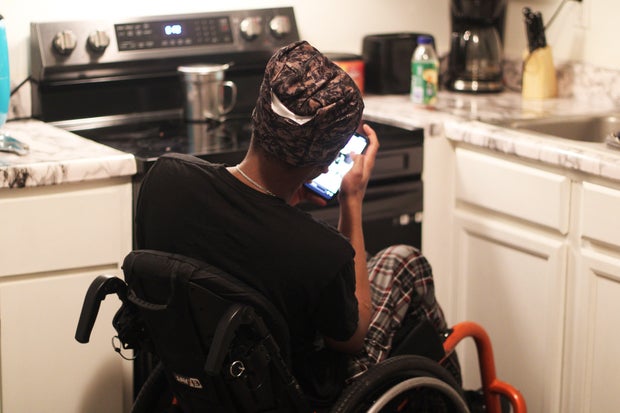
While his peers were getting ready to embark on their senior year of high school, he had another milestone on his mind — turning 18. He celebrated his birthday in August at the St. Louis Aquarium, a far cry from the tank with plastic neon fish that he had in room 3005.
His aunt also quietly celebrated the first time Jaloni took out the trash. "He wasn't going outside at first," his aunt whispered while Jaloni took a phone call a few feet away.
He's trying to enjoy life outside the hospital, but he still largely stays inside. He gets anxiety when he's around a lot of people, and he fears more violence. To stay safe, the teen tries to make himself invisible, usually going out when it's dark and wearing a black hoodie.
On a recent Sunday afternoon, Jaloni sat in his dimly lit bedroom watching YouTube videos while his aunt opened a new air freshener in the living room. She's trying to cut back on her smoking, but the stress of caregiving, work, and taking care of herself makes it hard to quit.
She's doing her best to help Jaloni fly. This time, she wants him to soar toward his dreams of getting his GED, learning a trade, and becoming a business owner.
In the meantime, Jaloni just wants to stay out of the hospital — and stay alive.
This project was supported by a grant from the Association of Health Care Journalists, with funding from The Joyce Foundation.
KFF Health News is a national newsroom that produces in-depth journalism about health issues and is one of the core operating programs at KFF — the independent source for health policy research, polling, and journalism.