60 Minutes Transcript: Drug cartels tweak molecules to make new synthetic opioids
The DEA, the U.S. Drug Enforcement Administration, is now confronting what it calls the greatest and most deadly drug threat the country has ever faced: synthetic opioids, which have killed more than a quarter of a million Americans in the last five years. Synthetics include fentanyl, but now also ever-more-lethal new drugs that are entering the bloodstream of this multi-billion dollar criminal industry. These drugs are concocted and tweaked in clandestine labs, cartels changing one molecule at a time to evade law enforcement and meet demand. Tonight: lessons in deadly chemistry: the latest front in the U.S. opioid epidemic, a crisis far from over.
This past August, St. Petersburg, Florida, we joined heavily-armed DEA agents as they prepared for a raid. The goal: disrupting a ring that distributes drugs. Cocaine, and methamphetamine, but more critically, synthetic opioids.
Early morning, we were at this house in a residential neighborhood — one of 10 locations throughout the area hit simultaneously. A drone sent in to determine if anyone inside was armed. Then a flash grenade tossed into the house.
Recovered: stacks of cash, a weapon, and one man inside who was arrested.
Taking part in the sweeping operation: longtime agent, now head of the DEA, Terry Cole.
Adm. Terry Cole: After we took the main target in custody, we're going to continue to dismantle the network. The network that is bringing this poison in, this network that's killing our youth, that's addicting our youth.
Jon Wertheim: You're saying this is a snapshot–
Adm. Terry Cole: This is just–
Jon Wertheim: --what we saw this morning.
Adm. Terry Cole: --a small portion of what's going on globally for DEA.
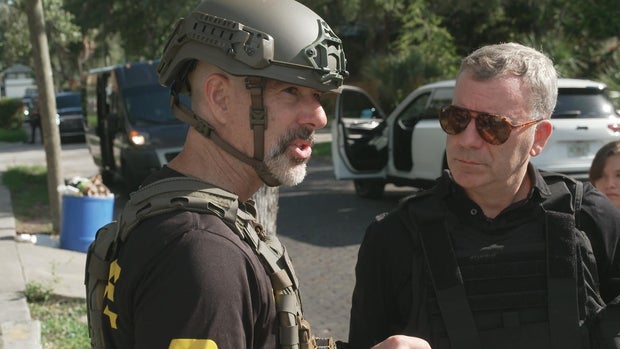
Danny Escobar, special agent in charge here, showed us some of the seized drugs.
Danny Escobar: You got the prescription pills that are fake prescription.
Jon Wertheim: Whoa, alright.
Danny Escobar: So they have all these different kinds of pills that they're using. We don't know what any of this is, where it was manufactured, how they did it. The cartels, this is what they're distributing to our people.
In raids like this, DEA head Terry Cole says agents are increasingly finding new synthetic pills, more deadly than anything they've ever seen.
Jon Wertheim: Most Americans know about fentanyl. We're hearing about all sorts of other synthetics now.
Adm. Terry Cole: I think as we continue to, you know, clamp down on the pressure in Mexico, they continue to evolve as well. The cartels will exploit every avenue and every source possible to bring new poison to the United States. Listen, it's all about profit for them. They don't care about our citizens, they don't care about our sovereignty, our national security.
Jon Wertheim: You're describing not just a public health crisis now, you're describing a national security crisis.
Adm. Terry Cole: Absolutely, you know, in the past when we talk about cocaine, methamphetamine, and heroin, the traditional type of narcotics that come into the United States, they've never killed at record numbers like we currently see now.
Opioid deaths are declining, owed in part to more effective enforcement, improved access to opioid treatment and reversal drugs. But they are still on pace to kill more than 35,000 people this year, the leading cause of death among Americans ages 18-45. The DEA continues its crackdown on fentanyl, while the cartels continue to innovate, cooking up ever-more-deadly synthetics, such as nitazenes. Here they are: an opioid not just more profitable than fentanyl, but up to 80 times more potent. Nitazenes, scarcely in the drug supply a few years ago, have already killed roughly 1,500 Americans, including Qua Broughton.
Frederica Roberson: Never in my life had I heard nitazene.
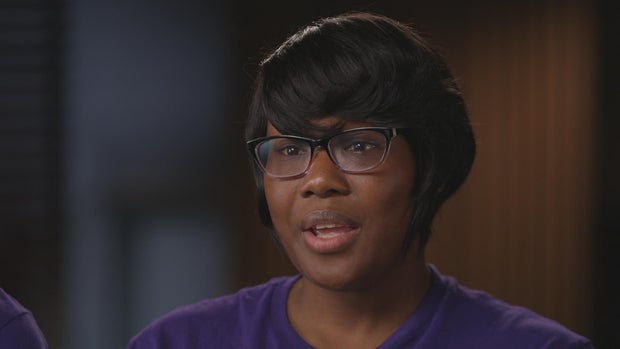
Qua's mom Frederica Roberson manages a medical practice outside Atlanta. Qua's older brother, Marquel Broughton: Broughton, was a two-time captain of West Point's football team, and is now a first lieutenant in the U.S. Army.
Jon Wertheim: Tell us about Qua.
Frederica Roberson: So, Qua was my energetic child. He was a ball of energy, always dancing, always jumping around.
Marquel Broughton: Qua was my – he was like my little twin as I would say. We did everything together.

In what's become an all-too-familiar American tragedy, Qua, a promising athlete, was prescribed painkillers after a high school sports injury. His mom says he became addicted. He turned to counterfeit opioid pills known on the street as "Blues"—usually containing fentanyl.
Jon Wertheim: How did Qua describe his addiction to you?
Marquel Broughton: He's, like, "I can't control it." He's like, "I don't want to be this way, but it-- it basically takes over everything. I would rather take this pill than eat." And–
Jon Wertheim: That's what he told you?
Marquel Broughton: Yeah. And that, that broke me.
Jon Wertheim: You hear that as a big brother, how do you process that?
Marquel Broughton:: I mean, you don't. Yeah, um.
On the evening of March 31, 2025, Qua, set to go back to rehab for addiction the next morning, went seeking one last high. And not from a corner drug dealer. He sent this Instagram message to a former high school classmate, "Who got blues?" He made an Apple Cash payment, and a couple hours later, pills dropped at the front door.
Frederica Roberson: They came via Uber courier in a book bag. The shock of somebody being able to drop a book bag off at your house.
Jon Wertheim: The book bag containing?
Frederica Roberson: Containing three pills.
Jon Wertheim: Do you know what he paid for those three pills?
Frederica Roberson: I think they were $10 a piece. I think he paid $30.
The next morning Frederica went to Qua's room to check on him.
Frederica Roberson: Qua was laying on the bed with his, like, legs hanging off the bed. So I instantly went into nurse mode. I ran and got my Narcan. I had three Narcans at the house. And I hit him with the Narcan, you know. I go to do CPR. And I was, like, "Come on. Stay with me. Stay with me." Hit him with another Narcan, and he looked at me. He laid his head in my hands, a tear rolled out, and he took his last breath.
Jon Wertheim: And you were right there.
Frederica Roberson: I was right there.
Next to Qua: some candy and a folded Post-It note — containing the pills and a personalized message from the dealer: "stay dangerous." The pills looked like the "blues" Qua was seeking, but with one fatal difference: they contained a nitazene.
Jon Wertheim: Was there any Percocet in those pills?
Frederica Roberson: Not one. No, no oxy-anything in it.
Jon Wertheim: Fentanyl?
Frederica Roberson: No fentanyl. Straight nitazene.
Jon Wertheim: This is something that can be up to 80 times more potent than fentanyl.
Frederica Roberson: Yes.
The first person to identify nitazenes in the American drug supply: forensic toxicologist, Alex Krotulski.
Alex Krotulski: We're on track this year alone to identify over 50 new drugs.
Jon Wertheim: That's one a week?
Alex Krotulski: Yeah, one a week.
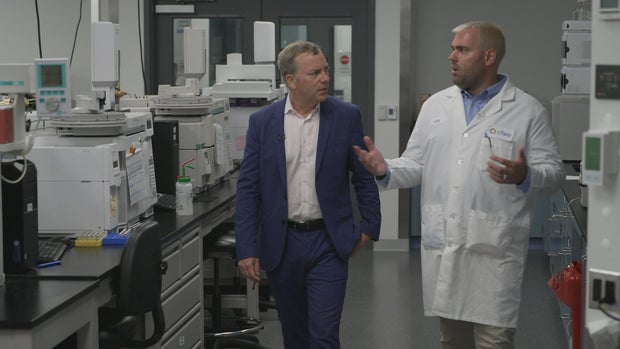
Director at the Center for Forensic Science Research and Education outside Philadelphia, Krotulski is on the front lines of the American opioid war. He sees the ever-changing chemistry, as he looks for new threats in blood samples from overdose victims and in drugs seized, bought undercover or purchased online.
Jon Wertheim: All over the U.S. is where you're getting this?
Alex Krotulski: Yeah, we have powders from the Midwest. This powder is black. It's often called gray death. I think there's somewhere around ten different opioids that are contained within this one individual powder.
Jon Wertheim: Ten opioids within one powder?
Alex Krotulski: Yeah, and this powder contains cychlorphine, which is one of these novel potent opioids.
Cychlorphine. It has killed more than 200 Americans in more than 20 states. It proliferated after a global crackdown on nitazenes. That's how the cartels work — create a new drug that's legal until regulation catches up.
So where do drugs like this come from? Illicit chemists actually dig up old patents. One synthetic, carfentanil, was once used as an elephant tranquilizer. Cychlorphine was formulated in the 1960s as a painkiller but was never approved. This past August, enforcement caught up and cychlorphine was scheduled, that is, banned. So goes the cat-and-mouse game.
Jon Wertheim: So you hear cychlorphine's now banned. You're not throwing a party. You're pivoting to figure out where the train's going after this.
Alex Krotulski: We're not saying, "Oh, yay, that's gone." We're saying, "Oh, crap, we've got something else new that we need to start looking for."
Sure enough, the illicit chemists took the chemical structure of cychlorphine and used it as a building block to create a new drug.
Three tiny edits — snapping on a chlorine atom here; and removing these two small chemical attachments — and behold… yet another synthetic opioid, that's already causing overdose deaths.
Jon Wertheim: We keep hearing this phrase, "One molecule at a time." Explain that.
Alex Krotulski: For us, one molecule at a time means today it could be cychlorphine; tomorrow it could be 5-Chloro desmethylchlorphine. On the street, they're still an opioid product. On the street, the person consuming it may not know even what they're consuming. But for us, looking at it at the molecular level, we're tracking it that closely to see these individual changes to the molecule over time.
It all gives new dimension to the term chemical warfare.
Head of the DEA, Terry Cole considers synthetic drug making the most deadly criminal act carried out by today's cartels.
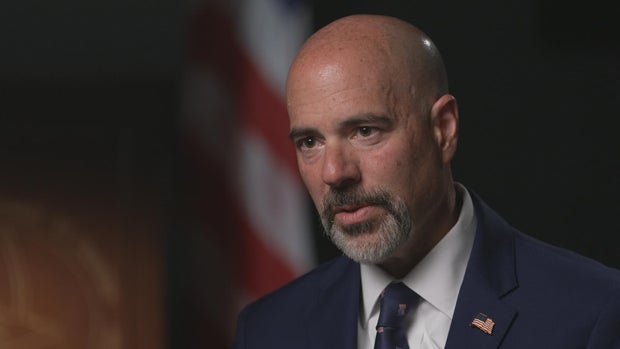
Jon Wertheim: We're seeing these synthetics getting made more lethal, with just a little tweak to a chemical compound, that must scare the hell out of you.
Adm. Terry Cole: How they evolve is truly amazing. Listen, they have the money to hire the best chemists in the world. They have the money to bring people into their laboratories. This is industrialization.
Industrialization through a global pipeline. Here's how the DEA explained it to us: Chemicals from China and India are ordered online and shipped to makeshift labs in Canada and in Mexico. The chemicals are then mixed by cartels and made into powders, and then pressed into pills either in Mexico or in the U.S.
The DEA let us into their Special Testing and Research Lab outside Washington, D.C., where we got a demonstration of just how easily the cartels can make synthetics. Lab director Agnes Winokur showed us how, for example, fentanyl is made by mixing chemicals in a plastic bucket, using some simple household tools.
Agnes Winokur: And that's what you see here to make about one kilogram of fentanyl. They may go to a hardware store, buy certain utensils.
Jon Wertheim: Someone made that in their basement.
Agnes Winokur: Yes. So if you had a reaction that require constant stirring, you can actually go and makeshift this, then tape it, right, like this, so that you don't have to hold it.
The DEA and its global counterparts have been trying to cut off the pipeline, before the chemicals reach the cartels. But it's not that easy. The chemical ingredients, known as pre-precursors, that make up the synthetic drugs, can enter countries legally for use in commercial products like dye and perfume.
The DEA has successfully pinpointed and regulated dozens of chemicals. But in the ongoing game of whack-a-mole. the cartels and their clandestine chemists simply find replacements.
Agnes Winokur: So let's say that all of a sudden you cannot obtain it. There's other substitutions…
Jon Wertheim: This gets scheduled and suddenly it's regulated.
Agnes Winokur: You still have ways to substitute. And now you have more variations.
Variations like the nitazene found in the "blues" that killed Qua Broughton — pills manufactured on presses like this one seized in a DEA raid.
Jon Wertheim: What kind of volume are we talking, here?
Agnes Winokur: A little over 330 tablets per minute, which is–
Jon Wertheim: Per minute?
Agnes Winokur: Per minute, so approximately 20,000 an hour.
That's millions of dollars worth of pills in 24 hours, part of the synthetic opioid supply that kills an American every 15 minutes. Taking lives like Qua's, who never saw his 22nd birthday. A reminder that, in our ongoing drug war, the stakes could scarcely be higher.
Jon Wertheim: Is there just an element of futility? Whatever we do, they're just going to pivot to a, to another substance.
Alex Krotulski: As much as we want to say, "This is a too tall of a mountain to climb," it's a mountain we have to climb because it's answers that families won't get, that public health and public safety won't get if we're not doing this work.
Produced by Denise Schrier Cetta. Associate producer, Elizabeth Germino. Broadcast associate, Mimi Lamarre. News associate, Eric Frank. Edited by Warren Lustig.