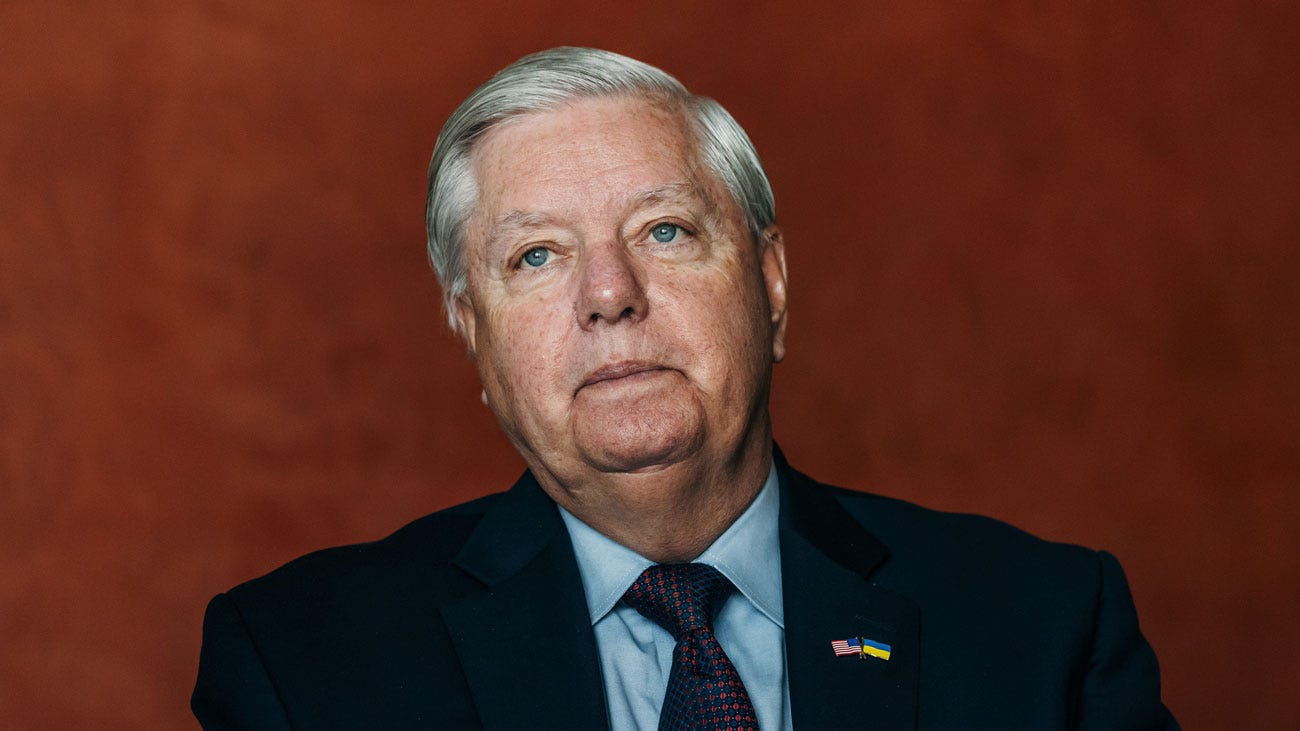
Congress returns with lengthy to-do list as Lindsey Graham's death hangs over Capitol Hill
Washington — Congress is returning to Washington on Monday facing limited time to address a number of priorities ahead of a lengthy August recess and the sprint to the midterm elections, while the sudden death of Sen. Lindsey Graham hangs over Capitol Hill.
Graham, who was 71, died Saturday evening, sending shockwaves through Washington and beyond. Now, his GOP colleagues are coping with the loss of a friend and key White House liaison at a time when their agenda has been repeatedly stalled by the other end of Pennsylvania Avenue.
Before the recess, President Trump poured fuel on internal divisions within the Republican Party over his focus on a voting regulations bill known as the SAVE America Act. His fixation on the bill — which lacks enough GOP support in the Senate — has undermined unrelated Republican priorities in both chambers and nearly paralyzed legislative business in the House.
There was also growing dissent among Republican lawmakers over the president's handling of the Iran war, now-stalled plans for the Justice Department's $1.8 billion "anti-weaponization" fund and funding for a massive new ballroom at the White House. Then, the president's controversial pick for temporary intelligence chief scuttled an extension of a key warrantless surveillance program.
The House and Senate now return with limited time to pick up the pieces, as the GOP majorities work to get their priorities across the finish line before the midterms. The House has just eight remaining days in session before lawmakers begin their five-week recess, while the Senate is scheduled to be in Washington through the first week of August.
SAVE America Act
The most pressing issue facing House Speaker Mike Johnson is how to navigate around a blockade on the floor by Republican hardliners who are demanding passage in the Senate of the SAVE America Act.
The members, led by Rep. Anna Paulina Luna of Florida, prevented most legislation from moving forward late last month. They have vowed to hold firm until the measure passes the Senate, where leaders have repeatedly stressed that it lacks the necessary support. To appease holdouts, Johnson proposed merging the SAVE America Act with the annual defense policy bill, known as the National Defense Authorization Act, before sending it to the Senate. But the hardliners voted against moving forward on the plan.
The standoff led Johnson to send the House home early for the Fourth of July recess. Vice President JD Vance was initially expected to attend the House GOP conference meeting on Tuesday as they look to move forward, but had a scheduling conflict, according to a source familiar with the plans.
Though the House has passed various versions of the elections measure, Mr. Trump has pushed for the legislation to go further and include bans on mail-in voting and transgender athletes' participation in women's sports. Johnson told Fox News that the president understands the mail ballot prohibition "is a bigger reach."
Johnson said there's a "big urgency" in passing the legislation and the House would "try one more time" to approve the measure via the party-line budget reconciliation process — which would pose its own obstacles.
Reconciliation 3.0
Mr. Trump has called on Congress to approve a spending bill without the help of Democrats through the budget reconciliation process, with $350 billion in defense funding and the SAVE America Act. In a Truth Social post last week, the president said House and Senate leadership must "make this their Number One Priority," requesting progress in the Budget Committee upon Congress' return.
House Republicans have been pushing to move forward on the reconciliation bill, which would be the third such effort this Congress, despite serious expressions of doubt from some key Senate Republicans.
In the upper chamber, a number of Republicans, like top appropriator Sen. Susan Collins of Maine, have thrown cold water on the possibility of another reconciliation bill. And Senate Majority Leader John Thune has expressed skepticism, pointing to the chamber's tight margins that have grown even slimmer with Graham's death and the prolonged absence of Sen. Mitch McConnell of Kentucky due to health issues.
The path forward is especially complicated by Graham's passing. As chairman of the Senate Budget Committee, Graham kickstarted the process in the upper chamber for the first two reconciliation bills, and would have led the new effort in the Senate.
Blanche and Clayton confirmation hearings
Senate Republicans are pushing forward with the confirmation process for both attorney general and director of national intelligence this week.
Acting Attorney General Todd Blanche is set to appear before the Senate Judiciary Committee on Wednesday for his confirmation hearing, which was already poised to be contentious. Some Republicans have voiced concern about the "anti-weaponization" fund, among other issues, and threatened to withhold support. Graham's death leaves Republicans with a slimmer margin on the Judiciary Committee.
Also on Wednesday, the Senate Intelligence Committee is scheduled to hold a confirmation hearing for Jay Clayton to be director of national intelligence. Mr. Trump torpedoed the original plans in June, demanding that senators first move forward on confirming a new U.S. attorney for the Southern District of New York, the position Clayton currently holds.
The Senate had sought to quickly confirm Clayton last month with the hope of ending the stalemate over a warrantless surveillance program that lapsed earlier in the month after Mr. Trump's temporary pick to lead the Office of the Director of National Intelligence, Bill Pulte, rattled lawmakers.
FISA reauthorization
Lawmakers are still grappling with Section 702 of the Foreign Intelligence Surveillance Act, after it expired on June 12 amid opposition to Pulte's leadership. Since then, there's been debate over the effects of the lapse given that the Foreign Intelligence Surveillance Court recertified the program through March. But concerns about potential national security risks remain.
Even before Pulte's appointment complicated its path to renewal, the law was already on a bumpy path as civil liberties-minded lawmakers in both parties demanded reforms on warrant requirements. The demands led Congress to punt the issue twice since it was initially set to expire in April.
Lawmakers reached a bipartisan deal to extend the surveillance authority for three years that they said would have more than enough support for passage before Mr. Trump disrupted the plans. With Clayton's confirmation, lawmakers are also hoping to unlock a path forward.
But the president's will could still stand in the way. In addition to the demand that Clayton's replacement be installed, Mr. Trump also linked the renewal of the surveillance authority to the SAVE America Act, threatening not to sign it without the election bill attached.
NDAA
Congressional leaders are also aiming to approve the must-pass defense policy bill known as the National Defense Authorization Act in the coming weeks. The Senate is hoping to make progress on the bill as soon as this week, but opposition from Democrats amid the renewed conflict with Iran is threatening its path forward.
Senate Minority Leader Chuck Schumer said in a letter to colleagues on Monday that Republicans are "pushing to advance the annual NDAA while refusing to negotiate on the president's bloated, partisan topline budget request." Democratic Sen. Brian Schatz of Hawaii said over the weekend that he would vote against advancing the bill, citing authorization for the Iran war and defense spending. He added, "I usually vote yes on NDAA but this is an easy call for me."
The House is not currently scheduled to take up the NDAA again this week.
Russia sanctions push
Lawmakers are pushing for action on a long-stalled Russia sanctions bill as soon as this week as they look to honor Graham, a foreign policy hawk who had championed the sanctions effort as part of a push to end Russia's war with Ukraine.
On Friday, Graham announced that he and a group of senators had reached an agreement with the Trump administration to move forward with an updated sanctions package. The package would impose sanctions and tariffs on countries doing business with Russia, including those that buy Russian oil.
Graham had been pushing for the sanctions for more than a year. But Senate Republicans waited for months for the go-ahead from the administration. As lawmakers paid tribute to Graham on Sunday following his sudden death, his colleagues on both sides of the aisle urged Senate leaders to move ahead on the sanctions bill in his honor. House colleagues pledged to introduce the bill in the lower chamber.
Democratic Sen. Jeanne Shaheen of New Hampshire, who was part of the agreement reached with the White House on the sanctions bill, said it was one of Graham's "most consequential efforts."
"There can be no more fitting memorial to Lindsey, his legacy, or the causes he fought for than to pass this legislation and realize his long-held dream of an independent and secure Ukraine," she said.