Can Romney leverage the "stature gap" in GOP race?
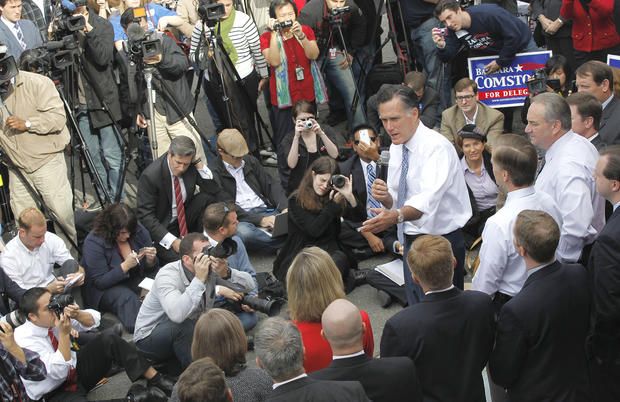

So far, things are going better than expected for Mitt Romney.
Early in the campaign, he was almost universally deemed a "weak" front-runner in the GOP presidential race, as Republican activists searched frantically for a viable contender who could become the consensus alternative to the former Massachusetts governor.
Even many Romney loyalists wondered if their preferred candidate could go the distance without ultimately being thwarted by his inherent vulnerabilities and a Tea Party base that remained largely unreceptive to him.
Surprising his doubters, Romney has thus far reaped the rewards that come with having already experienced the presidential campaign grind. He has dominated the debates and refined his message, while typically appearing more natural on the stump.
But he is also benefiting from a dynamic that has been outside of his control: The inability of his most formidable GOP opponents to project consistently the kind of gravitas that most voters demand from someone vying to become commander-in-chief.
In just the past couple of days, for instance, Rick Perry has seen the much-hyped rollout of his national flat tax proposal sidetracked by his comments to Parade magazine that he doesn't have "any idea" whether President Obama was born in the United States -- a notion that most Republican voters long ago considered settled.
Meanwhile, Herman Cain's attempt to counteract lingering perceptions that he isn't up to speed on fundamental issues, despite his surge in the polls, was undercut by his campaign's release of a bizarre Web video that featured as its most memorable moment Cain's chief of staff, Mark Block, smoking a cigarette.
"Mark Block is an old friend of mine, but I don't think I'd be spending campaign resources making an ad about him," said Corey Lewandowski, New Hampshire state director for the Tea Party-aligned Americans for Prosperity. "And I think there were originally very high hopes that Rick Perry was going to come out and be the anti-Romney, but due to his poor showings in the debates, many Tea Party people are becoming more aligned with Governor Romney specifically because they understand the long-term play here is to defeat President Obama in November of next year."
Cain's missteps easily can be chalked up to the inexperience of a candidate who has never before held elective office. Others have wondered whether the Web ad was the latest manifestation of the marketing talents of someone interested in using his candidacy to leverage rewards other than the presidency.
But for Perry, excuses are harder to come by.
Though he lacks Romney's presidential-level campaign experience, the Texas governor has run winning campaigns for almost three decades, and yet he has shown himself prone to a surprising lack of focus since entering the race.
From his widely panned remark back in August characterizing Federal Reserve Chairman Ben Bernanke as "treasonous" to his more recent statement giving some credence to the thoroughly debunked conspiracy theories about President Obama's birthplace, Perry's freewheeling style has turned off many influential Republicans who originally supported his candidacy wholeheartedly.
And it has tested the patience of more than a few who still back him.
Republican strategist Doug MacKinnon still thinks that Perry would be the strongest Republican to face off against Obama next November. But Perry's tendency to stray from his message and veer at times into the silly season has not been helpful to that theory.
"To inadvertently step on your own story with the birther issue would not be any communicator's idea of a good thing, so I'm sorry to see that going on," MacKinnon said. "No matter the intentions, it is stepping on his flat tax story."
Newt Gingrich and Jon Huntsman have each sought to position themselves as serious thinkers and problem solvers with the stature to be a viable nominee, but neither has enjoyed the recent success of Cain in the polls or the financial assets that will likely help Perry remain a contender for the foreseeable future.
Though analysts have noted time and again that Romney is the only Republican candidate who has consistently come across "like a president" in debates and other venues, this quality may not be as much of an asset once Republican voters actually go to the polls in the primaries.
For that reason, Romney is likely to continue to pair the gravitas with a healthy dose of the sharp combativeness he has flashed with growing regularity.
"The big question for me is if Romney tries to look too presidential early on, does he risk tipping the balance where he's not necessarily appealing to the red-meat crowd?" said Republican consultant John Feehery. "He can't win the general election yet. He's got to win the primary, and you do that by the kind of gut-punching on issues like immigration."
More from RealClearPolitics:
Connie Mack Expected to Enter Florida Senate Race
GOP's "Non-Campaign": Just a Slow Start or a New Model?
Scott Conroy is a National Political Reporter for RealClearPolitics and a contributor for CBS News..