Your AI shopping agent may not spot a fake online store this Black Friday
Scammers are using AI to churn out convincing copies of real online stores, and this Black Friday, the AI agents that many shoppers will rely on often can't tell the difference.
These fake sites pose a risk to the millions of Americans who are tasking their AI agents with making online purchases and transacting on their behalf.
"Artificial intelligence just makes building websites so much easier. You can upload anything into HTML and build a website very, very easily," Harrison Tang, co-founder of Spokeo, a data aggregator, told CBS News.
AI is enabling scammers to build what Tang described as convincing dupes of legitimate online stores in only hours, including copies of a brand's logo, marketing language and product images and descriptions.
"AI just makes creating these look-alike fake stores a lot easier, so there is a proliferation of them," Tang explained. "Platforms will try to catch them by not directing users there, but there are so many of them popping up all the time that they are hard to keep up with."
Research from Microsoft shows that criminals can use AI to set up fraudulent e-commerce sites in mere minutes rather than the days or weeks that were once required.
Spokeo identified copycat sites of dozens of popular brands, including UGG, L.L. Bean, Converse and Stella McCartney. As of Nov. 15, it had identified 65 distinct online stores that mimicked the legitimate sites of 60 brand names, according to its online shopping scam study.
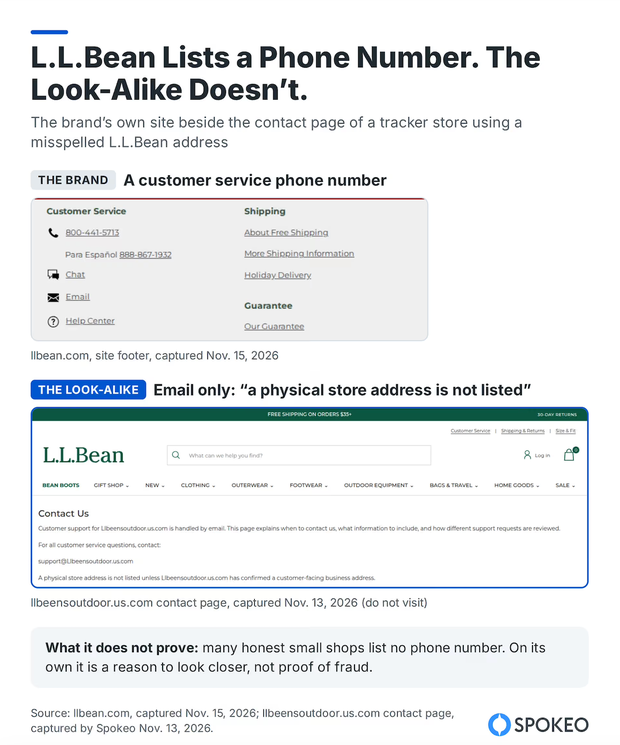
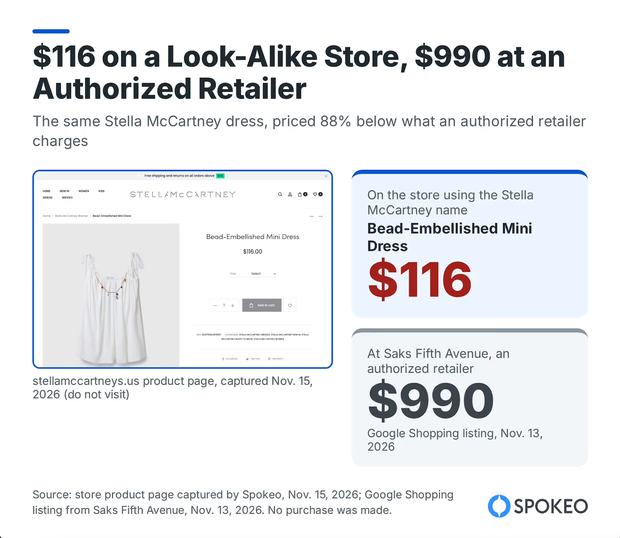
The discrepancies between the authentic stores and the scam websites are subtle and require close examination.
The first place to look for proof of fraud, according to Tang, is in the online store's web address. For example, a fake Converse store uses the web address converseshop.us.com, whereas the real store's address is converse.com. The .us domain name is the top-level domain for the U.S. and is reserved for U.S. residents, but is commonly used for phishing attempts, according to Tang.
"It looks like an official website, but it's not, so if you don't pay close attention, it's easy to get tricked," he said.
AI agents need to get savvy
Bots aren't as well trained as some humans are at spotting phony websites, which can dupe even discerning shoppers because of how realistic they look.
Recent research from Podqi, a firm that monitors for intellectual property infringement, on AI search risks shows that AI engines can inadvertently direct shoppers to scammy stores.
The group asked popular AI tools, including OpenAI's ChatGPT, Google's Gemini and Perplexity, questions about where to buy particular brands online. More than 18% of the AI bots' answers drew on a fake, infringing or invalid website.
For example, when asked where to buy clothing from Stussy, a streetwear brand, Perplexity referred to us-stussy.com, which it mistakenly identified as the brand's official website and "the best starting point for guaranteed authentic items." The web address us-stussy.com directs shoppers to a fake store. The real store's address is stussy.com.
Other brands with duplicate online stores include Figs, a medical scrubs maker; sock company Bombas; and dairy brand Fairlife.
Here are other tip-offs that a site is phony and should be avoided, according to Spokeo:
- Look-alike web addresses, but with misspellings
- Site lacks a corporate phone number or address
- Prices are too good to be true
- Third-party warnings on ScamAdviser or from the BBB