82nd Airborne soldiers train on drone-countering maneuvers used in Ukraine
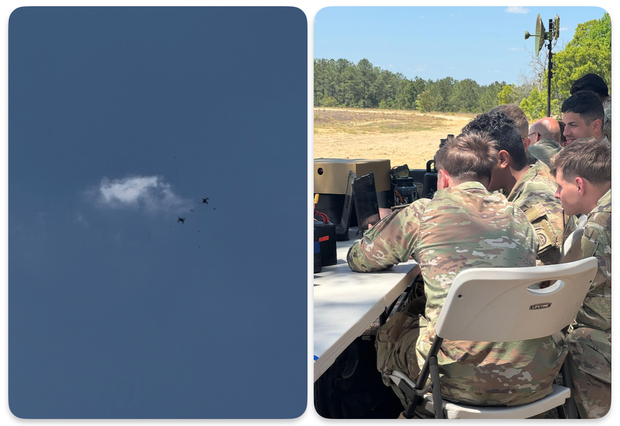
Fayetteville, North Carolina — Three small drones whizzed overhead, piloted by soldiers on laptops. Two of the Bumblebee drones were being steered to collide with the third, as part of the soldiers' initial training for the kind of drone-on-drone combat that's been taking place for months on the battlefield in Ukraine.
The training was held at Fort Bragg last week for a small group of soldiers from the 82nd Airborne Division in tandem with the Pentagon's efforts to produce cheap counter-drone systems that can quickly and easily be put to use by service members.
The soldiers trained on both the Bumblebee V1, a small, first-person-view drone that has seen thousands of combat flights in Ukraine, and the newer Bumblebee V2, which has automatic target recognition specifically meant to counter other drones and which has not been deployed yet.
Most of the training was on the Bumblebee V1, which is already being used by other soldiers in the 82nd Airborne Division and in the 10th Mountain Division, according to Sgt. Maj. Kellen Rowley, who is the senior enlisted adviser for the Pentagon's Joint Interagency Task Force-401, or JIATF-401, to counter drones.
Rowley said training for the V1 is taking place at several domestic bases, as well as at a training center for U.S. Central Command in the Middle East. As more service members flow into the Middle East, they will also be able to start doing the same kind of initial training on these systems.
"They pick up the skills necessary to do drone-on-drone combat," Rowley said of the training. "The feedback that we've heard thus far is 'I'm not gonna learn it in five minutes, but if I have 40 hours dedicated to learn how to figure this out,' they're gonna be an effective operator."
The Defense Department set up the task force to coordinate with other government agencies on countering drones. The war in Ukraine, drone incursions near military bases in the U.S. and now the conflict with Iran have all demonstrated the urgency of developing the technology faster.
The Bumblebee is one of the smaller systems the military is looking to use, instead of the more expensive interceptors that were developed primarily to take down incoming missiles. The U.S. military in the war with Iran has raised concerns about U.S. stockpiles of those types of munitions.
"There's a cost curve challenge, the offensive drones being used versus what we're using to shoot them down," said Lt. Col. Alex Morse, who manages acquisitions for the task force.
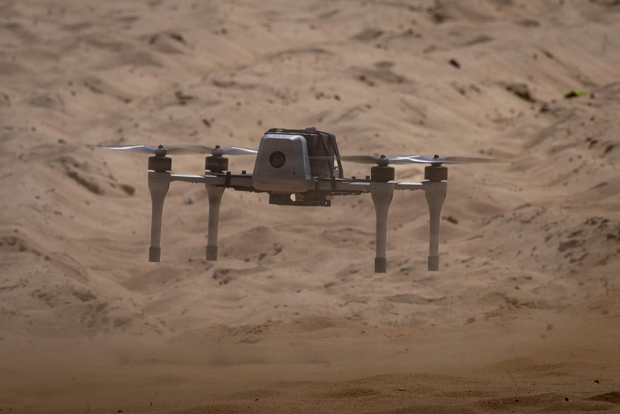
"Usually our defensive capability is in the hundreds of thousands or maybe in the millions. This is far below that," Morse said, as he held a prototype of the Bumblebee V2. "And we're going to continue to drive the cost down into the single digits of thousands."
Both versions are small enough for a soldier to hold. They have four legs with propellers, a camera in the middle, and a battery. The difference in the versions is that while the V1 requires the pilot to manually adjust the speed and altitude to lock onto a target, the V2 has autonomous targeting software to close in on a target that is approved by the pilot. The V2 has additional camera sensors and a gimbaled camera, not fixed, so it can move up and down.
The Bumblebees are designed to take out drones that are smaller than the Iranian-produced Shaheds estimated at 400 pounds used by both Iran and Russia, according to the Army officials.
Both are produced by Perennial Autonomy, a U.S. defense firm backed by former Google CEO Eric Schmidt, which had experts at the training to collect feedback from the Army.
"What we don't want to do is produce something and we have 10,000 of things that just don't work," Col. Tom Monaghan, the director of the Army's Joint Innovation Outpost, told reporters.
The two demonstrations reporters witnessed on Thursday at Fort Bragg consisted of three Bumblebee V1s, two working as a team against a third drone that was designated as the enemy drone.
The enemy drone hovered in one spot, as if it were gathering intelligence, and the two other drones took turns accelerating and revving into the enemy drone to take it down.
Each drone can be flown by one pilot controlling the drone from a computer, but in this training scenario, the soldiers worked as a team. Two or three soldiers seated near each laptop and then one soldier walking behind them coordinating between the teams. The soldiers together worked out the direction, altitude, and speed before calling out when to attack the enemy drone.
In the demonstrations, there were some misses where the drone raced right past the enemy drone, and twice, the drones collided with the enemy drone without completely taking it down. Once the drone was hit by another drone, the soldiers walked over to retrieve both drones and added them to the pile of drones damaged in earlier training sessions.
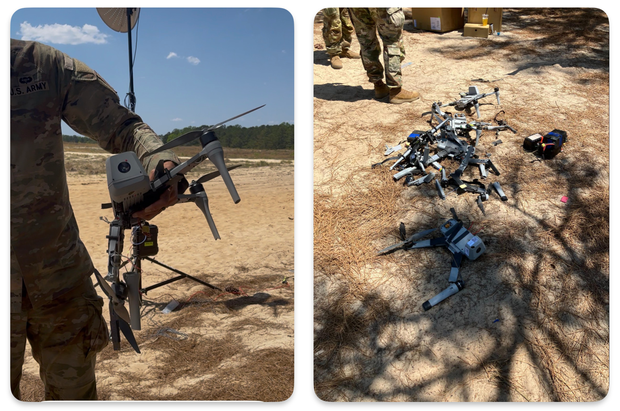
The training reporters saw was largely about marksmanship for the soldiers, the officials said, which is why the drones just hovered in one spot, and as the pilots improve, there will be different iterations, including testing the drones in an environment with electronic jamming.
"This is Day One for these kids — they're doing an amazing job," Ted Chavis, the senior adviser to the director of the task force, told reporters as he listed skills the soldiers trained on: crew drills, marksmanship, building drones, mission planning and coordination.
"They're going to go out and train tomorrow. They're going to train next week. And then they're going to come back in a couple weeks and do additional advanced training," Chavis said.
The Pentagon also plans to put more money behind the effort. The budget request for this year includes nearly $75 billion for drones, which is "the largest investment in drone warfare and counter-drone technology in U.S. history," Jules Hurst, the Pentagon comptroller, told reporters last week.