SpaceX launches crew to space station, including astronaut who'll miss birth of 3rd child during 6-month mission
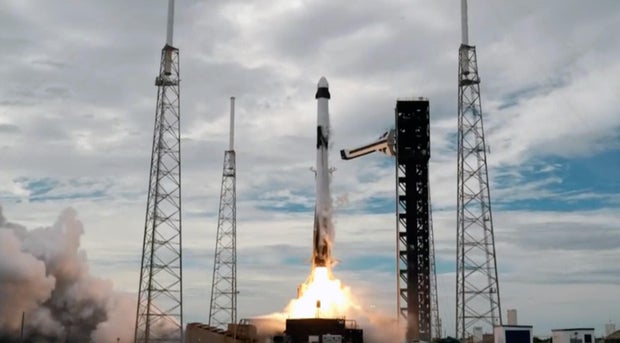
A SpaceX Falcon 9 rocket took off on a flight to the International Space Station Thursday carrying two NASA astronauts, a cosmonaut and a Canadian crew member whose wife plans a launch of her own later this year, giving birth to the couple's third child while her husband is in space.
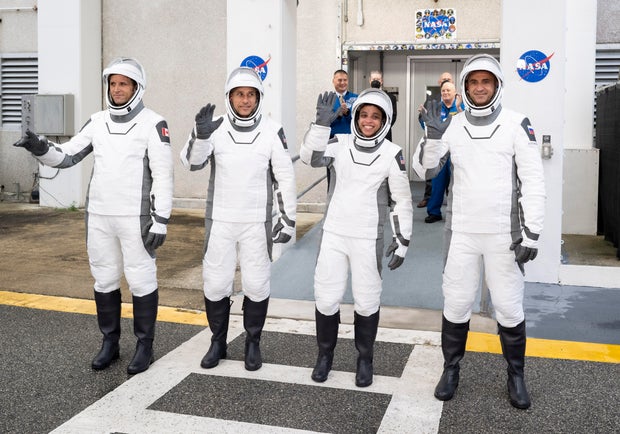
Strapped into a SpaceX Crew Dragon capsule, Crew 13 commander Jessica Watkins, pilot Luke Delaney, Russian cosmonaut Sergey Teteryatnikov and Canadian astronaut Joshua Kutryk blasted off from pad 40 at the Cape Canaveral Space Force Station at 11:10 a.m. EDT.
The launch originally was planned for mid-September, but the flight was delayed to replace a valve in the Crew Dragon's propulsion system.
Watkins, who holds a Ph.D. in geology, flew to space aboard a Crew Dragon in 2022. Her crewmates are space rookies — the 296th, 297th and 298th astronauts to fly aboard the ISS. Delaney and Kutryk are both former military test pilots while Teteryatnikov served in the Russian submarine force before becoming a cosmonaut.
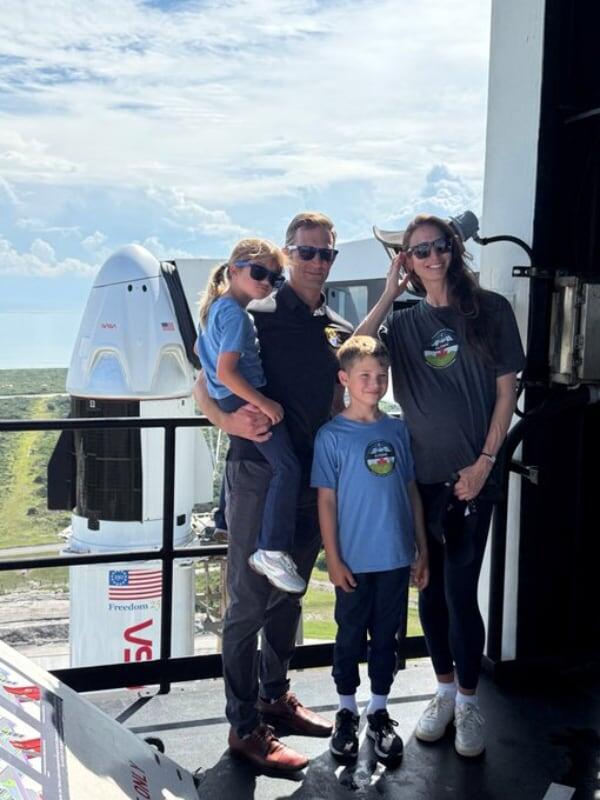
Kutryk and his wife Heather have two children, ages 5 and 7. They're expecting their third child around Thanksgiving, about two months into the Crew 13 mission. They will become the fourth couple in the history of space travel to have a child born while one parent was off the planet.
"Leaving these three (plus one on the way) is the hardest thing I've ever done," he wrote in a pre-launch post on X.
"But that has always been the nature of exploration. Words from Fridtjof Nansen, describing his departure for the North Pole, resonate in my mind," he continued. "'Behind me lay all I held dear in life. And what lay before me? Happy child, little do you know what life is - how strangely mingled and how full of change... and now, a farewell to home. It was the darkest hour of the whole journey.'"
Despite President Trump's recent animosity toward Canada, the Canadian Space Agency continues to play a major role in the U.S. space program. Along with supplying the robot arms that helped build the space station, CSA astronaut Jeremy Hansen flew around the moon on NASA's Artemis II mission. Kutryk is the 17th Canadian to fly in space.
"When I think about the space station, I hope the legacy is that people see this beacon in the sky going around Earth, one of the most complex things humans have ever, ever created, and they see it for all of its technical marvel and all the science and discoveries we're making there," said Kutryk.
"But (I hope) they also see it as sort of this beacon for what we can do when we make good decisions, when we work together and we collaborate and we prioritize things. It's testament to what we've done, what we can do, and really to what we hope the generations that follow can do."
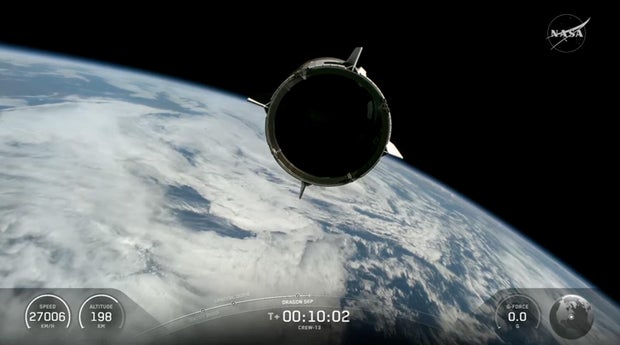
After boosting the Falcon 9 and Crew Dragon capsule out of the dense lower atmosphere, the Falcon 9's first stage flew itself back to a pinpoint landing at the Space Force station while the rocket's upper stage continued the climb to space. Minutes later, the second stage engine shut down and the crew capsule separated to fly on its own.
"What an epic ride!" Delaney radioed. "What an epic ride it was! Today, we proudly continue the streak of humans living and working in orbit, building on the legacies of yesterday to pave the way for future of space exploration. Huge thanks to the phenomenal teams at NASA, SpaceX, and all of our partners. ... Deepest appreciation to my family and friends who stood by me throughout this entire endeavor. Thank you. I love you guys. And to the Marines back on Earth, Semper Fi."
Flight to space station
Like all flights to the International Space Station, piloted and unpiloted alike, the Crew 13 launch was timed for the moment Earth's rotation carried the pad into the plane of the station's orbit. That's a requirement for rendezvous missions because no current rockets have the power to overcome their orbital momentum and change their direction of travel when moving at nearly 5 miles per second.
While a Falcon 9 cannot change orbital planes, the Crew Dragon capsule can change its altitude as required, flying lower — and faster — to catch up with its quarry and higher to slow down the approach.
In this case, it will take the Crew 13 capsule just 8 hours to catch up with the ISS, moving in for an automated docking at the forward port of the station's Harmony module at 7 p.m.
"I personally am looking forward to returning to the ISS as well as flying on Dragon a second time, and really looking forward to experiencing those experiences through the eyes of my crewmates," Watkins said.
"We expect a very busy mission with lots of station maintenance, both internal and external, with a few EVAs (spacewalks) on the docket as well as visiting vehicle capture and stowage operations, lots of science ... and plenty of outreach."
Standing by to welcome Watkins and company aboard will be the crew they are replacing: Crew 12 commander Jessica Meir, pilot Jack Hathaway, European Space Agency astronaut Sophie Adenot and cosmonaut Andrey Fedyaev. They're wrapping up a 235-day mission that began with launch atop a Falcon 9 rocket on Feb. 13.
Also on board: Soyuz MS-29/75S cosmonauts Pyotr Dubrov, Anna Kikina and NASA astronaut Anil Menon, launched on a Soyuz 2.1a rocket from the Baikonur Cosmodrome in Kazakhstan on July 14. They're in the midst of an eight-month stay, returning to Earth in early April 2027.
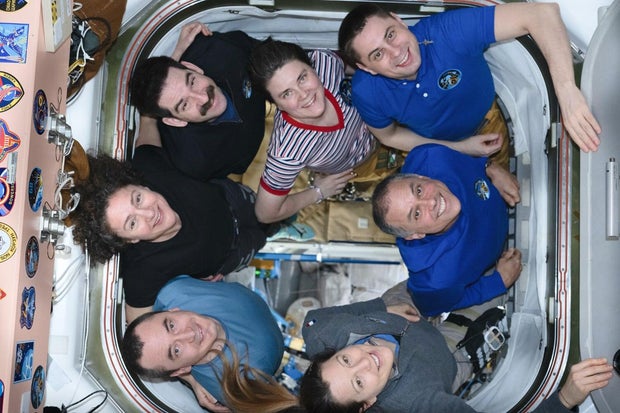
After an expedited "crew handover," during which Meir and her crewmates will show their replacements the ins and outs of station operations, Crew 12 will board their own Crew Dragon capsule and return to Earth. Undocking is planned for Oct. 5 with splashdown in the Pacific Ocean off the Southern California coast just past noon EDT on Oct. 6.
"I think the thing that I'm looking forward to most is seeing my 3-and-a-half-year-old daughter," said Meir, a two-flight veteran with seven spacewalks to her credit. "I'm so looking forward to seeing nature again, feeling the breeze on my face, the wind rustling through the leaves, experiencing all those things that we don't have up here.
"But I will very, very much miss being weightless all the time and the incredible views that we have."
Said Hathaway: "Going home and being able to take a nice long hot shower will be very relaxing and very nice. And, of course, I'm looking forward to seeing my family. But a hot shower is near the top of my list."
Crew 12's departure will free up the Harmony module's space-facing port for the arrival of a SpaceX Cargo Dragon on Oct. 13 that will be loaded with crew supplies, science gear, spare parts and two roll-out solar array panels. The Crew 13 fliers also expect to welcome a Northrop Grumman cargo ship in December, along with two Russian Progress freighters in November and February.
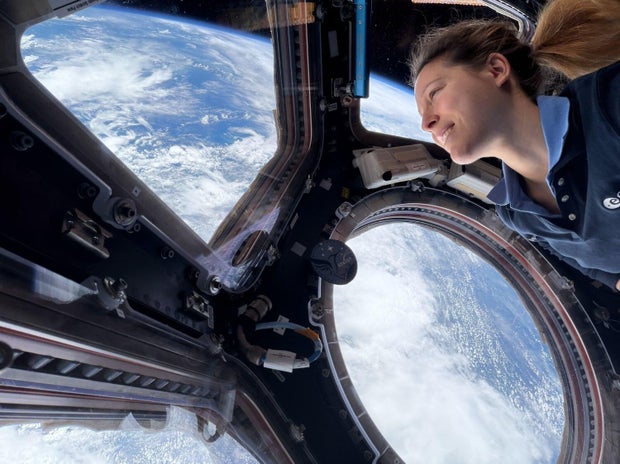
The roll-out solar arrays going up on the next Dragon Cargo ship are the final sets in a major upgrade to the station's original solar power system that began with initial installations in June 2021. The final two sets will be installed during spacewalks late this month and early November.
But the major goal of the flight, like all NASA missions to the station, is conducting research in the microgravity environment of space. Scores of experiments and technology demonstrations are running at any given moment with fresh studies going up on virtually every flight.
The Crew 13 fliers will face the same challenges.
"During the mission, the crew will help us fight heart disease and Parkinson's disease by studying human stem cell-derived tissues that will help improve medicine, disease modeling, and pharmaceutical testing," said Dana Weigel, director of NASA's low-Earth orbit mission directorate.
"They will also explore crop production that's important for longer-duration spaceflight missions, and they'll help us better understand blood flow abnormalities that we see in space, along with testing new diagnostic medical equipment for monitoring crew health. That's just a couple of the highlights of the research the crew will be doing on board."
All in all, Hathaway said, the crew is looking forward to an action-packed stay in space.
"For me, between the science, the spacewalks and everything else that the expedition is going to have, it's looking to be a great time," Delaney said. "Excited to launch with this crew, join the expedition, and integrate as an extension of NASA and all the ISS team members. So exciting times ahead!"


