9-year-old dog killed in Miami crocodile attack, with the family mourning their "family member"


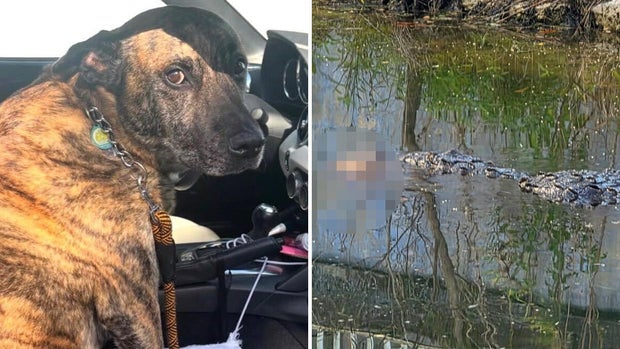
A South Miami family is mourning the loss of their 9-year-old Dutch Shepherd after the dog was attacked and killed by a crocodile Thursday morning, an encounter the dog's owner says happened just feet from the shoreline.
The crocodile had reportedly been spotted in the area before the attack, and one neighbor told CBS News Miami he had warned people who walk their dogs near the water about the animal.
"I warned everybody about it. There is a big crocodile, and he looks, he sits and he watches," said Dexter Lovett, who said he had previously recorded video of the crocodile while fishing.
Lovett said he repeatedly cautioned neighbors about getting too close to the water.
"Everybody who walks their dogs, don't take them by the water," he said.
Hours after the attack, Lovett helped recover the body of Kygo, a 9-year-old Dutch Shepherd belonging to Enrique Pomares. Lovett was also the person who called the family to tell them Kygo's body had been found.
Pomares said he believes the crocodile was massive.
"This thing was somewhere between 13 and 15 feet, so it's not a small animal," Pomares said.
Police said the attack happened near Southwest 64th Court in South Miami.
Pomares told CBS News Miami that he normally takes his three dogs — Kygo and two French bulldogs — outside in the morning. He followed the same routine Thursday, but shortly before 9 a.m., he said the crocodile grabbed Kygo near the shoreline.
Pomares initially considered going into the water in an attempt to rescue his dog.
"I was going to put my kayak in the water to try to get him, and then the crocodile came back out and came toward me," he said.
Pomares backed away, avoiding what could have become another dangerous encounter.
The death has left Pomares grieving and frustrated over what can be done about the crocodile.
"Crocodiles are protected, and there is nothing much that we can do," South Miami Detective Jackeline Del Sol said.
Police's warning to South Florida residents regarding the attack
Authorities in South Florida are urging residents to be aware of their surroundings after the crocodile attack in South Miami.
"Residents, pet owners, and visitors in the area are advised to remain vigilant around nearby canals, waterways, ponds and other bodies of water where a crocodile may be present," police said in a statement.
Police are reminding residents to keep dogs and other pets on a leash and away from the water, and to keep children under close supervision.
The American crocodile is protected under both state and federal law, and the public is reminded to not attempt to injure, capture, harass or relocate a crocodile.
It is also currently nesting season for alligators and crocodiles in South Florida. Zoo Miami Foundation conservation liaison Ron Magill says both creatures act on instinct rather than aggression.
"It just goes on instinct," Magill said. "So if something is splashing in the water, it doesn't know if it's you swimming or a duck struggling that could be food."
Magill says relocation is an option for the crocodile, but it is not always successful.
"These animals have an incredible homing instinct," He said. "It's not very easy to say we are going to move it, we are going to relocate it because we have generally found that if it's less than 100 miles or so, they are going to find their way back."
The dog's owner is urging for more done to protect residents and pets
Pomares said he wants to see whether something more can be done to protect residents and their pets.
"I'm reaching out to friends in the political arena and see what we can do," he said, becoming emotional as he spoke about losing Kygo.
The Florida Fish and Wildlife Conservation Commission responded to the location where Kygo's body was found. CBS News Miami reached out to the agency about the incident, and officials said it is under investigation.
Lovett said he believes authorities had been warned about the crocodile before Thursday's attack.
"They could have been warned, came and got it. I reported it several times," Lovett said.
Kygo's death is particularly painful because the dog was preparing for a major change.
Pomares said Kygo was going to move out of state with his daughter. She was so devastated by the dog's death that she declined to speak with CBS News Miami.
Instead of preparing for Kygo's move, the family is now saying goodbye to an animal they considered a member of the family.
Wildlife officials urge people to keep themselves and their pets away from the water's edge in areas where crocodiles may be present.
What to do during a Florida crocodile encounter
To stay safe around crocodiles, the FWC has several tips on how to do so:
- Keep your distance: If you see crocodiles, stay at least 20 feet away from them.
- Avoid the water at night: Crocodiles are the most active at dusk and dawn.
- Swim in designated areas: Only swim in areas where it's safe to do so.
- Keep pets away: Keep your pets leashed and away from the water.
- Don't feed them: It's illegal and dangerous to feed crocodiles.
- Dispose of fish scraps properly. Throw away any fish scraps in designated containers and not in the water.
If a crocodile attacks you, the FWC said you should fight back if you can and make a lot of noise. If you're able to move, hit and kick the crocodile or poke it in the eyes to escape. Once you're away from the reptile, seek immediate medical attention.
If you are concerned about a crocodile, call the FWC at (866) 392-4286.
How to tell Florida's crocodiles and alligators apart
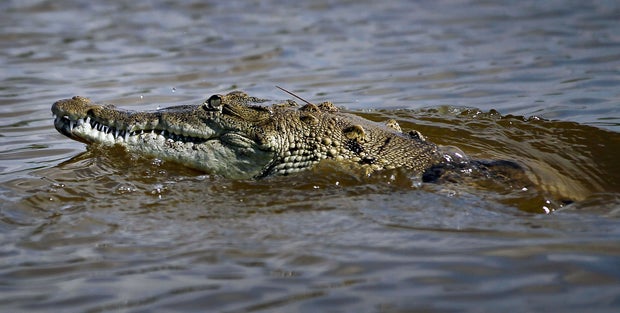
While American crocodiles and American alligators may look similar at first glance, several distinct traits make it easy to tell them apart once you know what to look for.
- Build and snout: Crocodiles are leaner and more streamlined, whereas alligators have a bulkier, heavier frame. The most obvious clue is in the snout. Crocodiles have a long, pointed snout, while alligators' are wider and rounded at the end.
- Teeth: The Florida Fish and Wildlife Conservation Commission notes that a crocodile's fourth tooth on each side of the lower jaw stays visible even when its mouth is shut. In alligators, that same tooth disappears when the mouth is closed.
- Color: Crocodiles tend to have a lighter gray or olive tone, while alligators are darker, almost black, which helps them blend into murkier freshwater environments.
- Habitat: Crocodiles favor South Florida's coastal zones and brackish waterways such as mangroves, canals and estuaries. Alligators, by contrast, are freshwater dwellers that populate lakes, ponds and marshes across the state. As a result, crocodiles are rarely spotted far from saltwater, while alligators are common well inland.