Nepal flood death toll surpasses 600, with more than 3,000 missing, as poor weather hampers rescues
The death toll from Wednesday's devastating flash floods in Nepal and along the border with China rose to at least 676, with around 3,000 people still missing, as rescue operations entered their fourth day.
Chinese authorities have reported seven deaths and more than 550 missing, while Nepal's disaster agency said the death toll had climbed to 669 with 2,426 missing.
Poor weather and challenging terrain have hampered aerial rescue operations.
In Nuwakot, one of the Nepali districts devastated by the floods, helicopters resumed operations before noon Saturday after poor weather temporarily obstructed their activities. Some helicopters were loaded with boxes and bags of aid, including clothes, instant noodles, crackers and rice. Others returned from the flood-hit areas carrying survivors.
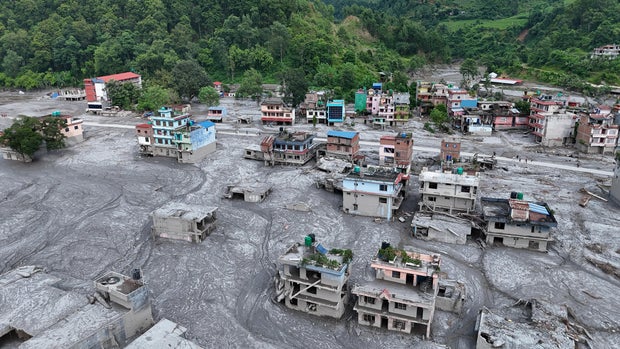
More than 3,700 people have been rescued in Nepal so far, according to authorities there, while China's state media said 558 people were missing on the Chinese side. Hundreds of the missing are foreigners who were in the area to work, trek or make a pilgrimage to a sacred peak on the Tibet side of the border.
Authorities search for dozens trapped in tunnels
Nepal's government says more than 100 workers may still be alive and trapped inside tunnels at hydropower projects, with rescue efforts focused on the Trishuli 3A and 3B sites. Initial reports suggested the 100 trapped were in a single location, but Energy Minister Biraj Bhakta Shrestha said "rescue efforts are going on in multiple tunnel sites." Rescuers managed to reach some people with helicopter baskets and ropes, but struggled with 4 to 5 feet of mud and limited landing sites, Brig. Gen. Raja Ram Basnet said.
On Saturday, rescuers broke through the mud at Trishuli 3A. They were able to begin sending air into the tunnel, and excavation efforts are underway, Nepali Home Minister Sudan Gurung. The Ministry of Energy reported efforts to send a camera into the tunnel have begun.
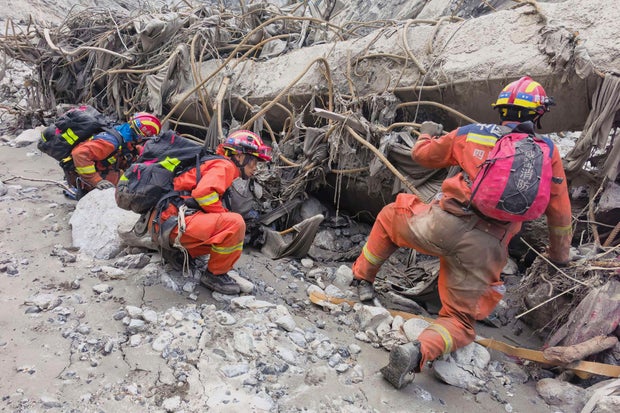
Specialized Indian and Chinese tunnel-rescue teams have joined the effort to free the trapped workers. India has extensive experience with difficult Himalayan tunnel rescues, including teams of "rat-hole" miners skilled in being able to crawl into narrow spaces. Nepal's expert mountain rescue teams — used to aiding climbers on the world's highest peaks, including Everest — are also joining the search for the missing.
Photographs shared by Nepal's disaster office showed workers wading through churned mud and navigating vast boulders left by the floods.
Priti Kharel said she believes her brother Milan is one of those trapped. He works as an engineering geologist at Doosan Enerbility, and his family has not heard from him since the floods. Kharel said friends who were at the site told her family that Milan might still be there.
"It's already four days," Kharel said. "We want the government to rescue him as soon as possible."
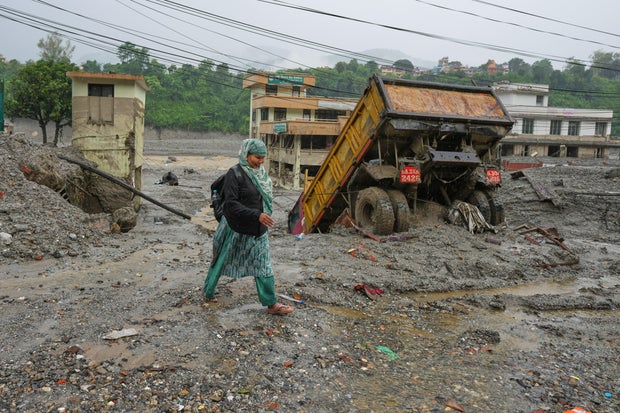
Nepalese Foreign Minister Shisir Khanal said locating those still missing is "currently our national priority." He said Nepal's government has sought specialized support from neighbors for tunnel rescue, survivor-detection technology, rapid forensic and DNA analysis, and morgue refrigerators.
Families search for information
At relief centers, families are waiting anxiously for news of their loved ones as the death toll and the number of those missing continue to rise. Others scour hospitals and paper lists for any signs of hope.
In Kathmandu, Nepal's capital, relatives and friends gathered outside the main government hospital from early morning, desperately searching for news of missing loved ones. Many shuffled between the help desk and the hospital notice board, clutching photographs and scanning injured patients' lists in the hope of finding them.
Families covered hospital walls with posters showing missing relatives, photographs and contact numbers in a desperate appeal for any clue that could bring them home. Nearby were photographs of unidentified bodies that officials put up in hopes families or friends could recognize them.
Gajendra Rawat, a security official at the hospital help desk, said families had so far registered around 1,600 missing persons since the disaster struck.
"People are coming from all parts of Nepal," he said.
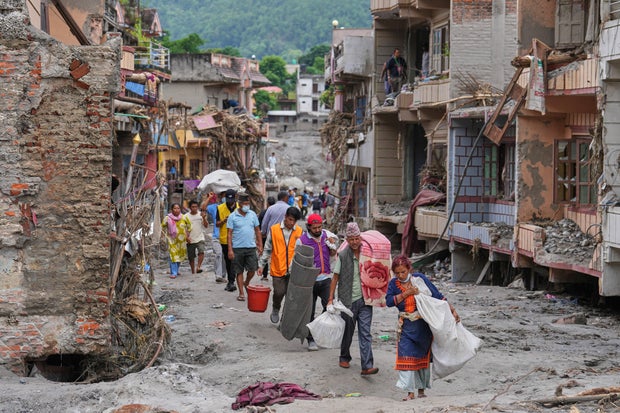
Dil Maya Lama stood weeping outside the help desk at the hospital, searching for information about her missing 26-year-old brother, a driver for a hydropower company in Rasuwa. She had traveled from Ramechhap, about 80 miles away.
"I came here with the hope that I might find him," she said. "There is no information about him."
Nelza Moktan anxiously sought information about her missing cousin, who also worked as a driver in Rasuwa.
"I feel hopeless. It has already been four days," she said.
Back in Nuwakot, military personnel taped sheets of paper listing dozens of missing people to a wall at a relief center, prompting families to crowd around them. Some scanned lists of the missing and dead, took photos and wiped away tears. Rajesh Kumar Ram, who is searching for his son, desperately searched a list for his son's name.
"I'm hopeful, by chance, that my son is somewhere," he said, crying as he spoke. "Maybe they find him stuck somewhere. I'm waiting for that moment only."
The Red Cross said Friday that some 90,000 people had likely been impacted by the flooding. Khanal said Nepal has received over 57 metric tons of relief supplies from India, with additional aid arriving from China, Japan, Australia and other countries. Khanal added that further support will be sought as needs assessments continue.
Authorities wary of further flood risk
Rescuers have been on high alert for more flooding from a new lake that formed high up in the Himalayan mountains after the initial floods on Wednesday. Experts warned that the lake, created after the glacier collapse that triggered the floods, was starting to overflow.
Basnet said rescue teams had been forced to relocate temporarily when authorities issued warnings about possible further flooding.
Monitoring data from the Chinese Ministry of Water Resources showed late Friday that the lake had dwindled in size. The water level dropped by 32 feet from its high point on Thursday morning, Chinese broadcaster CCTV said.
Scientists said satellite images indicated that the initial flooding was caused when bedrock underneath a glacier high in the Himalayan region had collapsed, taking part of the glacier with it. The rockfall was so extreme that it registered as a magnitude 5.2 seismic event. The rocks and melted water suddenly swelled the rivers in the valleys below, causing torrents of water that swept buildings, bridges and earth downstream in Tibet and Nepal.
Jakob Steiner, a geoscientist at the University of Graz in Austria who is currently based in Bangladesh, said "a lower part of a glacier has really come off."
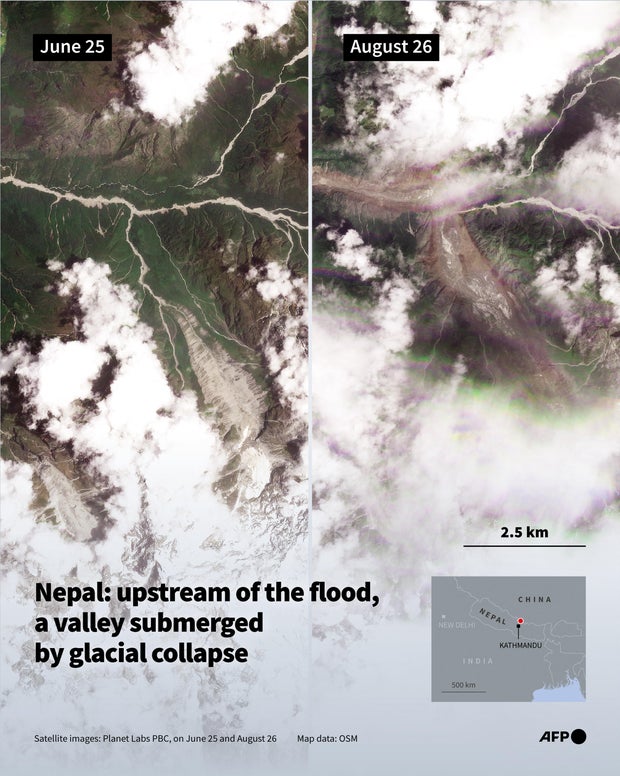
The Hindu Kush Himalayan region is warming rapidly, driving major changes in glaciers, snow cover, permafrost and mountain slopes, according to climate scientists. Around 78% of the glacier area, located between about 14,760 and 19,685 feet above sea level, is highly exposed to warming.
"What happened yesterday is unfortunately the new normal. It's going to get worse from here onwards," Steiner said.
Americans among the missing
Five Americans have made their way to safety, and around 90 are among those unaccounted for, the U.S. State Department said Friday.
In a statement, the U.S. Embassy in Nepal said the U.S. was "delivering a range of supplies requested by the Government of Nepal and is working with Nepal to ensure that assistance reaches the people who need it."
"Catholic Relief Services, working through implementing partner Caritas Nepal, will deliver more than 2.5 metric tons of food supplies, 500 blankets, 500 mosquito nets, and 500 insulating foam sheets for temporary shelter flooring to two school locations in Rasuwa," the embassy said, noting plans for subsequent supply shipments were already in place.
Twenty-two people from the U.S. were among the 80 who went missing from a pilgrimage run by the Isha Foundation, a volunteer-run group that promotes well-being founded by Indian spiritual leader Sadhguru Vasudev.
"At this point we are awaiting word," community liaison Leslie Crespi said in a phone interview from McMinnville, Tennessee, of the missing pilgrims. "We have done as much outreach as we can through the State Department, through the embassy."
The 22 missing Americans were all adults, and included 13 women and nine men, the foundation later said in data it provided to CBS News. She said the Isha Foundation has organized pilgrimages for 21 years, and "in those 21 years, we have never lost a life."
U.S. citizen Deepak Dandu said his wife, Sridevi Vejella, was among those missing in Nepal. She was on the pilgrimage with the Isha Foundation to Mount Kailash in Tibet — a sacred site for Hindus, Buddhists and others — which he said was a "lifelong dream" for her.
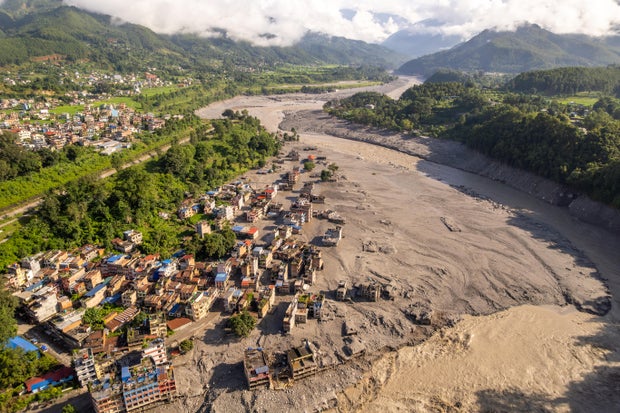
He told CBS News she was crossing from China into Nepal when the flood hit. The foundation told him she was part of a group that was present at the Gyirong Port immigration complex.
President Trump called the flooding terrible to see on Thursday, saying that "strong, well-built buildings were wiped out like they were toothpicks."
He told reporters in the Oval Office that U.S. officials had spoken with Nepalese leaders and offered to provide "anything they want."


