First-time Miami voter says aunt's deportation, abortion rights and economy are driving her to the polls
For 21-year-old Sofía Lumbre, voting in her first U.S. election is more than a civic duty. It's an opportunity to make her voice heard on issues that have directly affected her family, including the recent deportation of her aunt.
Lumbre, a nursing student at Florida International University, became a U.S. citizen last year and plans to cast her first ballot in the Nov. 3 midterm elections.
"I feel like I have a responsibility to myself, to my family, and to my country," Lumbre said. "I feel more like an adult."
Born in Spain to Peruvian parents who immigrated to Miami 19 years ago, Lumbre said she always knew she wanted to participate in an election. She registered to vote before leaving the U.S. Citizenship and Immigration Services (USCIS) field office after becoming a citizen.
But she never expected her first election to feel so personal.
Aunt's deportation brings immigration concerns close to home
One of Lumbre's biggest motivations for voting is the deportation of her aunt, who she said was detained by U.S. Immigration and Customs Enforcement (ICE) in July.
According to Lumbre, her aunt spent a month at a detention facility in New Orleans before being deported to Lima, Peru. Lumbre declined to identify her aunt, citing concerns for her family's safety.
"Ever since my aunt got deported, I've been scared," Lumbre said. "My parents always tell me to carry my passport with me at all times."
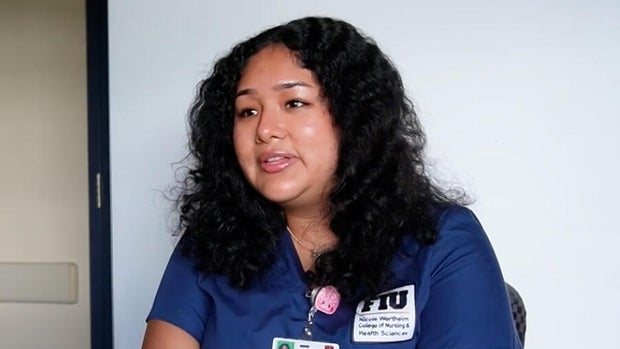
The experience has left her worried about other relatives, particularly her mother, who she said is not fluent in English.
"I'm scared that maybe one day, they are going to stop her and she's not going to know how to explain herself," Lumbre said.
Abortion rights and economy also shape her vote
Immigration is not the only issue influencing Lumbre's political views. She is also concerned about abortion rights and the economy.
The U.S. Supreme Court's 2022 decision overturning Roe v. Wade, which ended the federal constitutional right to abortion, is particularly important to Lumbre as she pursues a career in nursing.
"As someone in the nursing profession, I do believe that abortion is a given right to anyone," she said.
The rising cost of living is another concern, especially gas prices.
Lumbre, who recently purchased a Honda, said she has been frustrated by how much it costs to fill up her car.
"When I first got my car, gas prices were already $4. I never was able to experience the $3.20 kind of thing," Lumbre said. "It's really frustrating."
Navigating misinformation ahead of her first election
As Election Day approaches, Lumbre has been researching candidates and their positions on issues that matter to her.
Much of what she has learned has come from social media, but she recognizes that not everything she encounters online is reliable.
"I always double check," Lumbre said. "I go on Google and search up the thing I saw, and it tells me if it's true or not."
She said she is particularly cautious about news sources she considers politically biased and worries that social media algorithms can reinforce people's existing beliefs by showing them information that aligns with their views.
Beyond misinformation, Lumbre is also anxious about the voting process itself.
"I don't know what to expect when I go to the voting facility," she said.
She is especially concerned about encountering people outside her polling place who might try to influence her decision.
"I'm scared that there's going to be protestors out there telling me to change my vote," Lumbre said. "I'm scared to be influenced the wrong way."
Despite those concerns, she won't be heading to the polls alone.
Lumbre plans to vote alongside her younger brother, who recently turned 18 and will also be casting his first ballot. She also hopes to get guidance from her sister, who will be voting for the second time.
A first vote with hopes for the future
For Lumbre, participating in the midterm elections represents a milestone in her life as a new American citizen and an opportunity to help shape the country's future.
While voting may be routine for millions of Americans, she sees it as a chance to have a say in decisions that could affect her family and others facing similar challenges.
"Voting is something that a lot of people do every four years, but to me it's something new," Lumbre said.
"I hope that the country does better in the future. There's a lot of disagreements going on, there's a lot of war, there's children being left stranded because of deportation."
This story was written by a Florida International University journalism student for Caplin News, a publication of FIU's Lee Caplin School of Journalism & Media, and edited by CBS News Miami.