18 people, including ex-Haitian official, appear in Miami court involving plot to kill Haiti's president in 2021

A former Haitian government official and more than a dozen other people appeared Monday in federal court in Miami on charges related to the 2021 assassination of Haitian President Jovenel Moïse.
Joseph Badio, a former Haiti Ministry of Justice employee, was brought into the Florida court in a wheelchair. The hearing happened a day after he and 17 others described as Colombian mercenaries were flown to the United States from Haiti where they had been in custody.
They're among 30 people charged in the indictment, including Christian Sanon, a Palm Beach County, Florida, resident and dual Haitian-American citizen who was already preparing to face trial next week. Authorities said he aspired to be Haiti's president.
Cameras are not allowed in federal court, but CBS News Miami was able to observe the men being brought into court. They were handcuffed, shackled, and brought in one group at a time.
When they were all seated together, they filled an entire side of the courtroom. The judge called them up one at a time.
Many of them, through an interpreter, asked for a court-appointed public defender.
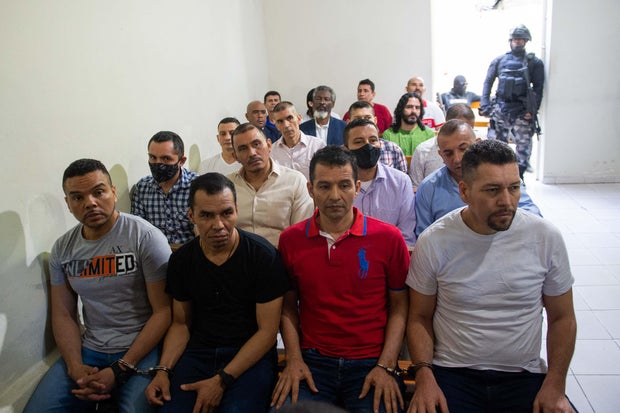
South Florida served as a central location for planning and financing the plot to oust Moïse and replace him with someone of the conspirators' choosing, U.S. authorities have alleged. At least nine people so far have been convicted at trial or through guilty pleas.
Moïse was "assassinated by individuals seeking to profit from illicit financial opportunities and business contracts," U.S. Attorney Jason Reding Quiñones said.
Moïse was killed on July 7, 2021, when about two dozen foreign mercenaries, mostly from Colombia, attacked his home near Port-au-Prince. Moïse's wife, Martine, was wounded during the attack.
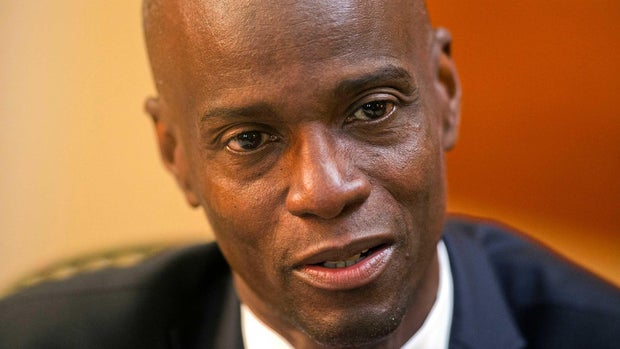
Badio posed as a U.S. drug agent and participated in Moïse's killing, according to the indictment. He's charged with conspiracy. A lawyer appointed to temporarily represent him could not immediately be reached for comment.
Badio once worked in the government's anti-corruption unit until he was fired for alleged ethics violations weeks before the assassination.
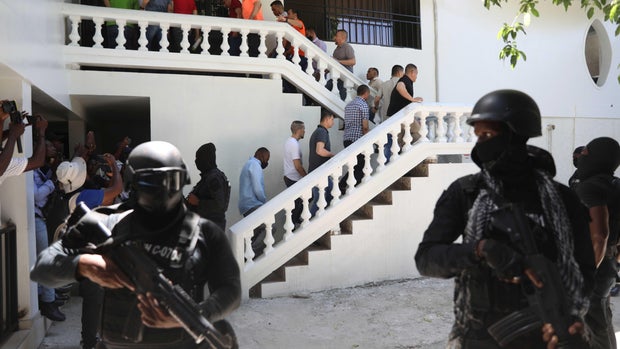
U.S. Magistrate Judge Lisette Reid assigned lawyers and set additional court dates during a series of brief dialogues with each of the 18 defendants.
On Sunday, Haiti's Ministry of Justice and Public Security said that it surrendered the suspects to the U.S. "to allow for their trial."
Any proceedings in Haiti "continue to face significant difficulties," the statement said.
The scheme to kill Moïse included paying mercenaries with money obtained from U.S. government programs that were intended to help businesses during the COVID-19 pandemic, the indictment says.
Haiti has not had a president in the five years since Moïse's death. It has instead been overwhelmed by gang violence: More than 3,000 people were killed this year by June, and about 1.5 million people were displaced, according to the U.N.
An expert explains why the trial was moved to South Florida
"Haiti is an unfortunate case because it has no functioning court system," said Dr. Eduardo Gamarra, professor and Latin Affairs expert at FIU.
He says that has delayed a trial and that's partly why it's been moved to the United States. The other reason: much of the alleged planning of the plot was done in South Florida.
He believes some of the Colombian mercenaries may try to argue they did not know exactly what they were being asked to do.
"A lot of the Colombian soldiers have been arguing that they did not know they were going to kill the president," Gamarra said.
"That's what they've been saying and, you know, who knows if it's true or not — the reality is that the president was killed," he added.