Lawsuit accuses Florida of violating rights of defendants with mental illness held in jail without treatment

Elizabeth Pizzo was terrified earlier this year of what would happen to her son.
"Honestly, I was afraid I was going to have to bury my kid," she said. "I cried, and I prayed. It was awful. I didn't know what to do. I really felt helpless."
Starting in 2024, her son Phillip, who was diagnosed with schizophrenia and has struggled with mental health issues for most of his life, stopped taking his medication and had a series of minor run-ins with the law, including a charge that he attempted to assault a police officer.
Last Fall, for the second time in less than a year, a judge determined he was "incompetent to proceed" and ordered the state to transfer him to a state hospital for treatment. Under Florida law, that transfer was supposed to happen within 15 days. But despite two separate judges, in two different counties, finding Phillip in need of immediate help, he languished.
Phillip remained in an isolation cell at a county jail for months, where his mental state steadily declined. The jail staff said he would spend days standing naked in his cell, staring blankly off into the distance and refusing to speak to anyone. Other days he would become agitated, punching the walls until he fractured his hand.
The jail staff, unequipped to handle the seriously mentally ill, would intercede in the only way they knew how – restraining him, tackling him, tasering him and using pepper spray. After one encounter with jail staff, Phillip was taken to the infirmary with a bloody white bag over his head as one of his eyes was swollen shut.
"I was angry," Elizabeth recalled. "I mean, I was very, very angry. I was frustrated. We didn't know what was really going on. The mentally ill should not be in jails at all. It only makes things worse."
On Wednesday morning, a group of advocates filed a federal civil rights lawsuit in Miami against the state of Florida and the Department of Children and Families, arguing that cases like Phillip's are now so common that the delays amount to deliberate and unconstitutional punishment of people with mental illness.
Click on the image below to read the full lawsuit.
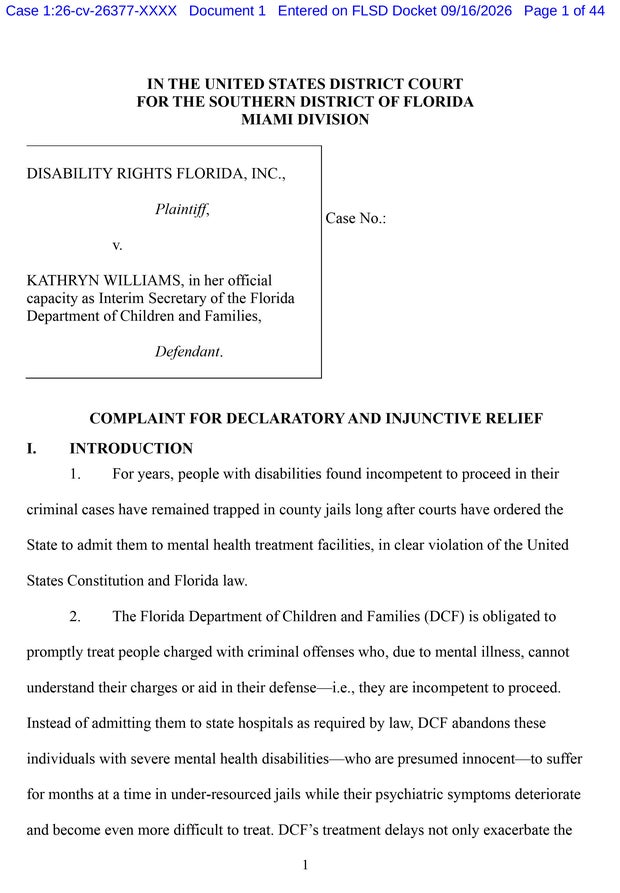
"For years, people with disabilities found incompetent to proceed in their criminal cases have remained trapped in county jails long after courts have ordered the State to admit them to mental health treatment facilities, in clear violation of the United States Constitution and Florida law," the suit contends. "The Florida Department of Children and Families (DCF) is obligated to promptly treat people charged with criminal offenses who, due to mental illness, cannot understand their charges or aid in their defense."
"Instead of admitting them to state hospitals as required by law," the suit continues, "DCF abandons these individuals with severe mental health disabilities – who are presumed innocent – to suffer for months at a time in under-resourced jails while their psychiatric symptoms deteriorate and become even more difficult to treat. DCF's treatment delays not only exacerbate the risks stemming from this vulnerable population's disabling conditions, but the delays also often cause physical and mental harm that would otherwise be avoided."
The lawsuit was filed by Disability Rights Florida, along with the Southern Poverty Law Center, the Florida Justice Institute and the Washington civil rights law firm of Terris, Pravlik and Millian.
"Individuals with mental health disabilities, including those who have been arrested and deemed incompetent to proceed, deserve to be treated with dignity and respect," said Caitlyn Clibbon, litigation director for Disability Rights Florida. "Instead, DCF allows these individuals to suffer for months in jails which are neither equipped nor funded to provide the type of treatment they need and that the court has ordered. This cannot continue."
"Denying people with serious mental illness access to court-ordered mental healthcare is both cruel and unconstitutional," said Kelly Knapp, senior staff attorney for the Southern Poverty Law Center. "Florida has known about this crisis for nearly 50 years, and yet every time the waitlist grows, the state's answer remains the same: further delays. These individuals with mental health disabilities have not been convicted and are presumed innocent. Yet, the state is punishing them by leaving them to deteriorate in jail cells instead of providing desperately needed treatment."
According to the suit, it takes, on average, more than 115 days for individuals who are judged to be incompetent to proceed to receive treatment – long past the 15 days required by law. And the delay often takes six months or longer.
The lawsuit also claims DCF maintains "a fluctuating waitlist of between 650 and 880 people across Florida."
The suit also claims that at least three individuals, who were waiting for treatment, died while in custody in local jails. It also provides a dozen harrowing examples of individuals who were held in county jails for months without treatment, allowing their mental state to deteriorate.
"The state cannot leave people in legal limbo while their mental health deteriorates," said Dante Trevisani, litigation director, at the Florida Justice Institute. "It must address this crisis that has persisted for decades."
DCF did not immediately respond to a request for comment regarding the lawsuit. In the past, DCF have complained to legislative officials that they do not have the funding or the hospital space to treat in a timely manner individuals found to be incompetent.
That argument holds little sway with Knapp, the SPLC attorney.
"The federal Constitution does not allow for the defense of, `We don't have enough money,'" she told CBS News Miami. "It's cruel, it's inhumane to hold somebody with a serious mental illness in county jails that are unequipped to provide the treatment that they need, and it is also punishment because these people have not been convicted of any crime. Not dedicating, not prioritizing, not committing to funding the mental health services that are necessary under state law and the federal constitution is not an adequate excuse."
For Phillip, it was 117 days before he was finally transferred to a state hospital to receive the treatment he needed. But for each of those 117 days, Elizabeth worried her son was either going to be killed in jail or that he would take his own life.
Once he made it to the hospital, Elizabeth remembered what he was like when she finally was able to see him. His front tooth was broken from one of his encounters with jail guards, and he was very quiet, almost childlike.
"He said to me, `Hi mama, my tooth is broken.' And he said, `They tased me,'" she recalled. "I was mortified. How can this happen? It is abuse on such a high scale for the vulnerable. I never expected this to happen,"