Florida's new congressional map faces court challenge over alleged partisan gerrymandering
New U.S. House districts that could help Republicans win several additional seats in Florida are set to face their first test in court Friday, amid claims that the map violates the state's constitutional ban on partisan gerrymandering.
Lawsuits filed on behalf of voters ask a state judge to block the districts from being used in the midterm elections, creating a potentially significant hurdle for President Donald Trump's effort to maintain a narrow Republican majority in the U.S. House by redrawing districts in the GOP's favor.
Republicans currently hold 20 of Florida's 28 U.S. House seats.
The new congressional map, signed into law by Gov. Ron DeSantis after a swift two-day special legislative session, could improve the party's chances of winning four additional seats in November.
Florida lawmakers approved the new map on April 29, the same day the U.S. Supreme Court weakened federal Voting Rights Act protections for minorities while striking down a majority-Black congressional district in Louisiana. Since then, several Southern states have moved to eliminate minority districts that have historically elected Democrats.
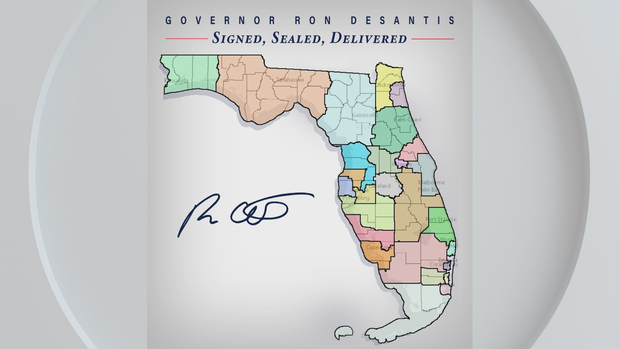
Challenges over partisan gerrymandering in Florida
Congressional districts are typically redrawn once every decade following the U.S. census to account for population changes. But after Mr. Trump pushed for mid-decade redistricting last year, Republicans began pursuing new maps in several states, including Texas, Missouri, North Carolina, Ohio, Florida, Tennessee and Alabama. GOP leaders believe those efforts could net as many as 15 additional House seats.
Democrats, meanwhile, believe they could gain six seats through redistricting efforts in California and Utah.
Democrats had also hoped to gain up to four additional seats in Virginia, but the Virginia Supreme Court last week struck down a Democratic-backed redistricting plan approved by voters, ruling lawmakers failed to follow proper procedures when placing it on the ballot.
The U.S. Supreme Court ruled in 2019 that federal courts do not have the authority to decide whether partisan gerrymandering goes too far. However, the court said such claims can still be challenged in state courts under state constitutions and laws.
Florida voters approved a constitutional amendment in 2010 prohibiting congressional districts from being drawn to favor or disfavor a political party or incumbent. The amendment also bars districts from diminishing the ability of racial or language minorities to elect candidates of their choice and requires districts to be compact while following existing political and geographic boundaries whenever feasible.
Lawsuits argue Florida's new map favors Republicans
The lawsuits, filed in Leon County on behalf of voters, seek a temporary injunction blocking the new congressional map from taking effect. The legal challenges focus heavily on allegations of partisan favoritism.
"The plan takes the state's partisan skew to an unprecedented extreme," one of the three lawsuits states.
A legal brief filed on behalf of the Florida Senate argues that partisan intent has not been proven and says a temporary injunction would be inappropriate before a full trial is conducted.
Although DeSantis called lawmakers into special session before the Supreme Court ruling in the Louisiana case, his administration anticipated a decision that would weaken Voting Rights Act protections for minority districts.
Among the changes in the new map is the reshaping of a southeastern Florida district that DeSantis' office said had originally been designed to help elect a Black representative in compliance with the federal Voting Rights Act.
DeSantis' office said racial data was not used in drawing the new map presented to lawmakers. In a memo to legislators, DeSantis General Counsel David Axelman argued that Florida's constitutional provision governing racial redistricting violates the U.S. Constitution.
Axelman further argued that if one part of the 2010 amendment is found unconstitutional, then the entire amendment, including its ban on partisan gerrymandering, should be considered invalid.