Florida AG calls state's bump stock ban unconstitutional, says office will no longer defend it
Florida Attorney General James Uthmeier announced that his office will no longer defend the state's ban on bump stocks in appeals of convictions under the law, arguing that the 2018 measure violates the Second Amendment.
The announcement marks a significant shift in the state's position on a gun control measure enacted following the 2018 mass shooting at Marjory Stoneman Douglas High School in Parkland, which left 17 people dead.
"As currently written, the overly broad law appears to restrict the use of trigger enhancements used by firearms owners for lawful purposes, subjecting them to five years in prison," Uthmeier wrote Friday on X.
Uthmeier also shared a formal legal opinion from his office arguing that Florida's ban is unconstitutional because it prohibits an entire category of firearm accessories protected by the Second Amendment.
The opinion states that the law "imposes a categorical prohibition on an entire class of firearm components that can increase a semiautomatic weapon's rate of fire."
"But semiautomatic firearms with these and similar structural modifications are bearable arms covered by the Second Amendment's plain text," the opinion continued.
The announcement does not repeal Florida's bump stock ban, which remains on the books.
What are bump stocks, and why were they banned?
Bump stocks are firearm accessories that allow semiautomatic weapons to fire more rapidly by using the weapon's recoil to facilitate repeated trigger pulls.
The devices became a focus of gun control efforts following the Oct. 1, 2017, mass shooting in Las Vegas, when a gunman fired more than 1,000 rounds from a 32nd-floor hotel balcony into a crowd attending an outdoor concert, killing 58 people and wounding hundreds more.
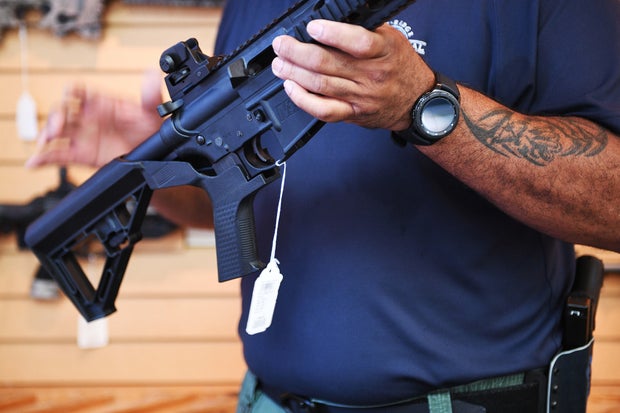
The federal government subsequently banned bump stocks, but the U.S. Supreme Court overturned that prohibition in a 6-3 decision in 2024.
The court ruled that bump stocks do not convert semiautomatic firearms into machine guns under federal law because the trigger must still be released and reengaged for each additional shot.
Unlike semiautomatic firearms, machine guns can fire multiple rounds with a single pull of the trigger and are subject to strict federal restrictions.
The Supreme Court's ruling addressed the federal government's authority to ban bump stocks under existing law, rather than whether such bans violate the Second Amendment.
Florida's separate state-level prohibition remained in effect following the decision.
Florida's bump stock ban was enacted after the Parkland school shooting
Florida lawmakers approved the bump stock ban in 2018 as part of a sweeping school safety and gun control package following the Feb. 14 shooting at Marjory Stoneman Douglas High School in Parkland, where 14 students and three staff members were killed.
The legislation included three major gun control provisions: banning bump stocks, raising the minimum age to purchase rifles from 18 to 21, and establishing a "red flag" law allowing authorities to seek court orders temporarily removing firearms from people deemed a danger to themselves or others.
The measure also provided funding for school safety improvements and established a guardian program to train certain school personnel to carry firearms and respond to potential shootings.
Although the legislation received bipartisan support, it also divided lawmakers in both parties.
Some Republicans opposed the gun control provisions, while some Democrats, particularly Black lawmakers, raised concerns about allowing armed personnel in schools.
Then-Gov. Rick Scott, a Republican, signed the legislation into law and has defended it as a necessary measure to help prevent future mass shootings.
Governor-elect Byron Donalds opposed the 2018 gun control law
Florida Governor-elect Byron Donalds, who served in the state House when the legislation passed in 2018, voted against the measure.
Donalds has also criticized the gun control provisions included in the law during his campaign for governor.
Uthmeier's announcement comes as Florida prepares for a new administration under Donalds, who is set to take office in January.
While the attorney general's decision changes how his office will handle appeals involving convictions under the bump stock ban, the law itself has not been struck down by a court or repealed by the Legislature.