101 Freeway wildlife crossing bridge gets first layer of soil
The Wallis Annenberg Wildlife Crossing over the 101 Freeway in Agoura Hills got its first layer of soil on Monday.
The bridge, made with 26 million pounds of concrete, is unlike most freeway overpasses, as it is intended only for animals and will be off-limits to humans.
While the passing will support a variety of wildlife, including deer, bats, desert cottontails, bobcats, native bird species, and monarch butterflies, its primary inspiration was the mountain lion.
"This crossing will save the local mountain lion population from extinction, stand as a global model for urban wildlife conservation – and show us that it's possible for a structure of this magnitude to be built in such a densely populated urban area," Beth Pratt, California's executive director for the National Wildlife Federation said earlier at the onset of construction.
Researchers have estimated that the mountain lion population in the Santa Monica Mountains could become extinct within 50 years. The lions are largely isolated due to freeways that act as barriers to movement across the region.
Los Angeles's favorite feline, P-22, had to be euthanized in 2022 from what animal care workers described as chronic health problems and too many severe injuries, suspected to be linked to a vehicle strike. P-22 was famously known for roaming through the Hollywood Hills and Griffith Park area.
Work on the wildlife crossing began in 2022 and is scheduled to be completed in 2026. The 165-foot-wide crossing spans 10 lanes of the 101 Freeway at Liberty Canyon Road, connecting the Santa Monica Mountains with the Simi Hills and Santa Susana Mountains.
Construction started one day after a mountain lion was struck and killed by a vehicle on the 405 freeway in the Sepulveda Pass. The month prior, a mountain lion was also struck and killed on Pacific Coast Highway in Malibu.
Monday's soil addition marks the first steps of turning the bridge's construction into a living habitat. "This is the first natural layer. We are going to be putting the first layers of subsoil on, and for me, what I can envision with that is a mountain lion's paw print in the soil," Pratt said.
The soil was engineered by soil scientists, biologists, engineers, and mycologists as they worked to identify, harvest, and cultivate native soil biology and beneficial fungi directly from the project site.
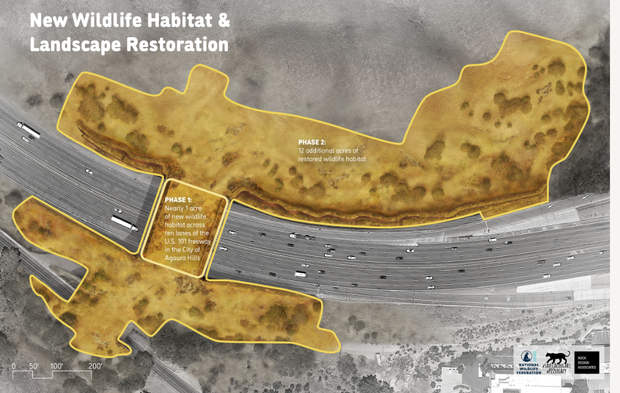
After the soil is laid across the nearly 1-acre native wildlife habitat site, about 5,000 native shrubs and wildflowers collected from the surrounding area will be planted on the crossing.
Another element of the bridge that is to encourage wildlife use will be the 12-foot-tall sound walls on both sides of the structure, which drown out traffic noise.
In the second phase, as part of broader ecological restoration efforts, the adjoining additional 12 acres of open space will benefit from the planting of 50,000 native plants, including native trees, shrubs, and perennials.
The crossing is named for the Annenberg Foundation, a major financial contributor to the effort. The effort is a public-private partnership that includes Caltrans, the National Park Service, the Santa Monica Mountains Conservancy/Mountains Recreation and Conservation Authority, Resource Conservation District of the Santa Monica Mountains, and the National Wildlife Federation.