Retiring Smithsonian head Lonnie G. Bunch III: "You can run from history, but you can't hide"

When Lonnie G. Bunch III walks through the Smithsonian's National Air and Space Museum in Washington, D.C., his love of history is on full display. "I just love this museum so much," he said.
One of his favorite pieces: The 1903 Wright Brothers' flyer, the first successfully-flown powered airplane. "I was in North Carolina, Kitty Hawk, and went to see the replica, and I wanted to say, 'We got the real one!'" he laughed. "And it's here in the Smithsonian, so that forever, people are going to be able to say, 'Oh, my goodness,' and really sort of begin to understand the creativity and the joy that is incumbent in the American spirit."
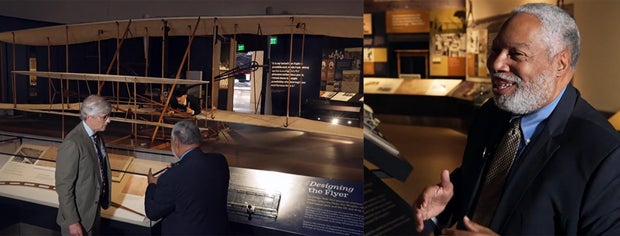
As Secretary of the Smithsonian Institution, Bunch runs the place, overseeing 20 museums and the National Zoo. But it was the Air and Space Museum that launched his career nearly 50 years ago when he was hired by the museum's then-director, former Apollo 11 astronaut Michael Collins.
Asked what Collins saw in the 25-year-old historian, Bunch replied, "I think he probably saw passion. I cared so much about history. I didn't understand what I was going to do, but I loved it."
Bunch made history himself in 2019, becoming both the first historian and the first African American to serve as Secretary in the Smithsonian's 180-year history. At his installation ceremony seven years ago, he said, "We are here speaking in a place as an African American where Fredrick Douglass could not speak, but we are a different institution, we've made great changes and continue to do so. Nothing is impossible.
"I kept thinking about Frederick Douglass," Bunch told us, "and I really wanted to say, 'He's now speaking.' I just wanted to signal that I will never be afraid of telling truthful stories, no matter how hard or how painful they are."
Asked what happens if we don't tell difficult stories, Bunch replied, "It's kind of like, you know, you go to the doctor, you get your physical. And suddenly, you say, 'Only tell me half about what happened,' right? So, you only know a little bit about who you are – you're incomplete."
Museums, Bunch says, are the best storytellers in America. But over the last year-and-a-half, the Smithsonian itself has become the story. In March 2025, President Trump issued an executive order excoriating the institution for what it called its "divisive, race-centered ideology," and threatened to cut funding. And he hasn't held back on social media. In an Aug. 19, 2025 post, the president claimed the Smithsonian's museums were "out of control, where everything discussed is how horrible our county is, how bad slavery was…"
Asked if his decision to retire had anything to do with pressures from the White House, Bunch replied, "No, not really. And in fact, the challenges that we've experienced are one of the reasons I stayed so long. There's a part of me that says I should stay forever to protect the Smithsonian, but also to protect history, as well as sort of dealing with mischaracterizations that the Smithsonian is this place run by left-wing radicals who want to destroy America."
But that's pretty much how the White House painted Smithsonian leadership when it turned the screws even tighter this past July 4, with a 162-page report blasting its National Museum of American History. It claimed: "It would benefit most Americans, especially parents bringing their children for a tour, if the Smithsonian's flagship history museum had a label at every entrance that reads, 'Warning: The exhibits in this museum were prepared by people who don't want you to love your country.'"
"I can't even comment on that," said Bunch, "because the people who work at the Smithsonian love their country in profound ways. You know, the challenge is that often people look for simple answers to complex questions."
Among the report's allegations: The museum hasn't done enough to honor the founding fathers. "Those stories are there," said Bunch. "Could they be told more expansively? Sure. But I think the reality of saying that they aren't there, that there's not the love – more importantly, not the acknowledgment of the special nature of the Founding Fathers – is wrong."
Asked if he were personally offended that his patriotism has been questioned, Bunch replied, "Anybody that knows me personally knows my love of this nation. I'm the son of somebody who was a World War II veteran. I can remember every Memorial Day going to parades. So, I come at it from a world of, let us love our nation, but let us not be afraid to understand the totality of who we are. I believe very strongly that you can run from history, but you can't hide."
That belief was the driving force behind the creation of the National Museum of African American History and Culture, which opened its doors 10 years ago to near-universal acclaim. Bunch was its founding director. "There's no doubt that the most important thing I've ever done in my career was be part of building the National Museum of African American History and Culture, no doubt about it," he said. "Because that is a museum that says, 'Here is a story of us all. Here is a people's journey, but a nation's story.'"
As far as who will be the next head of the Smithsonian, Bunch suggests, "It needs to be somebody who cares about the history of the institution; needs to be somebody who understands the political world we're dealing in; and needs to be somebody who is courageous enough, when all else fails, to blame me" – the guy who was there before.
Until he leaves at the end of the year, Bunch says the institution he runs will continue doing its level best to give America a full picture of itself.
"The Smithsonian is America's collective memory," he said, "and you don't want to be a nation that forgets."
WEB EXCLUSIVE: Watch an extended interview with Lonnie G. Bunch III (Video)
Story produced by Robbyn McFadden. Editor: Lauren Barnello.
See more: