New study says toxic carcinogen from 2025 Los Angeles wildfires may have spread to 3.3 million people
A new University of California study says that a toxic carcinogen with "potentially serious impacts on human health" may have spread as far as nine miles downwind from the Palisades and Eaton fire zones in 2025 and reached more than 3 million people in Los Angeles County.
Michael Jerrett, the study's co-author and a professor of environmental health sciences at the UCLA Fielding School, says that hexavalent chromium, otherwise known as chromium-6, is a toxic metal and carcinogen that can impact a person's lungs and is commonly associated with asthma, bronchitis and lung cancer.
"It shows that well after the wildfires were extinguished, nanoparticles, which are so small they can enter the circulatory system very quickly, were in the air around the burn zones," Jerrett said in a news release posted on the UC Davis website. "These probably traveled far enough to give 3.3 million people doses that were hundreds of times the levels that are normally seen in the air in Los Angeles."
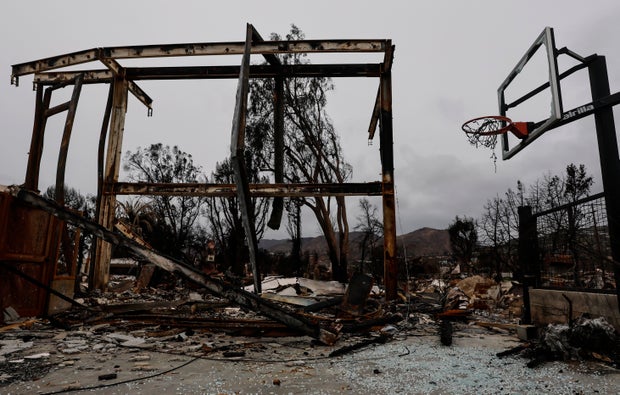
The study, titled "Airborne hexavalent chromium nanoparticles detected around cleanup zones for the 2025 Los Angeles wildfires," was peer-reviewed and published in the "Nature Communications Earth & Environment" journal. While still subject to final revisions, the findings suggest that the airborne chromium was "predominantly in the carcinogenic ... state two months after the fire."
The levels registered below the National Institute for Occupational Safety and Health workplace exposure limits, but above the U.S. Environmental Protection Agency's screening levels for indoor air.
"Caution and health surveillance is warranted for nearby residents given that nanoparticles can easily cross cell membranes and circulate throughout the body," said Michael Kleeman, the study's lead author and UC Davis College of Engineering and Air Quality Research Center professor.
He said that discovering airborne, chromium-bearing nanoparticles in wildfire debris cleanup zones is unique and implicates the fires as a source of the toxic metals. While speaking with CBS LA, Kleeman said that high temperatures in fire will convert some metals into a more dangerous state than they would've been otherwise.
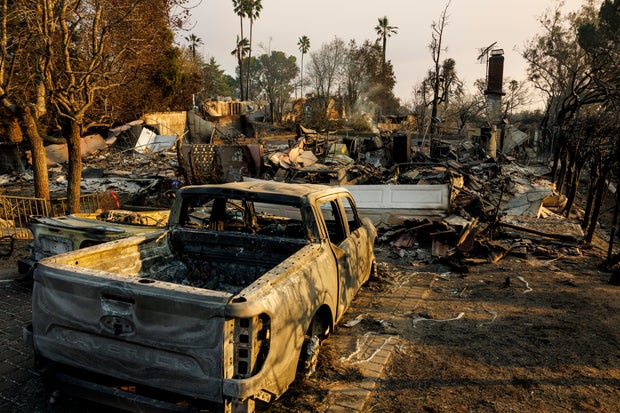
Researchers used calculations based on wind models, which suggest that the chromium nanoparticles may have traveled six to nine miles downwind, entering communities that are "well away" from the neighborhoods where the fires occurred.
"In Los Angeles, for example, that includes communities as far from the Palisades fire as the southern San Fernando Valley to the north and Beverly Hills and West Hollywood to the east," the UC Davis release said. Kleeman told CBS LA that other areas possibly affected by the traveling nanoparticles include Santa Monica, Venice, Brentwood and Westwood "and moving towards central Los Angeles."
Researchers said that chromium-6 concentrations declined over time through reduction to the less toxic form of chromium-3 before eventually returning to background levels around eight months after the fires.
"Monitoring near wildfire cleanup zones is warranted to ensure that concentrations decay to background levels over time," Jerrett said. "Residents living adjacent to wildfire cleanup zones should take steps to reduce their exposure by using indoor air filters and limiting outdoor exercise in the fire zones until conditions return to safe levels."
They also noted that the study highlights significant concerns about health risks that come with wildland-urban wildfires, which are increasingly common.
"Just like we need to learn to live with certain other natural disasters, I think we need to learn to live with this now," Kleeman told CBS LA.
The Palisades Fire, burned nearly 23,500 acres, killed 12 people and destroyed thousands of homes and businesses in the Pacific Palisades and Malibu areas, while the Eaton Fire destroyed more than 9,400 structures, killed 19 people and burned over 14,000 acres. The simultaneous blazes both register as two of California's most destructive and deadly since 2000.


