Highly-venomous snake possibly spotted in Santa Ana neighborhood

The Santa Ana Police Department urged residents to stay alert after receiving reports of a large, venomous snake in a neighborhood.
"We have received reports of a snake believed to be a Gaboon Viper, last seen in a tree within a residential neighborhood near Main Street and Edinger Avenue," police wrote in a Facebook post. "The snake is estimated to be approximately 4 to 5 feet long. Gaboon Vipers are highly venomous and are not native to North America."
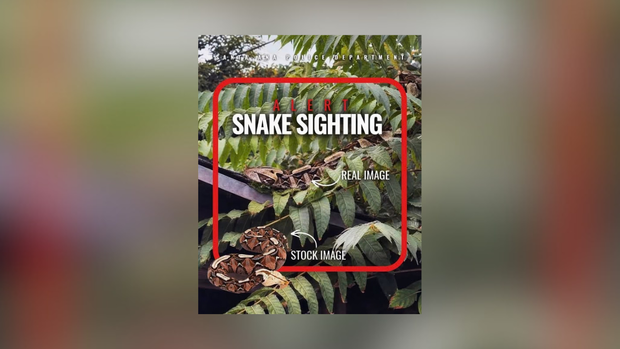
Joel Ciprian, who took the photo and sent it to police, said he brought his dogs into his home immediately after spotting the snake. Some didn't believe Ciprian, calling his photo AI-generated.
"I wish it was AI," Ciprian said. "It's in my backyard, and it's scary."
Santa Ana PD said Ciprian called police three minutes after taking the photo. Officers told CBS LA that they ran it through an A.I. detection system, which told them it was authentic.
"We're treating this as if it is a real snake," Officer Natalie Garcia said. "A Gaboon viper is a very serious snake. It's a very serious matter."
The Smithsonian's National Zoo and Conservation Biology Institute said the Gaboon viper's native habitat is in the rainforests and wetlands of Central, East and West Africa.
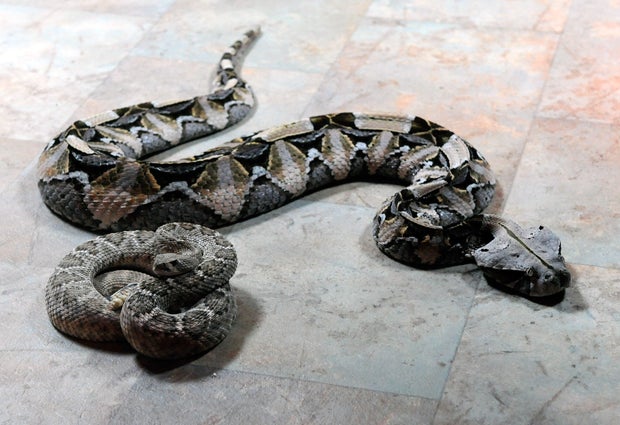
The Western and Eastern Gaboon vipers vary slightly in appearance and size but share a mix of light and dark brown, with pink and purple diamonds and stripes, according to the Smithsonian.
Smithsonian staff said the Eastern Gaboon viper can grow longer than 6 feet.
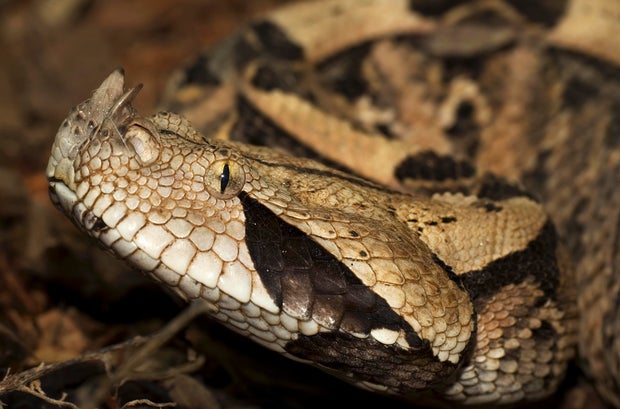
"Its coloration and broad head, which mimics a fallen leaf, camouflages it among leaf litter on the forest floor," the Smithsonian wrote on its website. "Though venomous, this snake has a calm nature and rarely bites humans."
The Los Angeles Zoo houses a Western Gaboon viper, which can be slightly smaller, with average sizes between 4-6 feet, but staff said it is still "one of the world's largest and heaviest vipers" with the highest venom yield of all venomous snakes.
"When threatened, they initially hold very still and hiss loudly as a warning," the LA Zoo wrote on its website. "While Western Gaboon viper bites are rare for humans, when they do bite, it is often fatal."
It added that the snake has a wide, triangular head with scales that look like a pair of horns.
"When I looked at it close, I was like, 'Oh, no, it's a venomous snake,' Ciprian said, before talking about the snake's horns.
The Smithsonian said the snake has a "placid nature" and typically bites humans when it's "stepped on before it has an opportunity to get away."
"In addition to its unwillingness to bite, the viper can control whether it injects venom and how much, so the result of a strike can range from no effect to rapid death," the Smithsonian wrote. "A hungry snake will strike at almost any sideways movement, so some bites might well be a result of mistaken identity."
Santa Ana police urged anyone who spots the snake to keep their distance, refrain from handling it and to call officers at the non-emergency line at (714) 834-4211.
Officers said residents need a permit to own a Gaboon viper. They do not have any permits on file within the city.
On Tuesday, police said Ciprian admitted that he made up the snake-sighting and confessed that the photo he showed neighbors and police of the viper was AI-generated,


