All evacuation orders lifted near Orange County chemical incident in California after officials find no risk to public
All evacuation orders were lifted in Orange County on Wednesday, nearly a week after a cracked chemical tank forced nearly 50,000 people from their homes as emergency personnel worked to mitigate the threat of an explosion or toxic fume leak.
The situation, dubbed the Western Incident, still had about 16,000 residents evacuated from their homes in the immediate area of GKN Aerospace in Garden Grove. That number was down from the approximate 50,000 who were evacuated over the weekend until 7:30 p.m. on Monday, when they officially lifted all evacuation orders.
Orange County Fire Authority officials shared the news on X, stating that the decision to lift all evacuations came through an agreement between firefighters, Garden Grove police, the Environmental Protection Agency and the Orange County Health Care Agency.
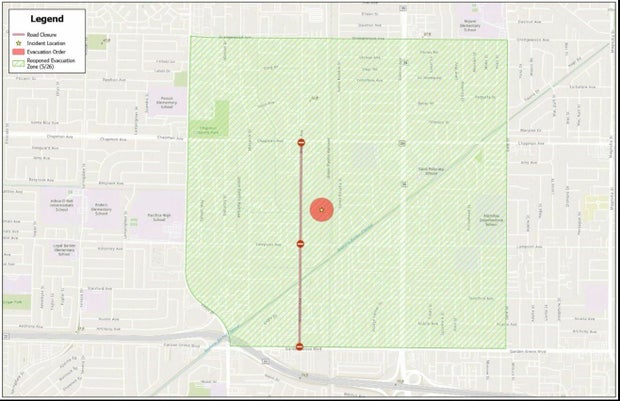
They said that ongoing testing determined that there was no chemical leak, no longer the risk of an explosion or fire and no risk to the public. They said that Western Avenue would remain closed between Chapman Avenue and Garden Grove Boulevard until further notice, and that a small radius around the aerospace facility would be closed to the public to allow for hazardous materials teams to continue working.
In an update posted to X at 10:19 a.m. Tuesday, OCFA Public Information Officer Greg Barta said the operation confirmed that internal temperatures on the failing tank remained stable at 92 degrees, which is a decrease from the dangerous 100-degree temperatures measured over the weekend.
"Our efforts [Tuesday] are also focused on the same," he said. "Continuing to neutralize the adjacent tanks and monitor that temperature and ensure it holds at 92 degrees."
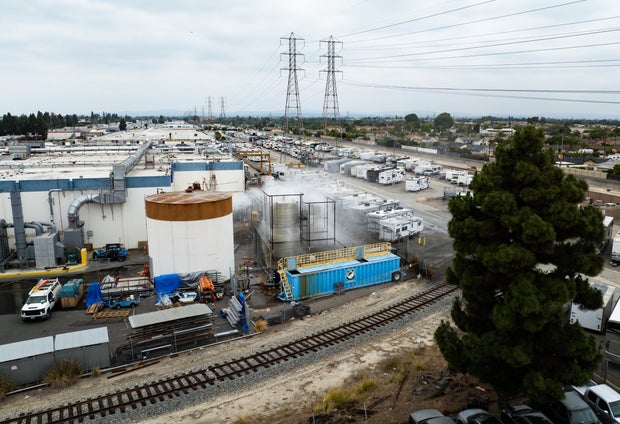
Late Tuesday afternoon, aerial footage showed a team dressed in white hazmat suits working underneath the tanks. The constant stream of water, which had been dousing the tanks since Thursday, had finally ceased as well.
Barta said it's OCFA's goal to reduce evacuation numbers even further, but no timeline was provided.
"We want to get you home as soon as possible," he said.
OCFA Interim Chief TJ McGovern said in a brief on Monday that the threat of a BLEVE, or Boiling Liquid Expanding Vapor Explosion, was off the table after being deemed the possible worst-case scenario in the early stages of the incident. The success of an operation performed late Sunday night and into Monday morning led to the decision to allow tens of thousands to return to their homes for the first time in days.
"Throughout the day today, I'm happy to report the most catastrophic and worst-case scenario was mitigated and resolved," McGovern said.
"I was handed an incident that had two options: a spill or an explosion," OCFA Division Chief and Incident Commander Craig Covey said. "As the chief said, it was unacceptable. … We found a plan and we [implemented] it. That took time."
Officials on Monday night continued to stress that the situation was still potentially dangerous, hence the remaining evacuations. The overnight operation starting Monday night had crews working to mitigate potential for a smaller explosion or spill of the methyl methacrylate stored inside the cracked tank.
Orange County officials said Monday that firefighters used a "deluge sprinkler system" to continuously douse a failing chemical tank at GKN Aerospace, helping to keep the temperature of the tank cool and preventing the potential of a fire.
"So, you've got a deluge system with a full throttle on it, and then we have that ground monitor ... that's flowing 1,250 gallons a minute," OCFA Division Chief Craig Covey said. "We're talking millions and millions of gallons [of water]."
The operation that started on Sunday night confirmed the existence of a crack on the chemical tank, which was alleviating the pressure inside, calming fears of a massive explosion.
Garden Grove Police Department Chief Amir El-Farra announced that the new zone would include homes and businesses for approximately 16,000 residents in an area bounded by Orangewood Avenue to the north, Dale Street to the east, Knott Street to the west and Garden Grove Boulevard to the south.
OCHA Dr. Regina Chinsio-Kwong assured those returning home that they "can feel safe."
"There was no contamination," she said. "You should feel comfortable going home, even if you're across the street from that new zone line."
Officials on Monday stressed that residents do not have to wash exteriors of their homes, outdoor furniture or walkways.
Garden Grove Unified School District said nine schools reopened on Tuesday. Alamitos Intermediate, Lawrence Elementary and Wakeham Elementary continue to be closed.
The Orange County Workforce and Economic Development Board encouraged small business owners impacted by the incident to submit an SBA Economic Injury Disaster Loan worksheet to determine eligibility for potential assistance programs.
California Gov. Gavin Newsom announced Monday that President Trump had approved the state's request for a federal emergency declaration in Orange County.
The approval will allow the Federal Emergency Management Agency, or FEMA, to "direct federal assistance with personnel, equipment, and other specialized resources to support life-saving response," according to Newsom's office.
"California didn't wait for this situation to escalate — we moved early, aggressively, and in close partnership with local responders to protect lives and support impacted communities," Newsom said in a statement. "We are grateful for the federal government approving our request and helping strengthen the resources already on the ground to help this community recover safely."
According to FEMA, a Presidential Emergency Declaration differs from a Presidential Major Disaster Declaration in that it provides preemptive and protective action, while the latter provides assistance after a disaster causes significant damage.
When did the Garden Grove chemical leak start?
Crews arrived Thursday afternoon at the GKN Aerospace facility in the 12000 block of Western Avenue in Garden Grove after receiving a hazardous materials call just before 3:40 p.m. that day, according to OCFA.
The chemical in the industrial tank initially stayed at the same temperature, officials said. However, about four hours after firefighters arrived, the temperature rose, causing a relief valve and sprinkler system to activate near the tank. Firefighters said the sprinkler safety system is designed to cool off the tank if it starts leaking.
The OCFA said crews initially made progress toward removing the chemical product but determined Friday morning that the "tank that is in the biggest crisis is in fact unable to be secured and mitigated."
No injuries have been reported.


