AI poses bigger threat in jobs with more women, study finds
Employees in women-dominated occupations are deeply vulnerable to the potentially transformative impact of artificial intelligence on the American workforce, according to researchers.
That's one of the main takeaways of a recent report from the Brookings Institution, a nonpartisan think tank, and the Centre for the Governance of AI, a policy research firm.
Drawing on a mix of public and private data, the report looks at which fields have the highest risk of being disrupted by AI and how workers in those sectors are likely to fare.
Of the employees most at risk of losing their jobs due to AI, more than 6 million workers would likely struggle to cope because they're older, have limited savings and other factors, the researchers said. Most of those workers are in clerical and administrative jobs — roles that historically have been dominated by women.
AI supplanting human workers in these jobs would continue a decades-long pattern of advancements in information technology handling work formerly done by people, Mark Muro, a senior fellow at the nonpartisan Brookings Institution, told CBS News.
"These are occupations that have been under attack for a long time," he said.
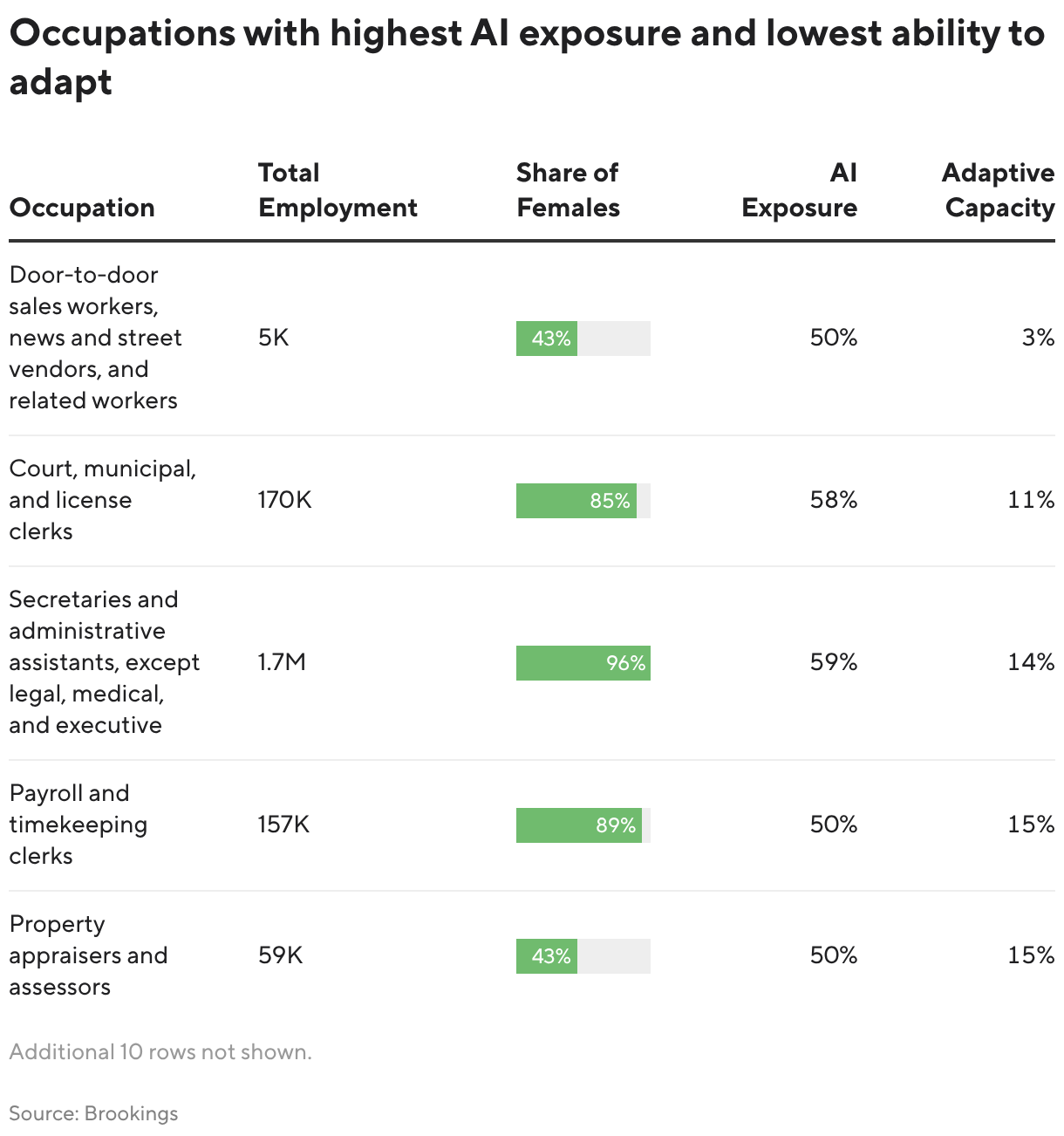
Of the roughly 6 million workers who would have the hardest time adapting to AI-related job loss and finding a new position, 86% are women, Brookings determined, tapping data from Lightcast, a labor market analytics firm. Muro emphasized that these women's vulnerability reflects their job functions, not their competency as workers.
"It's a bit more about what women do in the economy rather than what they are," he said.
Still, the finding underscores the conundrum many female workers could face as AI diffuses across the labor market.
Some workers better positioned to adapt to AI
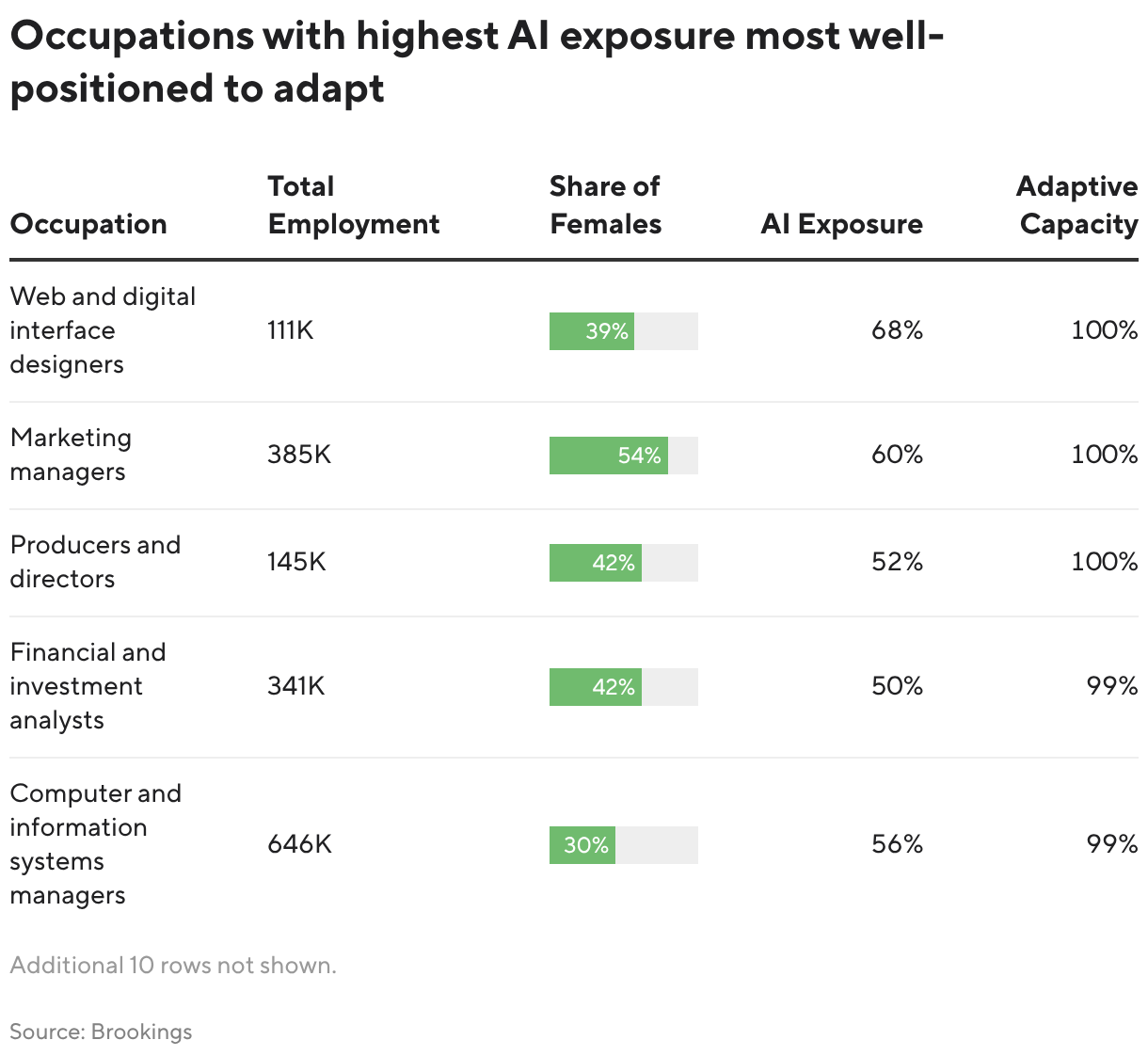
Despite concerns about artificial intelligence killing jobs, roughly 70% of workers in roles exposed to AI could likely pivot into a new position with comparable earnings if they are displaced from their job, the researchers said.
These workers are typically in fields like marketing, finance and science, which tend to have more technical and managerial roles that require diverse skills, according to Sam Manning, a senior research fellow at the Centre for the Governance of AI.
"There's a wider range of things that you need to leverage in [these jobs], versus some of these more administrative, back office-type roles where the core competencies are more narrowly defined," he told CBS News.
Although experts agree that AI in time is likely to have a profound impact on the workplace, for now the impact on the U.S. labor market appears relatively minor.
In a report released earlier this month, Ben May, director of global macro research at Oxford Economics, said there's little evidence to suggest that firms are replacing significant numbers of workers with AI. He also expressed doubt that AI would sharply push unemployment in the coming years.
"We're skeptical that firms can quickly and seamlessly substitute workers with AI even in sectors where the potential for AI disruption is greatest," he said.
Still, workers may want to take matters into their own hands. To combat AI encroachment in their fields, Manning and Muro suggest people take the AI bull by its horns.
"Trying to experiment with this technology to see how you can make yourself more productive and expand your capability set to stand out within whatever field you're in is definitely something that can help," Manning said.