Trump says U.S. has "total control" over Strait of Hormuz and might "keep it"
Follow updates on the war in the Middle East for Thursday, Aug. 13, here. See earlier coverage below.
What to know about the Iran war:
- President Trump said Wednesday the U.S. has "total control" over the Strait of Hormuz, a claim Iran has disputed and that comes as ships are hesitant to pass through the waterway. "I THINK WE WILL KEEP IT," he wrote on his Truth Social platform.
- The number of vessels tracked transiting the strait fell to a one-week low of eight, according to data reported by the Reuters news agency. About 130 ships a day passed through the vital waterway before the war started on Feb. 28.
- Six people on a vessel in the Red Sea were killed by the Iran-backed Houthi rebels, Yemen's coast guard said Tuesday.
Iran claims it controls Strait of Hormuz and U.S. doesn't
The head of Iran's Basij paramilitary unit, Hossein Taeb, asserted Thursday that the Strait of Hormuz is "under Iran's control and management," Reuters reported, citing Iran's semi-official Fars news agency.
The remarks came a day after President Trump wrote on his Truth Social platform that the U.S. had "total control" of the vital waterway.
More than 30 nations condemn Iran executions
More than 30 countries, including France, Britain and Canada, have condemned Iran's use of capital punishment, saying in a joint statement that the Islamic republic is executing protesters to "silence dissent."
The countries, joined by the European Union's top diplomat, said they "condemn in the strongest terms the ongoing executions of protesters and use of the death penalty" by Iran.
"The use of capital punishment to silence dissent, intimidate communities, and punish individuals exercising their human rights can never be justified," the statement said. "The people of Iran must be free to exercise their rights to freedom of expression and peaceful assembly without fear."
Australia, New Zealand, Ireland, Italy, Germany and numerous other European nations were among those calling for Iran "to immediately end the use of the death penalty and release all those arbitrarily detained."
Iran's foreign minister brushed off the criticism, saying, "Countries like France should stop lecturing the world about 'human rights' and international law. The hypocrisy is blatant and embarrassing.
"Your backing of Israel's genocide in Gaza -- and aggression against Iran -- has destroyed whatever moral high ground you imagined you had," Abbas Araghchi posted on X.
The joint statement speaks to growing alarm from the United Nations and rights groups over a surge in executions in recent months, after Iran was rocked by nationwide anti-government protests earlier in the year and the start of the Middle East war in February.
Lebanese prime minister criticizes Israel's "systematic destruction" in southern Lebanon
Lebanese Prime Minister Nawaf Salam on Wednesday condemned Israel's "systematic destruction" in the country's south as a violation of international law, as Israel's defense minister said its military was "destroying all the houses" there.
Salam said Israeli "attacks, incursions, demolitions and the systematic destruction of homes," infrastructure, government buildings and places of worship "represent a serious violation of the principles and rules of international law and international humanitarian law."
Claiming that villages and towns "are entirely 'military facilities' does not stand up to any logic and cannot be used as an excuse for destroying them, displacing their inhabitants and preventing them from returning," he said in a statement.
Israel's Defense Minister Israel Katz visited southern Lebanon on Wednesday, vowing to keep troops in a so-called "security zone" there and saying the Israeli military was "destroying the underground infrastructure" in the area and "destroying all the houses."
The Iran-backed militant group Hezbollah drew Lebanon into the war in March by attacking Israel, which responded with heavy airstrikes and a ground invasion that Lebanese authorities say have killed more than 4,300 people.
A framework deal reached in late June between Lebanon and Israel involves the disarmament of Hezbollah, a gradual withdrawal of Israeli forces from south Lebanon and the deployment of the Lebanese army to the region, starting in "pilot zones."
When asked about Katz's remarks, a U.S. State Department official responded in an email that the U.S. "expects all parties to act in a manner consistent with the framework they agreed to, and Israel clearly stated that it has no territorial ambitions in Lebanon. A permanent military presence in South Lebanon is not consistent with the commitments made in the framework, or the long-term peace and security of both states."
Trump's secret plane switch took place within a day of credible Iranian missile threat
Last month's elaborate ruse that saw President Trump secretly move from Air Force One to another plane by way of a catering truck took place within a day of U.S. and Turkish intelligence picking up on an Iranian plot to fire a missile at the presidential jet, CBS News has learned.
The decision to shift Mr. Trump to a different plane was made while the annual NATO conference was underway in Ankara, according to two law enforcement officials and a U.S. official. The president had flown into the Turkish capital on a newly retrofitted Boeing 747 donated by the government of Qatar, but an older white-and-blue jet that has served as Air Force One since the 1990s was also on the ground as a support aircraft.
Ahead of Mr. Trump's July 8 departure from the summit, the National Security Agency, the CIA and Turkey's MIT intelligence service picked up streams of information about a credible plot by Iran to fire a surface-to-air missile at Air Force One, according to two U.S. officials who spoke on the condition of anonymity because they were not authorized to discuss sensitive matters.
There were also reports of a team in Turkey tasked with firing the surface-to-air missile at the plane, the U.S. officials said. But after more probes, no team was detected.
As the U.S.-Iran war nears the six-month mark, there is a significant ongoing threat from Iran to kill Mr. Trump, according to the officials.
U.S. forces to complete Iraq pullout by Sept. 30, officials say
The U.S. military is on track to pull all of its forces out of Iraq by the end of September, officials said Wednesday, marking the end of a presence that started with the 2003 invasion against Saddam Hussein.
Washington and Baghdad agreed in 2024 to wind down the much smaller U.S.-led operations against the Islamic State group.
U.S. troops pulled out of bases in most areas of Iraq last year but maintained a presence in the semi-autonomous northern Kurdish region. Bases there have regularly come under attack since the U.S. and Israel launched the war on Iran on Feb. 28.
Iraqi Prime Minister Ali al-Zaidi met with Adm. Brad Cooper, who leads the U.S. Central Command, on Wednesday. Al-Zaidi said in a statement afterward that he had affirmed Sept. 30 as the "fixed and final date for ending the military mission of the Global Coalition to Defeat ISIS in Iraq and completing the departure of its forces."
A U.S. official confirmed that the U.S. expects to complete its pullout by Sept. 30, but declined to say how many troops remain in Iraq or where they would be redeployed.
Last month, an American soldier was killed during the controlled detonation of an Iranian drone in Iraq. Six more U.S. service members in Iraq were killed in March when a refueling plane crashed.
CBS/AP
Iran rejects Trump's claims the Strait of Hormuz is under U.S. control
Iran is countering President Trump's claim earlier Wednesday that the Strait of Hormuz is under U.S. control, though they did not refer to the president by name.
"Claims and repeated posts by U.S. officials that the Strait of Hormuz is no longer blocked do not change the reality: the Strait of Hormuz remains blocked and will not be reopened until Iran's conditions are accepted," the Persian Gulf Strait Authority said in a statement on X.
The Persian Gulf Strait Authority was the agency set up to manage transit through the strait — and collect a toll — soon after the war began.
Traffic in the strait has slowed to a crawl in recent weeks. Tuesday's tally of eight vessels fell below a 10-day average of about 12, for the lowest daily count since Aug. 5, according to Kpler data.
Mr. Trump wrote on Truth Social earlier that the U.S. has "total control over the Strait of Hormuz."
"I THINK WE WILL KEEP IT! Our Naval Blockade is being called, by everyone, 'A WALL OF STEEL,' and there is nothing Iran can do about it," he wrote.
Iran foreign ministry notes United States' "unprecedented violations" of Geneva Conventions on anniversary
Iran accused the U.S. of committing war crimes in its attack on the country as it noted the 77th anniversary of the signing of the Geneva Conventions on Wednesday.
"The international community, the States Parties to the Geneva Conventions, and Switzerland as the depositary of these instruments cannot remain indifferent to such unprecedented violations, which constitute clear war crimes," Iranian Foreign Ministry spokesperson Esmaeil Baqaei said on social media.
Baqaei pointed specifically to the U.S. allegedly targeting civilian infrastructure as a violation of the Geneva Conventions, which were signed Aug. 12, 1949, and set the rules for engagement during war for all signatories, including the U.S. and Iran.
He referred to the absence of punishment for the U.S. as an "erosion of one of the most fundamental civilizational and legal achievements of the post-World War II era."
"Wherever the law falls silent before power, what collapses is not merely a bridge or a power plant, but humanity's confidence in the possibility of the rule of law in international relations," Baqaei added. "If the threat to destroy civilian infrastructure becomes normalized in international affairs, no state can any longer feel secure about the inviolability of its hospitals, electricity grids, bridges, water facilities, or other vital arteries against external aggression."
What to know about Iranian supreme leader's new representative on national security council
Iranian Supreme Leader Mojtaba Khamenei this week appointed Maj. Gen. Mohsen Rezaei, a veteran commander of the Revolutionary Guard Corps, to serve as his representative on the country's Supreme National Security Council
Rezaei was the head of the IRGC during the eight years of war with Iraq in the 1980s, but retired from military affairs after the conflict, running for president many times without success.
Thought for a time to have been sidelined, he returned to the decision-making ranks of the IRGC again last year, and his role strengthened after this March when he was appointed adviser to the new supreme leader.
Rezaei is wanted by Argentine police for his alleged involvement in a deadly attack on a Jewish center in Buenos Aires in 1994, and is famous for making controversial comments during his multiple presidential campaigns, including suggestions that Iran should take American soldiers hostage and demand billions of dollars for their return.
EU and 26 other countries call on Iran to stop executions of protesters
The European Union and 26 other countries have called on Iran to stop executing protesters and to free political prisoners, French Foreign Minister Jean-Noel Barrot said Wednesday.
In a post on X, Barrot included an image of the joint declaration, which said the EU and the over two dozen other countries — including Canada, the U.K., Germany, France and Spain — "condemn in the strongest terms the ongoing executions of protesters and the use of the death penalty by the Islamic Republic of Iran."
"We call on the Iranian regime to immediately end its use of the death penalty and to release all those arbitrarily detained," it continued.
In 2025, Iran more than doubled its use of executions from the previous year, killing at least 2,159 of its own people, according to a May report by Amnesty International.
Israeli defense minister vows troops will stay in Lebanon, Syria, Gaza
Israeli Defense Minister Israel Katz visited southern Lebanon on Wednesday, vowing to destroy infrastructure and keep troops in a so-called "security zone" as well as in Syria and Gaza.
The comments came almost two months after Israel and Lebanon agreed to a U.S.-sponsored framework deal that involves the disarmament of the Iran-backed Hezbollah, a gradual withdrawal of Israeli forces from Lebanon's south and the deployment of the Lebanese army to the region, starting in test areas known as "pilot zones."
Katz and Prime Minister Benjamin Netanyahu have repeatedly vowed not to withdraw from the "security zone" in southern Lebanon — a strip of territory where Israeli forces operate that reaches around 6 miles into Lebanon.
"As the prime minister and I have clearly stated, we are not withdrawing from this security zone," Katz said during a visit to troops, according to a statement from his office.
The Israeli military "is here to protect the northern communities and its own forces. We will clear this area and guarantee the security of the residents of the north. We will in no way withdraw from the security zones: not in Lebanon, not in Syria and not in Gaza," he added.
In southern Lebanon, Katz said the military was "destroying the underground infrastructure" in the area and "destroying all the houses."
Lebanese Prime Minister Nawaf Salam said Israeli "attacks, incursions, demolitions and the systematic destruction of homes," infrastructure, government buildings and places of worship "represent a serious violation of the principles and rules of international law and international humanitarian law."
Hezbollah drew Lebanon into the Middle East war in early March with rocket fire aimed at Israel to avenge the killing of Iran's supreme leader in U.S.-Israeli strikes.
The quiet influence of the new commander of Iran's Basij militia
Of the six new appointments to Iran's hierarchy this week, one of the most politically significant was that of Hossein Taeb as commander of the Basij paramilitary militia, part of the Islamic Revolutionary Guard Corps.
The former head of the Revolutionary Guard Corps' intelligence branch, Taeb is an influential but secretive figure who has spent much of his career within Iran's intelligence and security apparatus. A cleric himself, he has reportedly maintained a close relationship with new Supreme Leader Mojtaba Khamenei and has long been regarded as a friend and mentor to the ayatollah.
His appointment is particularly important given the Basij's extensive role in Iran. The organization functions as a vast paramilitary and mobilization network that provides the state with a nationwide workforce. Its responsibilities extend beyond conventional military operations and include internal security, political mobilization, logistical support, local organization and assistance to state institutions.
The Basij demonstrated the breadth of this capacity during recent periods of instability. Its personnel were heavily involved in suppressing January protests and, during the subsequent war against the U.S. and Israel, have been mobilized nationwide to establish and operate tens of thousands of checkpoints and assist the authorities in maintaining internal security.
Trump claims U.S. has "total control" over strait: "I THINK WE WILL KEEP IT!"
Taking to Truth Social, President Trump claimed the U.S. has "total control" over the Strait of Hormuz, a claim Iran has disputed and that comes as ships are hesitant to pass through the waterways.
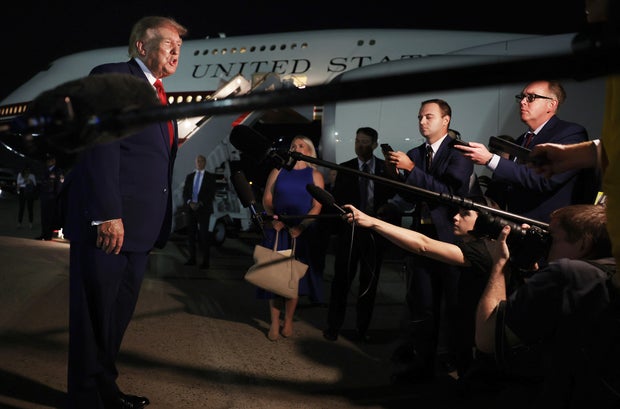
"The U.S.A. has total control over the Strait of Hormuz," he wrote. "I THINK WE WILL KEEP IT! Our Naval Blockade is being called, by everyone, 'A WALL OF STEEL,' and there is nothing Iran can do about it. They have no Navy, they have no Air Force, their remaining soldiers are unpaid, the IRGC is decimated and fleeing, and their 'Leadership' is uncertain, at best! They have No Money - Their country is 'shot.'"
"Praise be to Allah!" the president concluded.
Who is Ahmed Vahidi, the new commander of the Islamic Revolutionary Guard Corps?
This week has seen some significant appointments from Iran's new — and still unseen — Supreme Leader, Mojtaba Khamenei, as he continues to reshape the country's military and national security leadership.
Six senior military leaders have been appointed in total.
Among the most consequential was the appointment of previous interior and defense minister Brig. Gen. Ahmad Vahidi as commander of the paramilitary Islamic Revolutionary Guard Corps (IRGC). Vahidi, a secretive figure accused of involvement in the 1994 bombing of a Jewish community center in Argentina, is seen as one of the most powerful figures in Iran, following the death of former Supreme Leader Ali Khamenei in February.
The IRGC remains one of the most influential institutions in the Islamic Republic, exercising extensive military, political, economic and security influence.
Despite his growing authority, Vahidi has maintained a relatively low public profile since the beginning of the war. Civilian political figures, particularly Parliament Speaker Mohammad Bagher Ghalibaf, have been considerably more visible.
Vahidi, an IRGC veteran and former Quds force commander, had already been serving in the role following the February killing of Iranian military officer Mohammad Pakpour.
Oil from tanker grounded off Oman has started reaching mainland, Reuters reports
Oil from a spill off Oman has started to reach the country's mainland, the U.N.'s shipping body said on Wednesday, according to the Reuters news agency.
"Oil is drifting offshore to the northeast of [Oman's] Al-Qibliyyah Island, with some oil reported to be reaching the mainland. Oil spill contingency planning is in place," a spokesperson at the International Maritime Organization (IMO) said.
The oil is believed to be leaking from the grounded tanker Caroline Bezengi, with the slick now covering almost 155 square miles, according to the Omani government.
The IMO said the tanker was carrying approximately 800,000 barrels of oil from Russia to Asia, but grounded off the coast of Oman on June 30, Reuters reported.
"Oil has been leaking from the vessel for some time. The seasonal monsoon has limited access to the vessel and delayed salvage operations," the IMO said.
Erdogan eyes expansion of regional defense pact
Turkish President Recep Tayyip Erdogan said Wednesday he hoped more countries would join a defense agreement signed last week between Turkey, Saudi Arabia and Pakistan.
"Our vision for it is not limited to the three countries," the Turkish leader told the London-based Asharq Al-Awsat daily, which is owned by the Saudi royal family. "Rather we aspire for it to grow, and perhaps appropriate conditions will emerge one day for all countries of the region to gather under its umbrella."
Foreign Minister Hakan Fidan on Saturday said Turkey expected Egypt to join the pact, called the Mecca Joint Defense Agreement. Egypt has not commented on the agreement nor on the remarks by Fidan, who will visit Cairo on Thursday and Friday.
The pact consolidates three major U.S. allies into an alternative security architecture that rejects Israel's hegemony and seeks to boost security cooperation, while also opening the way for "developing joint projects in the defence industries," Erdogan said. It contains a clause saying any attack on one would be seen as an attack on all.
CBS/AFP
Oil prices largely unchanged on Wednesday
Oil prices were essentially flat Wednesday after rising sharply this week, with the Strait of Hormuz effectively shut down as fighting in Iran continues.
The price of a barrel of Brent crude, the international standard, rose 0.19% to $89.08 early Wednesday. U.S. benchmark crude oil ticked up 0.4% to $83.53.
U.S. gasoline prices also edged 2 cents higher overnight to a national average of $4.04 per gallon, according to motor club AAA. That's 16 cents higher than at this point last month.
President Trump said he would seek compensation from Iran for the conflict after Tehran said it would seek payments from the U.S. before it opens the strait, through which a fifth of the global oil supply runs,
Meanwhile an attack by the Iranian-backed Houthi rebels on a vessel in the Bab el-Mandeb strait at Yemen's southern tip has raised concerns that the violence could reignite civil war and further threaten regional shipping routes.
"The renewed hostilities between the U.S. and Iran suggest that a long-term reduction in shipping through the Strait of Hormuz is now the most likely scenario," said Ben May, director of global macro research at Oxford Economics.
No discussions between Tehran and Washington on extending ceasefire, Iranian source tells Reuters
There have been no discussions to extend a ceasefire between the United States and Iran because there was no deal and therefore nothing to extend, a senior Iranian source told the Reuters news agency on Wednesday.
Turkey's Anadolu news agency reported Tuesday that Pakistani government sources were saying the two sides had agreed to extend the 60-day ceasefire they agreed to as part of the memorandum of understanding that was signed in June but swiftly collapsed.
"There is no talk of an extension because, from Iran's perspective, there is no period that began and therefore nothing to extend. The United States violated the interim agreement 48 hours after it was reached and withdrew from it a few days later," the source told Reuters.
"One of the issues that is being discussed via mediators is the U.S. returning to the interim agreement and defining a timeframe for implementing the commitments," the source added. "There has been absolutely no progress on this issue."
Oil spill reaches island in Strait of Hormuz as Iranian authorities investigate source
Oil from a spill has reached parts of Iran's Qeshm island in the Strait of Hormuz, Iran's semi-official Fars news agency reported Wednesday, and authorities are investigating its source.
According to the report, Iran's Department of Environment said oil was spotted along parts of the island's coastline. Cleanup operations are underway and are expected to be completed by the end of Wednesday.
International Energy Agency cuts 2026 oil demand forecast again as traffic on Strait of Hormuz remains low
The International Energy Agency (IEA) on Wednesday sharply reduced its forecast for global oil demand this year, with supplies still crimped by the disruption of shipping through the Strait of Hormuz and high prices deterring buyers.
Demand is expected to slump by 1.6 million barrels per day, compared with its forecast slump of one million barrels in its previous monthly report in July.
Crude prices have remained well above levels seen before the U.S. and Israeli attacks on Iran in late February, sparking a war that has seen oil infrastructure damaged in several Gulf countries and some supply routes for oil severely disrupted.
Tehran also responded by effectively shutting down tanker and cargo traffic in the Strait of Hormuz, through which around one-fifth of global oil supplies usually transit.
"The ongoing closure of the Strait of Hormuz and elevated fuel prices continue to weigh on oil consumption," the Paris-based IEA said.
Despite a purported ceasefire and repeated claims that a deal to open the strait was imminent – which the IEA referred to as "sudden diplomatic pivots" – only a handful of ships are being let through, leading to volatile pricing on global oil markets.
The IEA said global supplies rose by 2.4 million barrels per day in July, to reach 101.5 million barrels per day, but that was still 6.3 million per day lower than a year ago.
But "renewed hostilities and maritime disruptions in July and early August undermined the recovery efforts," the agency said.
It now expects global supply to fall by 4.3 million barrels per day on average this year, before recovering next year.
On the demand side, the IEA is projecting a return to growth in the fourth quarter of this year.
Iran says it still has more than 75% of its missile and drone capability
Iran still has more than 75% of its missile and drone capability intact, a military official said Tuesday.
Iranian Army Deputy Commander for Executive Affairs, Brig. Gen. Alireza Sheikh, told state news agency IRNA that "more than 75% of Iran's missile and drone capabilities remain intact and ready."
The claim comes after President Trump denied last week that the U.S. has nearly run out of its stockpile of long-range missiles.
"The 'leakers' of these treasonous statements are being hunted down," Mr. Trump wrote on social media. "Long term jail sentences will be sought!"
Sheikh also emphasized Iran's drone capability, particularly the Arash drone, claiming that it had "become the enemy's nightmare."
He added that Iran's strategy was to impose disproportionate costs on its adversaries with relatively inexpensive systems.
"Victory in diplomacy is the product of power on the battlefield," he added.
Pakistan interior minister in Iran to discuss regional security
Pakistan's interior minister is visiting Iran to discuss regional security, stability and other developments, the Pakistani foreign office said Wednesday, as Islamabad tries to mediate a resolution to the Iran war.
Mohsin Naqvi, who has previously been involved in mediation efforts between Iran and the U.S., is known to be close to the powerful head of the Pakistani army, Asim Munir.
Iranian state news agency IRNA reported late Tuesday that Naqvi met with Iran's President Masoud Pezeshkian, Foreign Minister Abbas Araghchi and Interior Minister Eskandar Momeni.
"He is discussing bilateral relations, security, regional security and stability, and constructive engagement amongst the parties in the region and regional developments," Pakistani foreign ministry spokesman Tahir Andrabi told reporters in Islamabad.
The Iranian government's website said Naqvi conveyed to Pezeshkian "a message from the Pakistani prime minister and the chief of the army," without specifying its content.
Pakistan's defense minister told Bloomberg in Islamabad on Tuesday that the U.S. and Iran are close to "some sort of an arrangement."
"Things are shaping up again in favor of a peace arrangement or a deal," he said. "The signals in the last two three days are that we are close to some sort of an arrangement."
Last week, Iran said it had agreed a route with neighboring Oman for ships transiting the strait and was finalizing arrangements for jointly managing the strategic waterway.
On Tuesday the U.S. military announced that it had fired on a Panama-flagged cargo ship that attempted to break the American blockade of Iran's ports.
CBS/AFP
Strait of Hormuz traffic falls to one-week low
The number of vessels tracked transiting the Strait of Hormuz fell to a one-week low of eight, according to data reported by the Reuters news agency, as the ongoing conflict and stalemate kept shipping companies away from the vital waterway.
Tuesday's tally of eight vessels fell below a 10-day average of about 12, for the lowest daily count since August 5, according to Kpler data reported by Reuters.
Around 130 ships a day passed through the vital waterway before the war started on February 28.
Houthi strikes mark escalation by rebel group against Yemen government
The alleged Houthi strikes that left at least six people dead aboard a cargo vessel off Yemen are the first known deaths from Houthi attacks on shipping in the region, since the latest bout of fighting in the country began.
The deadly incident in the Bab el-Mandeb strait came amid Houthi attacks on the government-held port city of Mokha on the Red Sea and other areas of the country, which killed dozens of government troops and civilians since last week, according to the Yemeni military.
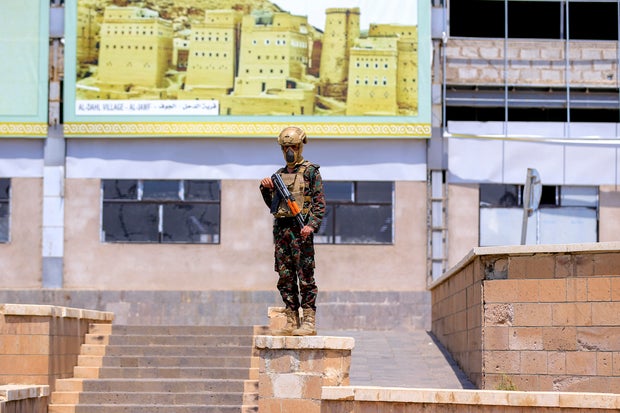
The strikes are part of an escalation by the Houthis against government forces in Yemen and oil facilities in neighboring Saudi Arabia, which supports the Yemeni government, and the kingdom's shipping in the Red Sea.
The Houthi attacks could reignite Yemen's civil war following a 2022 truce, and open a new front in the Middle East war.
Mohammed Abdul-Salam, the Houthis' chief negotiator and spokesperson, accused Saudi Arabia in a social media post of exploiting the ceasefire to tighten an air and sea blockade it imposed in 2015.
He said the Houthis are open for negotiations but any settlement must include lifting the blockade.
U.S. forces hit Panama-flagged vessel trying to bypass blockade of Iranian ports, Central Command says
An American military helicopter struck a Panama-flagged vessel after it tried to bypass the U.S. blockade of Iranian ports, U.S. Central Command said.
It was unclear if there were casualties from the attack after a U.S. Navy MH-60 helicopter fired two Hellfire missiles into the Vela Nova's engine room, according to CENTCOM. The ship's civilian crew allegedly ignored repeated warnings from U.S. forces as they attempted to transit the Gulf of Oman.
"The ship is no longer transiting to Iran in violation of the U.S. blockade, which remains in full effect," CENTCOM said.
As of Tuesday, CENTCOM said it has disabled three non-compliant vessels, boarded two and redirected 55 commercial vessels attempting to run the U.S. blockade.