Trump launches Board of Peace in Davos, Zelenskyy announces U.S.-Russia-Ukraine talks
What to know about Trump's Board of Peace and U.S.-Ukraine-Russia talks
- President Trump led a signing of the founding charter of his Board of Peace without major U.S. allies in Davos, Switzerland, on Thursday. He offered little new detail on what the body would do, but said it would work with the United Nations to ensure peace in the Middle East and hinted at wider ambitions.
- The Board of Peace was announced last year as part of a Trump-brokered Gaza peace plan and framed as an international body chaired by the president to help oversee the reconstruction of the Palestinian territory.
- After the signing, Mr. Trump met with Ukrainian President Volodymyr Zelenskyy, who said that representatives from Ukraine, Russia and the U.S. will meet in the United Arab Emirates this week – the first meeting of its kind over the Russia-Ukraine conflict.
- The gathering of world leaders and business titans in Davos for the 2026 World Economic Forum has been partially overshadowed by the president's gambit to take over Greenland and his threats to slap tariffs on European countries that have pushed back. The president, however, called off the tariffs on Wednesday and said he'd reached a "framework" deal regarding Greenland.
Trump withdraws Canada's invitation from Board of Peace
In a social media post Thursday night, President Trump said the Board of Peace is withdrawing Canada's invitation.
"Please let this Letter serve to represent that the Board of Peace is withdrawing its invitation to you regarding Canada's joining, what will be, the most prestigious Board of Leaders ever assembled, at any time," Mr. Trump wrote in a post he addressed to Canadian Prime Minister Mark Carney.
Earlier Thursday, Canada said it had accepted an invitation to join the board. It's unclear what prompted Mr. Trump to withdraw the invitation. CBS News has reached out to the White House and Global Affairs Canada for clarification.
In his speech Tuesday at the World Economic Forum in Davos, Carney, in remarks seemingly directed at Mr. Trump's efforts to acquire Greenland, spoke of "a rupture in the world order" caused by changing geopolitics.
"If great powers abandon even the pretense of rules and values for the unhindered pursuit of their power and interests, the gains from transactionalism will become harder to replicate," Carney said.
In his own address Wednesday in Davos, Mr. Trump took aim at Carney's speech, saying, "Canada gets a lot of freebies from us, by the way. They should be grateful, but they're not. I watched your prime minister yesterday. He wasn't so grateful."
"It's all about the land," Zelenskyy says about the last hurdle to a peace deal
Zelenskyy said Thursday that disagreements over the fate of a massive portion of eastern Ukraine occupied by Russian forces were "not solved yet," adding: "That's what I think Steve Witkoff spoke about."
Witkoff, Mr. Trump's senior envoy for Ukraine and Russia, said earlier that the negotiations were "down to one issue," though he didn't say what the issue was.
"It's all about the eastern part of our country. It's all about the land," Zelenskyy said. "This is the issue which we [have] not solved yet."
Zelenskyy has long refused to accept — and he's been backed in his stance by America's European NATO allies — any formal transfer of occupied Ukrainian territory to Russia as part of a peace agreement.
He, along with his European backers, have argued that letting Russia take a neighboring nation's land by force would set a dangerous precedent and invite future expansionist moves by the Kremlin.
The same issue has snarled previous efforts by the White House to craft a peace agreement.
NATO Secretary General Mark Rutte told CBS News in August that while Russia may hold Ukrainian territory right now, "we can never accept that in a legal sense."
Zelenskyy says documents to end war with Russia "nearly, nearly ready"
The Ukrainian president said his team was working with President Trump's negotiators "almost every day," calling the discussions to nail down a ceasefire agreement suitable to both Kyiv and Moscow "not simple," but voicing optimism.
"The documents aimed at ending this war are nearly, nearly ready," Zelenskyy said at the World Economic Forum event on Thursday.
Zelenskyy says U.S., Ukrainian and Russian officials to meet this week
Zelenskyy said in Davos on Thursday that representatives from Ukraine, Russia and the U.S. would hold their first trilateral talks in the United Arab Emirates on Friday or Saturday, or perhaps on both days. He said they would be at the technical level, which usually indicates less senior representatives.
Neither the White House nor Moscow have confirmed a trilateral meeting yet, but President Trump's top envoys Steve Witkoff and Jared Kushner were expected to hold meetings with Russian officials in Moscow on Thursday.
"I think it will be the first trilateral meeting in [the] Emirates," Zelenskyy said. "It will be two days' meetings in [the] Emirates. I hope that Emirates know about it."
Mr. Trump previously suggested that trilateral talks would be held "at the right time."
Zelenskyy stressed that any final peace agreement would need to include security guarantees for Ukraine backed by American power.
"The U.K. and France are ready to actually commit their forces on the ground," he said, "but the backstop of President Trump is needed. And again, no security guarantees work without the U.S."
Zelenskyy says "last mile" of peace process with Russia will be difficult
Zelenskyy acknowledged progress in the U.S.-led negotiations with both his country and, separately, with Russia, but said he believed the "last mile" of the road to peace would be "difficult."
U.S. envoy Steve Witkoff said in Davos earlier that he believed there was only one issue in the way of an agreement, but he didn't say what it was.
"Everybody has to be ready," Zelenskyy said at an event in Davos on Thursday, hinting at the need for the separate talks between the U.S. and his country and the U.S. and Russia to eventually become unified.
"Nobody knows what is in his head," he said, referring to Russia's Putin.
"It's better than not to have any dialogue," he said of the ongoing process, but adding that Ukraine was still under attack by Russia, and was responding.
Where things stand on Trump's "ultimate long-term deal" on Greenland
President Trump said Wednesday that the framework of a plan to resolve his administration's standoff with Europe had been reached, calling it an "ultimate long-term deal" on Greenland.
While he offered few details, he is what we know about where negotiations stand:
- Mr. Trump said Wednesday that he wouldn't use U.S. military intervention to seize control of Greenland. Mr. Trump then met with NATO Secretary General Mark Rutte and, afterward, said they had come up with "the framework of a future deal."
- Rutte told Reuters the framework deal would require NATO to step up on Arctic security. He said Greenland's mineral resources had not been discussed.
- A NATO spokesperson said Rutte's meeting with Mr. Trump was "very productive," and the framework the president referred to would focus on collective allied efforts to ensure Arctic security.
- The NATO spokesperson also said negotiations between the U.S., Denmark and Greenland would continue, to ensure that neither Russia or China get a military or economic foothold in Greenland.
- U.K. Foreign Secretary Yvette Cooper said the new framework could include a new NATO "Arctic Sentry" security partnership.
- President Trump said in an interview Thursday with Fox Business that while details are still being worked out, the framework agreement would include "total access" to Greenland. "Essentially it's total access," he said. "It's, there's no end, there's no time limit."
Zelenskyy says Trump meeting was "productive and substantive"
Ukrainian President Volodymyr Zelenskyy described his Thursday meeting with President Trump in Davos as "productive and substantive."
"We discussed the work of our teams, and practically every day there are meetings or communication," he said in a post on X.
"We also spoke today about air defense for Ukraine," he said. "Our previous meeting with President Trump helped strengthen the protection of our skies, and I hope that this time we will reinforce it further as well."
Zelenskyy also said he thanked Mr. Trump for "the previous package of air defense missiles and asked for an additional one."
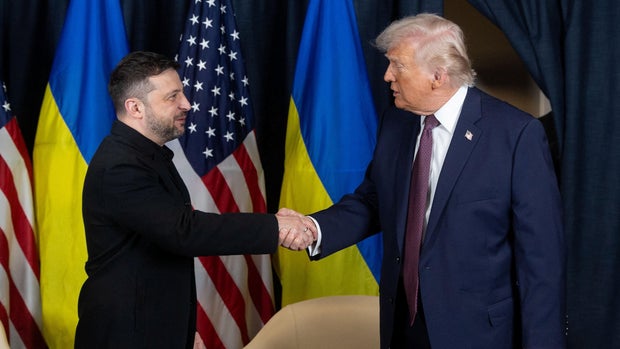
Trump says "war has to end" after meeting Zelenskyy
President Trump said he had a "good" meeting with Ukrainian President Volodymyr Zelenskyy in Davos and called for Russia's war on Kyiv to end.
"This war has to end," Mr. Trump told reporters when asked what his message was to Russian President Vladimir Putin, who will meet Mr. Trump's envoy in Moscow later on Thursday.
"The meeting was good with President Zelensky," he said. "We'll see how it turns out."
Trump and Zelenskyy meet in Davos
President Trump and Ukrainian President Volodymyr Zelenskyy met in Davos on Thursday, ahead of an expected meeting between U.S. representatives and Russian President Vladimir Putin later in the day.
The meeting lasted for about an hour, according to the White House.
Zelenskyy's media adviser Dmytro Lytvyn called it a "good" meeting, The Associated Press reported.
President Trump discussed Ukraine earlier on Thursday during his Board of Peace ceremony, saying, "We're working to end the horrible killing in Ukraine."
Trump says framework deal for Greenland would include "total access"
President Trump said in an interview with Fox Business that while details are still being worked out, the framework agreement for Greenland would include "total access" to Greenland.
"Essentially it's total access," he said. "It's, there's no end, there's no time limit."
Mr. Trump said the U.S. is getting everything it wants at no cost, and also said a piece of his "Golden Dome" missile defense shield will be on Greenland.
President Trump said Wednesday in a post on Truth Social that he and the secretary-general of NATO reached "the framework of a future deal" regarding the island and that he would not be imposing tariffs against European countries over their objections to his efforts to acquire Greenland.
He told CNBC that "we have a concept of a deal" and that he thinks it will be "a very good deal for the United States, also for them."
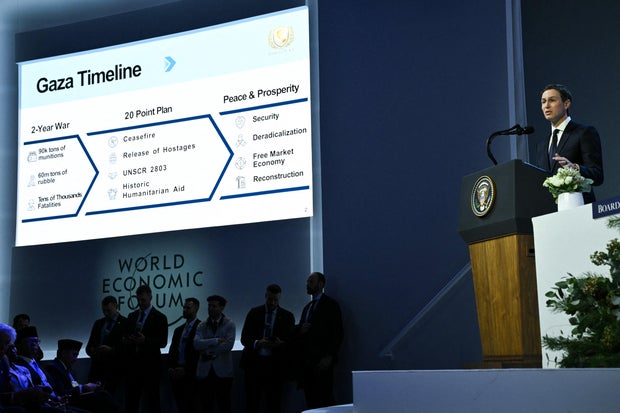
Jared Kushner shows slides on Gaza plans
President Trump's son-in law Jared Kushner spoke during the Board of Peace ceremony and shared slides showing future plans for Gaza and the different steps in the plans to rebuild.
Kushner said he hopes Gaza can become a "destination" with a lot of industry, where people can thrive.
"We do not have a plan B," Kushner said. "We have a plan. We signed an agreement. We are all committed to making that agreement work. There's a master plan."
President Trump also spoke briefly about the future of Gaza at the Board of Peace ceremony. He spoke about the location of the Palestinian territory and called it a "beautiful piece of property," mentioning that he is a "real estate person at heart."
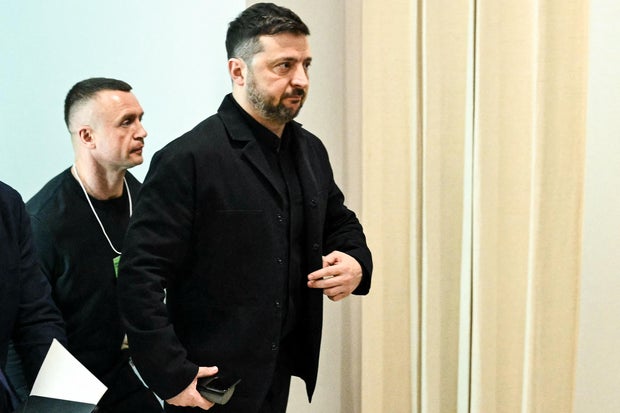
Zelenskyy arrived to meet with Trump, his office says
Ukrainian President Volodymyr Zelenskyy arrived in Switzerland Thursday to participate in the World Economic Forum and meet with President Trump, according to a statement from his office.
Their meeting was scheduled for approximately 1 p.m. local time (7 a.m. ET).
Zelenskyy would also participate in a panel session of the "International Advisory Council for Ukraine' s Recovery" and meet with representatives of energy companies, according to the statement.
Belgium says it did not sign charter, has "reservations"
Belgium says it did not sign the peace charter, after a White House list included the country earlier Thursday.
"Belgium has NOT signed the Charter of the Board of Peace. This announcement is incorrect," said Maxime Prévot, deputy prime minister and minister of foreign affairs, in a post on X.
"We wish for a common and coordinated European response. As many European countries, we have reservations to the proposal."
Finland leader on why Europeans not immediately on board
Asked on Thursday why Finland had, like other European nations, declined to sign onto the "Board of Peace" chaired by Mr. Trump, Finnish President Alexander Stubb told CBS News correspondent Ed O'Keefe in Davos there were "two reasons why we can't sign on right away with our European allies."
"One is that this is an international organization which, basically, then needs parliamentary approval. So, you know, we are liberal democracies. We can't come here and say, 'okay, here's the statute.' The other one is that we want to link it even more closer to the U.N. So I think, for instance, that the Gaza peace board is based on a U.N. mandate, which is really good. So now we just need to make sure that some of the other mandates can be put into the U.N. as well. But we'll see what the other Europeans do and what we do together. I think it's a good initiative."
Rubio voices hope that peace board membership will grow
U.S. Secretary of State Marco Rubio called the board a work in progress, indicating the Trump administration's expectation that membership would increase.
"Many others who are going to join, you know, others either are not in town today or they have to go through some procedure internally in their own countries, in their own country, because of constitutional limitations, but others will join," Rubio said.
White House lists 22 participants in Board of Peace
Ahead of the signing ceremony on Thursday, the White House shared a list of the participants, which added Egypt and Belgium to the board's signatories.
The White House said that, in addition to the U.S., the following nations were taking part: Bahrain, Morocco, Argentina, Armenia, Azerbaijan, Belgium, Bulgaria, Egypt, Hungary, Indonesia, Jordan, Kazakhstan, Kosovo, Mongolia, Pakistan, Paraguay, Qatar, Saudi Arabia, Turkey, United Arab Emirates and Uzbekistan.
Major European allies have not signed onto the board thus far, with many voicing concern over Mr. Trump's invite to Russia's authoritarian leader Vladimir Putin and his close ally in Belarus, Aleksandr Lukashenko. Russia hasn't yet committed to joining the board. And while Belarus wasn't listed by the White House as participating in Thursday's event, Lukashenko said earlier that he had accepted membership.
Trump hopes peace board will "spread out to other things"
Mr. Trump said the board would be committed to ensuring Gaza's demilitarization — and he renewed his warning to Hamas to lay down its arms — but hinted at wider ambitions for the group going forward.
"I think we can spread out to other things as we succeed with Gaza," Mr. Trump said.
Trump signs founding charter of Board of Peace
After his remarks, President Trump sat down and was among the first to sign the founding charter of the Board of Peace.
Representatives from Bahrain and Morocco were the first to join Mr. Trump in signing the charter.
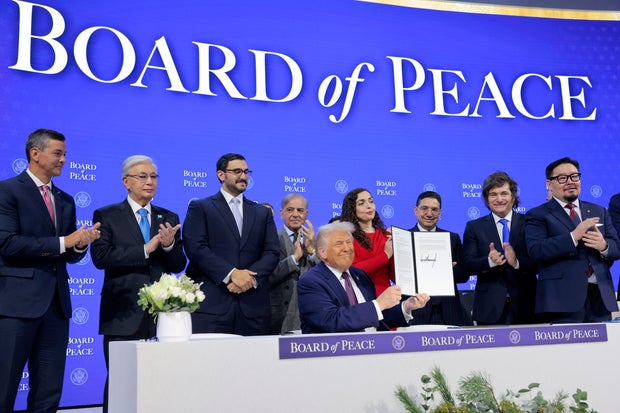
White House press secretary Karoline Leavitt then introduced the other members one by one who joined Mr. Trump at a table to add their signatures.
Trump says Gaza ceasefire has ended starvation in the Palestinian territory
President Trump said the ceasefire his administration helped to broker between Hamas and Israel in Gaza had been maintained, and "delivered record levels of humanitarian aid."
"You don't hear those stories anymore with people starving," Mr. Trump said.
The ceasefire has held, but hundreds of Palestinians have been killed in Gaza since it took effect in strikes that Israel routinely says are targeted against threats to its forces in the territory.
Three journalists were killed in one of those strikes on Wednesday, including one who had worked extensively for CBS News. Israel's military said it was investigating, but that its forces had struck, "suspects who operated a drone affiliated with Hamas in the central Gaza Strip, in a manner that posed a threat to their safety."
"We're going to be very successful in Gaza," Mr. Trump said. "Once the board is formed we can do pretty much whatever we want to do. And we're going to do it in conjunction with the United Nations."
He lauded the global body but said it had failed to live up to its "tremendous potential."
He said the board would work "coupled with the United Nations," to create a "safer future for the world, unfolding before your eyes," adding that it would help to "end decades of suffering."
Illegal drug shipments into U.S. by water down 98.1%, Trump says
Mr. Trump claimed the U.S. strikes against alleged drug boats in the Caribbean and surrounding waters had reduced water-borne narcotics shipments into the United States by 98.1%, which he said was up from 97% previously. It is unclear how the figures presented by Mr. Trump are calculated.
He repeated his vow to transition the U.S. offensive operations against Latin American drug cartels onto land, without naming any countries that he expected to order strikes on. As he did on Wednesday, he said the land strikes would be easy compared to the attacks on boats at sea.
Trump touts purported economic successes, speaks broadly about peace initiatives
Mr. Trump offered no new detail about the objectives or operations of the Board of Peace in his initial remarks, moving quickly into a rehash of his economic goals in the U.S. before repeating his misleading claim to have ended eight wars.
He said his press secretary Karoline Leavitt would later introduce the individual members of the peace board, who joined Mr. Trump on the stage in Davos.
"Places are really calming down," Mr. Trump said, claiming to have saved millions of lives by averting an all-out war between Pakistan and India, among other peace-brokering successes he touted.
Trump acknowledges some of his board partners "not so popular"
Mr. Trump said he was joined on the stage by members of the board who he described as "leaders of countries that are, in many cases, quite popular, but in other cases, not so popular."
Trump says Board of Peace will work with others, "including the United Nations"
President Trump opened his remarks at the signing ceremony by calling it a "very exciting day," and amid concern that he could be trying to build the board into a new global body to take on the role long held by the U.N., he said "we will work with many others, including the United Nations."
Putin still discussing potential peace board membership with his "strategic partners"
President Vladimir Putin said his country was still consulting with Russia's "strategic partners" before making a decision on whether to commit to Mr. Trump's peace board, The Associated Press reported Thursday.
Mr. Trump's invitation to Putin and other authoritarian leaders to join the group has left some of America's longtime allies reluctant to commit to the vaguely defined board.
Mr. Trump has said he wants "everybody" powerful to take part.
"I have some controversial people. But these are people that get the job done. These are people that have tremendous influence," Mr. Trump said.
Kremlin spokesman Dmitry Peskov said ahead of the event Thursday in Davos that Putin, "highly values peacemaking efforts by President Donald Trump and his team," according to the AP.
Trump arrives for Board of Peace signing ceremony
President Trump's motorcade has arrived at the Davos Congress Centre ahead of his expected participation in the signing ceremony for the Board of Peace.
U.K. not signing onto peace board due to potential involvement of Russia's Putin
Britain has declined to sign onto the peace board for now, U.K. Foreign Secretary Yvette Cooper said Thursday, and would not be taking part in the signing ceremony in Davos.
"We won't be one of the signatories today," Cooper told the BBC. "Because this is about a legal treaty that raises much broader issues, and we do also have concerns about President Putin being part of something which is talking about peace, when we have still not seen any signs from Putin that there will be a commitment to peace in Ukraine."
Here's what we know about the Trump-backed Board of Peace
Mr. Trump could offer more details Thursday on his proposed international "Board of Peace" as questions linger over its composition and scope.
The president floated the concept of a Board of Peace last year, as part of a plan brokered by his administration to end the Israel-Hamas war. The board was conceived of as an "international transitional body" that could help oversee a new, technocratic post-Hamas government in the Gaza Strip and fund the Palestinian territory's redevelopment.
"This body will call on best international standards to create modern and efficient governance that serves the people of Gaza and is conducive to attracting investment," the peace plan said.
Last week, the White House said the board would play a role in implementing the Gaza peace deal and "providing strategic oversight, mobilizing international resources, and ensuring accountability as Gaza transitions from conflict to peace and development."
The board is set to be led by an executive committee that includes Secretary of State Marco Rubio, U.S. special envoy Steve Witkoff, Mr. Trump's son-in-law Jared Kushner, former U.K. Prime Minister Tony Blair and World Bank Group President Ajay Banga, among others.
The organization is set to be chaired by Mr. Trump. In a press conference last year, the president said he's slated to lead the board "not at my request, believe me. I'm very busy. But we have to make sure this works."
Countries can contribute $1 billion to the Board of Peace to become permanent members instead of having a three-year membership, a U.S. official told CBS News, confirming a Bloomberg report. The official said it isn't a requirement to contribute to become a member.
The official also told CBS News that any contributions will be used to rebuild Gaza and said "virtually every dollar" raised will be spent on the Board's mandate. There will be no "exorbitant salaries" or "administrative bloat," the official said.
These countries have said they will join the Board of Peace
CBS News confirmed that more than 50 countries had been invited to join the Board of Peace as of Wednesday. As many as 20 to 25 countries have agreed to join, Witkoff told CNBC. But so far, only a handful have said so publicly.
Among the countries that have said they're accepting Mr. Trump's invitation: Israel, Egypt, Azerbaijan, Armenia, Kosovo, the United Arab Emirates, Belarus, Morocco, Hungary, Qatar, Vietnam, Canada, Kazakhstan and Uzbekistan.
Mr. Trump told reporters that Russian President Vladimir Putin has accepted his invite.
Other countries are considering their invitations.
In a joint statement, officials from Qatar, Turkey, Egypt, Jordan, Indonesia, Pakistan, the UAE and Saudi Arabia said they welcomed the invitations to join the body.
Norway and Sweden said Wednesday they're holding off, at least for now, due to concerns about the terms for joining. A source familiar with the matter told CBS News earlier this week that France intended to decline.
Trump says "we have peace in the Middle East"
"I think we have peace in the Middle East," Mr. Trump told reporters Wednesday when asked about his Board of Peace and the situation in the wake of the war between Israel and Hamas.
He said the U.S. would know in the next few weeks whether Hamas would disarm — a key criteria of the 20-point ceasefire plan negotiated by the president's team last year.
"If they don't do it … they'll be blown away. Very quickly," Mr. Trump said.
The president said if the U.S. had not attacked Iran's nuclear facilities in June last year, a deal would not have been signed.
"They were very close to having a nuclear weapon, and we hit them hard, and it was total obliteration. They may try again, but they have to try from a different area, because that area was obliterated," Mr. Trump said of Iran.
"If we didn't do that, there was no chance of making peace" between Israel and Hamas, he said, arguing that countries such as Saudi Arabia, the United Arab Emirates and Qatar would not have backed an agreement. "They were afraid. We had a bully. The bully was Iran."
Could Trump's Board of Peace replace the United Nations?
Mr. Trump said Tuesday the Board of Peace "might" replace the United Nations, an organization the president has regularly criticized for years.
"I mean, the U.N. just hasn't been very helpful. I'm a big fan of the U.N. potential. But it has never lived up to its potential," he said in a more than 90-minute press conference.
But he added, "I believe you've got to let the U.N. continue because the potential is so great."
The following day, CNBC's Sara Eisen noted to Witkoff that "some people say it's a U.N. alternative." Responded Witkoff: "No, no, it's just, it's a great group of leaders coming together with great opinion and sharing opinion to achieve peace, and that's what we need."
Trump backs off from tariff threat over Greenland, says he has deal "framework"
Mr. Trump said Wednesday he will not be imposing tariffs on European countries over their objections to his efforts to acquire Greenland, revealing that he and the secretary-general of NATO reached a "framework of a future deal" regarding the island.
The president's renewed push to take over Greenland for security reasons has rattled U.S. allies. Denmark, a NATO member that oversees Greenland, has ruled out the idea and warned that a U.S. takeover by force would effectively spell the end of the NATO alliance. Last week, Mr. Trump threatened tariffs against countries that decline to "go along with" the plan.
But in an interview with CNBC on Wednesday, the president said "we have a concept of a deal" for Greenland and that he thinks it will be "a very good deal for the United States, also for them."
He declined to provide specifics of the framework, saying "it's a little bit complex" and that the U.S. will "explain it down the line." He did note that the agreement would last "forever."
Denmark's foreign minister, Lars Løkke Rasmussen, later said the day "is ending on a better note than it began," and called for negotiations to address Mr. Trump's "security concerns."
Two diplomatic sources later told CBS News that there is no agreement for U.S. control or ownership of Greenland. American ownership of the territory is still a red line for Greenland and Denmark, the sources said.
The framework of the deal, according to the sources, would consist of ramping up security for Greenland beyond an existing 1951 agreement, allowing the U.S. to establish multiple military bases on the island. The U.S. currently only has one base in operation, Pituffik Space Base.
It would also increase NATO's role with the specific intent of blocking Russia and China from gaining a foothold on the island, the sources said.
But such a deal would still need to be directly negotiated with Denmark and Greenland.
Trump questions NATO alliance in Davos speech
Mr. Trump addressed the World Economic Forum on Wednesday, dedicating parts of his speech to criticizing several NATO allies and questioning whether the alliance benefits the U.S.
"The United States is treated very unfairly by NATO," Mr. Trump said of the seven-decade-old alliance. "We give so much, and we get so little in return."
The president also said at one point: "The problem with NATO is that we'll be there for them, 100%, but I'm not sure they'll be there for us." The clause in NATO's charter that requires member countries to defend each other has been invoked only once, when the U.S. was attacked on 9/11, and NATO allies did rally around the U.S. and fought in the war on terror.
Mr. Trump specifically criticized Canadian Prime Minister Mark Carney, whom he accused of ingratitude despite getting "a lot of freebies from us," and the United Kingdom, which he said should take greater advantage of oil underneath the North Sea.
The president also defended his strategy of levying tariffs on foreign imports, and said many Western governments had turned their back on "everything that makes nations rich and powerful and strong." He argued Europe is "not heading in the right direction."
Mr. Trump reiterated that he wants the U.S. to take control of Greenland, a semi-autonomous territory of Denmark, though he ruled out using force to take over the island.
"You need the ownership to defend it," the president said of Greenland. "You can't defend it on a lease. Number one, legally it's not defensible in that way, totally. And psychologically, who the hell wants to defend a license agreement or a lease?"
Hours later, the president announced a possible deal over Greenland — though there's no indication that it will involve the U.S. taking control of the entire territory.